

Pete Hegseth Backdrop Draws Nazi-Era Comparisons as Critic Says 'Accidental Nazi Is Just Not a Thing'
Critics say the design differs from the Department of War's seal, but no evidence suggests it was meant as a Nazi reference

An eagle graphic displayed behind US Secretary of War Pete Hegseth during a speech at the US Air Force Academy has drawn comparisons with Nazi-era imagery. Critics focused on its angular wings and other reported differences from the department's established seal.
The department's published brand guide specifies the official seal's design and prohibits alterations beyond permitted changes in size. However, the reporting cited does not identify who created the backdrop, who approved it or whether the graphic was intended to represent the official seal.
🚨 Pete Hegseth gives speech echoing Nazi Germany imagery. pic.twitter.com/qosGLUnfoS
— GOP Ls (@GOP__Ls) October 4, 2026
Eagle Design Draws Comparisons
Hegseth addressed cadets near Colorado Springs on Saturday 3 October, ahead of the annual Air Force–Navy football game. An official departmental video listing confirms the event's date and location, while an Air Force account says approximately 3,500 cadets attended.
A US LGBTQ+ news publication reported that the backdrop displayed five stars rather than the official seal's 13. Its analysis also described the absence of the seal's radiating rays and the laurel and olive wreaths beneath the eagle.
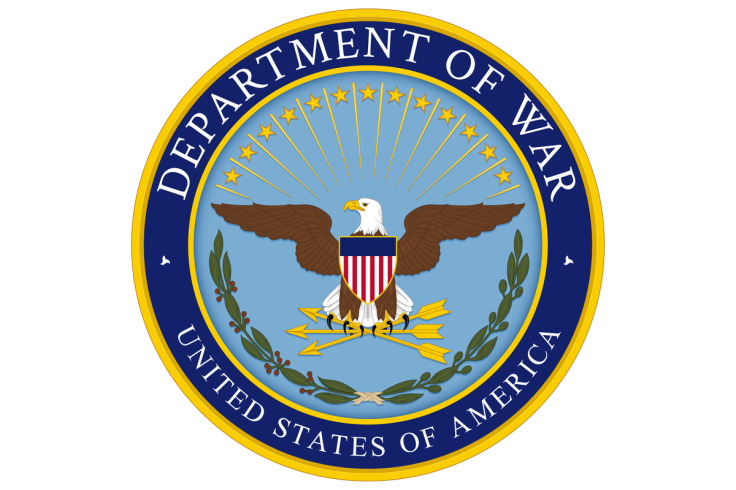
The report said the upper edges of the eagle's wings formed an almost straight line divided into three sections. Critics compared that angular rendering with the Nazi-era Reichsadler, which depicted an eagle above a wreath containing a swastika.
The comparison concerns perceived similarities between the designs. It does not establish that the stage graphic reproduced the Nazi emblem or that Hegseth intended such a reference.
Official Guide Distinguishes Seal and Logo
The department's brand guide distinguishes its official eagle seal from its Pentagon-based logo. The two marks are not interchangeable, and separate guidance governs their use.
The seal features an eagle with horizontally displayed wings, a shield of 13 pieces and three crossed arrows. Above it are 13 stars and alternating rays, with laurel and olive wreaths below.
Horizontal wings are therefore part of the established American design. The criticism concerns the reported treatment of those wings and other details, rather than their horizontal position alone.
The guide's historical account dates approval of the design to 8 October 1947, when it represented the National Military Establishment. The department adopted the Department of Defense designation in 1949.
Its current instructions state: 'The official DOW seal should in no way be edited or presented in any way except how it is displayed above.' The guidance permits changes in size, subject to minimum requirements.
Those instructions establish the published standard for the seal. They do not independently establish how the department classified the backdrop or whether its production complied with that standard.
Critics Question the Imagery
The report quoted an Instagram commentator identified as art critic Seema R. as saying: 'Accidental Nazi is just not a thing.'
Her comment expresses an interpretation of the design and its possible intentions. The report did not include an explanation from the Department of War or the Air Force Academy about the graphic's creation or approval.
The available accounts also do not establish whether it was a temporary stage design, an adapted departmental mark or an intended reproduction of the official seal. Those distinctions remain unresolved.
Departmental Titles Retain Statutory Limits
The administration's use of 'Department of War' and 'Secretary of War' follows an executive order signed by President Donald Trump on 5 September 2025.
Executive Order 14347 authorised those secondary titles in executive-branch communications, ceremonial contexts and other non-statutory settings. It did not replace the department's statutory name.
The order expressly states that references to the Department of Defense and Secretary of Defense remain controlling until changed by law. Authorisation to use the secondary titles does not, by itself, explain or establish approval of the stage graphic.
The published branding rules provide a basis for examining the backdrop, but its commissioning and approval remain unidentified in the reporting cited. The Nazi-era comparison remains the critics' interpretation, not an established finding about the department's intentions.
© Copyright IBTimes 2026. All rights reserved.