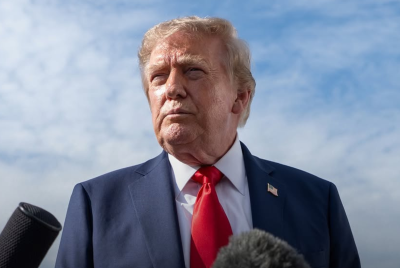
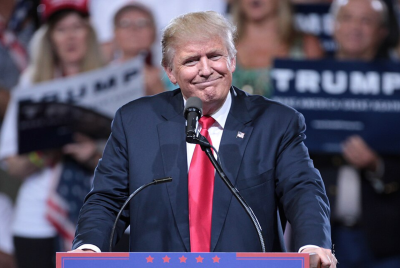
Donald Trump's 'Cheat Like Hell' Voting Pledge Draws Cult Claims After Dallas Midterm Convention Speech
The bizarre ritual, held at the American Airlines Center, drew condemnation from critics and political opponents who accused the president of demanding personal loyalty over constitutional allegiance
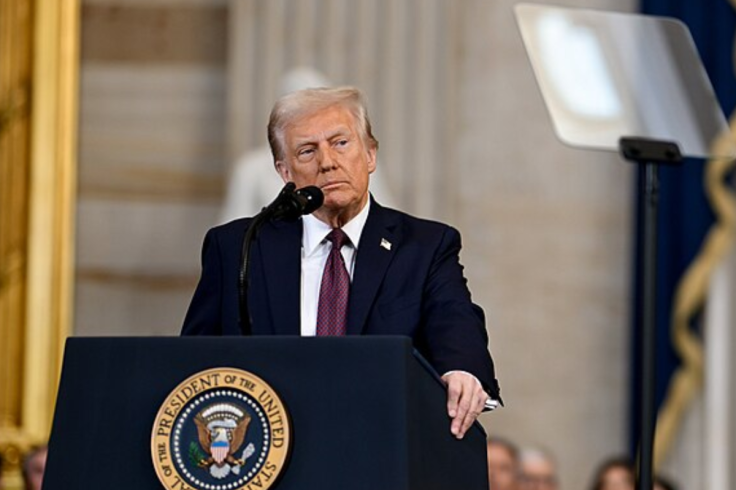
President Donald Trump has drawn national criticism over a Trump voting pledge at the Republican midterm convention in Dallas that included the words 'cheat like hell.'
Trump asked supporters to raise their right hands and repeat after him during his Thursday speech at American Airlines Center.
The unusual pledge quickly spread online, with detractors accusing him of turning a standard get-out-the-vote pitch into something closer to a loyalty ritual.
The moment came as Republicans try to protect their narrow House majority in the 3 November midterm elections.
The two-day gathering on 9 and 10 September was billed as the party's first national convention built entirely around a midterm contest, a show of force as Trump pushes voters to behave as if his own name were on every ballot.
Trump used the Dallas stage to warn that Democrats would dismantle his administration's agenda if Republicans lose control of Congress. He told activists that the stakes were existential, framing the midterms as a referendum on his presidency and on what he calls 'election integrity.'
Trump's Raised-Hand Donald Trump Voting Pledge Sparks Backlash
During the pledge, Trump invited the crowd to join him in a scripted response. 'Raise your right hand. I pledge to the greatest president in the history of the United States,' he said, casting himself in the starring role and urging supporters to go out with their 'family' and 'friends' to vote.
He then added the line that detonated beyond the arena. 'I don't care if I'm registered or not. I'm going to try and cheat like hell, like they do,' Trump said, before declaring, 'There's never been bigger cheaters.'
The remark sat uneasily alongside his decade of warnings about supposed Democratic fraud. Trump has spent years making unsubstantiated claims that widespread cheating cost him the 2020 presidential election, and he has turned the idea of a 'rigged' system into a permanent talking point. Here, he flipped the script, at least rhetorically.
Supporters in the arena laughed and applauded, and some outlets noted that Trump appeared to be joking, or at least leaning heavily on hyperbole. The president went on to urge the crowd to bring friends and family to the polls on 3 November, saying even Democrats should vote, and he closed the moment with 'So help me God.'
He also tried a dark gag about apathy. 'You know what happens if you don't vote, right? You go to hell,' Trump told the crowd. 'And I don't want that to happen to you, so please go and vote.'
Outside the convention, the tone was very different. Critics homed in on both the 'cheat like hell' line and the optics of thousands of people standing with raised right hands, repeating a pledge that began with praise for Trump rather than any institution or principle.
California Governor Gavin Newsom, a frequent Trump antagonist, said on X that the president had 'replaced the Pledge of Allegiance with a pledge of allegiance to himself', adding that 'the choice is yours on the ballot: America or Trump.'
Journalist Brad Polumbo called the footage 'so strange and embarrassing'. Reporter Nikki Barnes went further, summing up her reaction in three words: 'It's a cult.'
Similar language surfaced on Reddit and other platforms once clips from the arena hit social feeds. One user wrote that Trump had said 'the 'cheating' part out loud' and accused the crowd of clapping along 'like a bunch of cult members.'
Those descriptions are, of course, opinions rather than legal or clinical diagnoses. Still, in politics, labels like that have a way of sticking.
Legal Fights Put Donald Trump Voting Pledge in Sharper Relief
The Dallas controversy lands in the middle of an intensifying battle over how Americans vote, much of it shaped by Trump's own agenda.
At the federal level, the administration is defending a March executive initiative on mail voting. An appeals court this week upheld a preliminary injunction that blocks key provisions from taking effect, according to court records. That ruling leaves in place a district judge's order stopping the US Postal Service from enforcing parts of Trump's directive.
The challenged rules include requirements for federal approval of ballot-envelope designs and demands for states to submit detailed voter information. Several Democratic-led states have resisted those conditions, and a related challenge is now before the US Supreme Court.
The dispute turns partly on the line between state and federal power. States run their own elections day to day, but the Constitution also gives Congress significant authority to regulate many aspects of federal contests. Judges have so far been cautious about letting the White House reshape that balance through executive action alone.
Trump has also encouraged Republicans to pursue favourable congressional maps. One of the highest-profile fights has played out in Missouri, where a Trump-backed Republican map designed to boost the party's chances of picking up another House seat ran into legal trouble.
Trump: "Please right your right hand. I pledge to the greatest president in the history of the United States. That loves us so much he can't even breath. That I will go out with my family, my friends, I'll do it any way -- I don't care if I'm registered or not, I'm going to try… pic.twitter.com/ywiYe8ZIdu
— Aaron Rupar (@atrupar) September 11, 2026
The Missouri Supreme Court ruled that the map could not be used without first going before voters. After months of wrangling and conflicting lower-court decisions, the US Supreme Court blocked efforts to use the Republican plan for the 2026 midterms.
On Capitol Hill, Trump is pinning hopes on the SAVE America Act, his flagship election bill. The House passed the measure 218–213 in February. It would require documentary proof of US citizenship to register for federal elections and impose a nationwide photo-identification requirement for in-person voting.
The proposal also adds identification rules for mail ballots, though it allows specified alternatives for voters who lack certain documents. For now, the bill is stalled in the Senate, with Democrats and a handful of Republicans unconvinced or openly opposed.
Polls ahead of the convention have not been kind to the president either. One national survey cited by campaign strategists put Trump's approval rating at 33 per cent, a worrying number for a leader trying to drag his party over the midterm finish line.
Seen against that backdrop, the Dallas Trump voting pledge looks less like an isolated oddity and more like a snapshot of where Trumpism stands in 2026: anxious about turnout, obsessed with elections, and still willing to play with fire on the language of cheating.
As November approaches, both parties remain locked in an aggressive struggle to define the boundaries of democratic participation.
© Copyright IBTimes 2026. All rights reserved.
- Recommended For You