

Who Is Alice Weidel? Lesbian AfD Leader Lives With Her Family in Switzerland as Party Opposing Gay Adoption Wins Saxony-Anhalt
Alice Weidel's leadership and personal life spark debate amid AfD's record-breaking election result
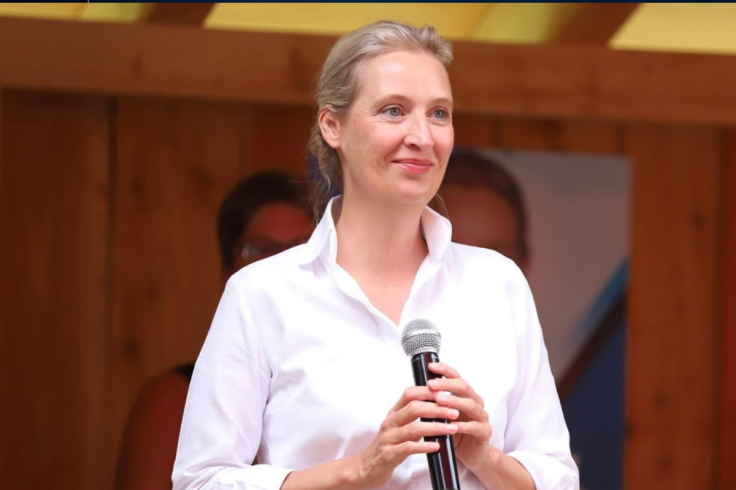
Germany's Alternative for Germany (AfD) has recorded its strongest result in a state election, bringing the party closer than ever to potentially leading a state government since the Second World War. The result has also renewed attention on Alice Weidel, the party's co-leader and one of its most prominent national figures.
On 6 September 2026, the AfD won 43.8 per cent of the vote in Saxony-Anhalt, more than doubling its 2021 result and finishing well ahead of Chancellor Friedrich Merz's Christian Democrats (CDU). The party secured 39 of the Landtag's 83 seats, leaving it three short of the 42 needed for an outright majority.
Weidel described the result as 'historic'. With the AfD unable to govern alone, however, the outcome leaves coalition negotiations and the party's ability to secure parliamentary support at the centre of the political debate.
How the AfD Stormed Saxony-Anhalt
Preliminary official results showed the AfD winning 576,037 second votes, or 43.8 per cent, compared with 226,622 votes, or 17.2 per cent, for the CDU. The AfD's share increased by around 23 percentage points compared with 2021, while turnout reached a record 77.8 per cent.
AfD lead candidate Ulrich Siegmund told supporters, 'We have made history in this state.' Weidel similarly presented the result as a clear political mandate, although the party's lack of a majority means it cannot form a government on its own.
The result represents a major breakthrough for the AfD, which has previously struggled to translate strong electoral performances into governing power amid other parties' refusal to enter coalitions with it.
Saxony-Anhalt's domestic intelligence service has classified the state's AfD branch as 'confirmed right-wing extremist', a designation Siegmund has rejected as politically motivated.
Germany's established mainstream parties, including Merz's CDU, have largely maintained the so-called firewall against cooperation with the AfD. The position has come under renewed pressure after the election, particularly after figures in the BSW signalled openness to talks.
JUST IN: 🇩🇪 Germany's AfD wins Saxony-Anhalt election, becoming first far-right party to take power at state level since World War II. pic.twitter.com/sTAlAoOqff
— BRICS News (@BRICSinfo) September 6, 2026
The Former Goldman Sachs Banker Leading the AfD
Weidel, 47, is a former Goldman Sachs analyst and economist who holds a doctorate in economics. She spent several years in China researching the country's pension system and speaks Mandarin.
She joined the AfD in 2013, the year the party was founded, initially attracted by its opposition to the euro. She subsequently rose through its federal leadership and became one of the party's most prominent national figures.
Weidel became one of the AfD's lead candidates for the 2017 federal election and has since established herself as one of the party's most recognisable public faces. She is openly lesbian and has frequently faced questions about how her personal life intersects with the AfD's positions on family and social policy.
Her paternal grandfather, Hans Weidel, was a judge during the Nazi era. Weidel has said the subject was not discussed in her family while she was growing up.
Weidel also played a leading role in the AfD's campaign for the 2025 federal election, in which the party finished second nationally. Her position alongside co-chair Tino Chrupalla has made her one of the most prominent figures on Europe's populist right.
Weidel's Private Life and the Afd's Family Policies
Weidel has been in a long-term relationship with Sarah Bossard, and the couple have two adopted sons. The family lives in Switzerland, while Weidel remains politically active in Germany.
Her private life has attracted attention partly because of the AfD's conservative family policies. The party has promoted traditional family policies and opposed same-sex marriage.
In 2018, the AfD introduced legislation seeking to repeal Germany's 2017 law legalising same-sex marriage.
The party's policies should be distinguished from Weidel's private circumstances rather than presented as evidence that she personally supports every AfD position.
She has generally not made her sexuality a central part of her political campaigning, but critics argue that her prominence gives the party a more socially liberal image than some of its policies suggest.
Alice Weidel z Afd
— Poland news War in Ukraine (@Propeertys) September 6, 2026
1- Jest przeciwna homoseksualistom - jest lesbijką.
2- Jest przeciwna imigracji - jej partnerka jest imigrantką.
3 - Jest przeciwna adopcji dzieci przez homoseksualistów - ma 2 adoptowane córki.
4- Udaje niemiecką patriotkę a mieszka w Szwajcarii. pic.twitter.com/LKGDWDKBBN
What Happens Next for the AFD
The Saxony-Anhalt result gives the AfD significant political momentum but does not automatically put it in government. With 39 of the Landtag's 83 seats, the party would need support beyond its own parliamentary group to secure a governing majority.
Whether other parties maintain their refusal to cooperate with the AfD will therefore be crucial.
The election has demonstrated the party's growing electoral strength, but converting that support into executive power remains a separate challenge.
For Weidel, the result further strengthens her position as one of the AfD's central figures.
It also ensures that both her political agenda and the contrast between the party's family policies and her own private circumstances will continue to attract scrutiny.
© Copyright IBTimes 2026. All rights reserved.