

Donald Trump Will Cause Tremendous Destruction Before Leaving Office, Columnist Jamelle Bouie Warns
The New York Times columnist linked his concerns to Trump's monument plans, his refusal to concede the 2020 election and uncertainty over the 2029 transfer of power
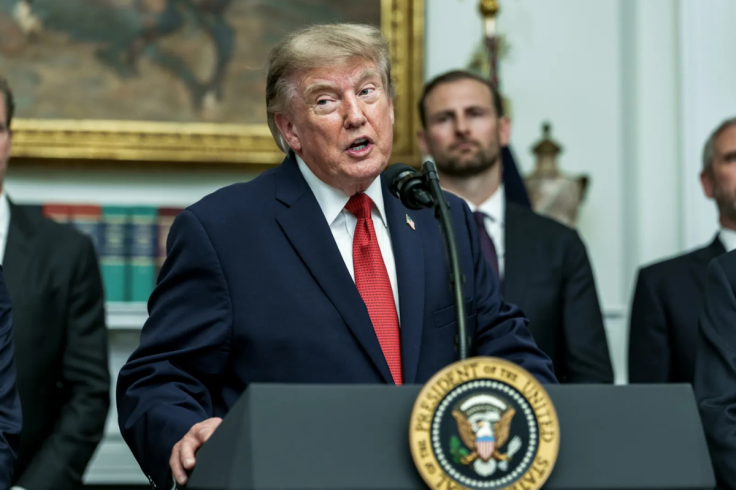
New York Times opinion columnist Jamelle Bouie warned that President Donald Trump could cause 'a tremendous amount of destruction' before his current term is due to end on 20 January 2029, arguing that the president's focus on monuments, legacy and personal recognition could intensify as that date approaches.
Bouie linked that warning to Trump's interest in a proposed triumphal arch near the Lincoln Memorial and Arlington National Cemetery, as well as the White House ballroom now under construction.
He said the projects reflect a broader concern about how Trump sees his place in American history and what he may do if that legacy is challenged.
Donald Trump's Monument Plans Draw Bouie's Scrutiny
Bouie said Trump is 'obsessed with his ballroom' and with building a triumphal arch in Washington, DC. Two of the veterans, Michael Lemmon and Shaun Byrnes, told the court they hope to be interred at Arlington National Cemetery.
Bouie said work is already underway at the proposed site, although construction of the arch itself has not begun. Survey and geophysical testing have been conducted, while archaeological test pits are planned as the project continues through federal review and litigation.
He described Trump as viewing the arch as 'the monument to himself' and said the president believes both the arch and ballroom would create a lasting marker of his presidency.
Bouie contrasted Trump's approach with the conventional process for federal commemorative works. The plaintiffs challenging the arch argue that congressional authorisation is required, while the administration maintains that earlier legislation already provides the necessary authority.
Bouie also argued that Trump's interest in permanent structures stems from a fear of being forgotten. He described the president as someone who connects self-worth with being known and said the prospect of disappearing from public memory may carry particular weight for him.
In Bouie's view, the projects are less about a conventional presidential legacy than about ensuring Trump remains visible in the national story. 'These monuments, this arch, this ballroom, represent his effort to force himself onto historical memory,' he said.
Warning About Donald Trump Extends Beyond Construction Projects
Bouie used the metaphorical phrase 'family annihilator presidency' to describe what he views as a pattern of politically motivated destruction driven by grievance and ego.
He said Trump's victory in the 2024 election marked the beginning of what he called a 'revenge tour against the American people themselves for rejecting him in 2020'.
That phrase is Bouie's characterisation, not an official or legal description of the administration. He used it to argue that, if Democrats win Congress as Trump's term approaches its final years, the administration could become increasingly focused on what Bouie described as destruction.
Bouie said he was particularly concerned about the period around 2028 and 2029, especially if Democrats win control of Congress in the November 2026 midterm elections.
He predicted that the administration could become 'all the more self-destructive' and direct more of its energy towards what he described as 'inflicting destruction on the American people, on Washington D.C., on the country'.
The columnist said his greatest concern remains whether Trump would leave office peacefully at the end of his term.
Bouie pointed to Trump's refusal to concede the 2020 election and his efforts to overturn the result as reasons to question whether he would accept the end of his current term peacefully.
'He had one chance to do it before, and he refused,' Bouie said. 'And all of our available evidence tells us that Trump will cause a tremendous amount of destruction before he is forced out.'
Bouie's Entire Focus Is on 2029
Bouie said he was less concerned that Trump would try to 'steal the midterms', but remained uncertain about what the final stretch of the presidency could bring. 'I think it's going to be pretty ugly,' he said. 'How ugly? I don't know. But pretty ugly.'
Bouie's concern is ultimately focused on the end of Trump's term in 2029 rather than the approaching midterm elections.
He argued that Trump's conduct after the 2020 election gives reason to question how he would respond to another transfer of presidential power, while acknowledging that the scale or form of any confrontation remains impossible to predict.
© Copyright IBTimes 2026. All rights reserved.