

'When Hope Is Alive': Nepal Army Shares Dramatic Tunnel Rescue After Himalayan Floods
Two workers have been rescued alive from a flooded hydropower tunnel in Nepal after nine days underground, in a rare moment of hope
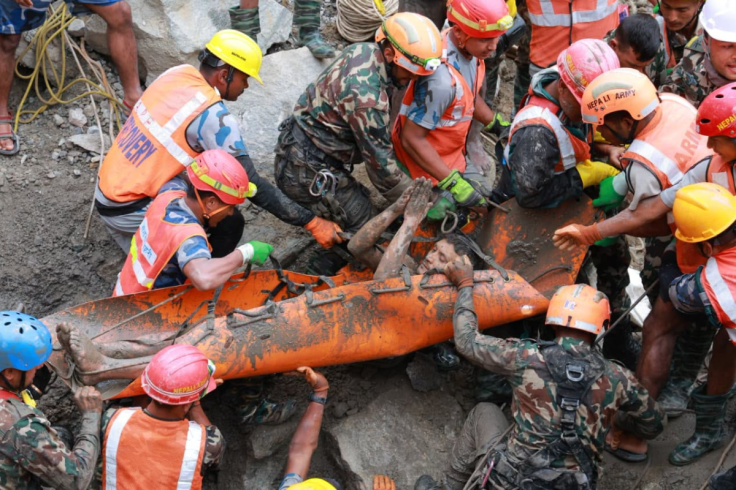
Two workers trapped for nine days in a flooded hydropower tunnel in Nepal were pulled out alive on Friday, in a dramatic Nepal Army rescue that briefly cut through the country's deepening grief.
The men were freed at the Trishuli 3A hydropower project in Rasuwa district, near Nepal's northern border with China. They had survived inside the tunnel after catastrophic Himalayan floods swept through the region on 26 August.
Nepal Army officials identified them as mechanical foreman Sanjay Sah, 30, and mechanical supervisor Kabir Maharjan, 45.
Their rescue, captured in striking images shared by the Nepal Army, has turned into an unexpected symbol of hope in a disaster that has already claimed thousands of lives.
Nepal Army Tunnel Rescue Offers a Rare Lifeline
The news came after days of increasingly grim updates from the Trishuli River corridor, where multiple hydropower schemes were hit hard by the floods.
At the Trishuli 3A plant alone, rescue officials say at least 557 workers are still believed to be missing, with around 115 thought to be trapped in the main tunnel.
It was inside that tunnel that teams first heard faint voices on Friday morning, a moment officials later described as the turning point in the operation.
The Nepal Army swiftly released photographs and a video of the rescue on its official Facebook page, allowing the country to watch along in real time.
One widely shared image shows the first rescued worker completely coated in mud, slung across a rescuer's shoulder and carried out of the dark tunnel towards daylight.
The accompanying caption read, 'When hope is alive, even the impossible becomes possible'.
Both men were airlifted from Rasuwa to Kathmandu for treatment, according to army officials and Nepal's disaster agency. The condition of the pair has not been officially detailed, but there is a clear sense that their survival after nine days underground borders on the miraculous.
'I can't explain what we are feeling at the moment. We are just grateful to God', said Amir Maharjan, Kabir's brother, speaking to reporters as the family rushed to see him.
More Voices in the Tunnel Keep Nepal Army on Alert
It can be recalled that early information from inside the Trishuli 3A tunnel has come almost entirely from survivors themselves.
Nepal Army spokesperson Brig Gen Raja Ram Basnet said one of the rescued men told rescuers that more people were alive deeper inside. That account is now driving the next phase of the Nepal Army rescue, although officials admit they cannot yet verify how many workers could still be reached in time.
'We are waiting for the rescue of more and more people', Nepal's communications minister, Bikram Timilsina, wrote on his Facebook page, echoing a countrywide mood that swings between stubborn hope and exhausted realism.
Authorities say more than 900 workers are missing from around a dozen hydropower projects across Nepal, and local officials estimate about 500 of them are likely trapped inside tunnels.
Rescuers are blunt about the challenges. Many of the hydropower sites sit in steep, remote gorges where roads have been ripped away or buried in landslides. Several tunnels have partially collapsed, while others are choked with mud, rocks and twisted machinery.
Air quality inside is a constant concern, and officials have repeatedly raised fears about how much drinking water trapped workers might still have.
Foreign Experts Roped in Tunnel Rescue Operations
With domestic capacity stretched, Nepal has brought in foreign experts to reinforce the tunnel operations. Teams are working around the clock, using controlled blasts, excavators and heavy earth-moving equipment to open new access points and stabilise damaged sections.
Authorities also released a preliminary estimate of the economic hit on Friday. Nepal's disaster agency puts damage to infrastructure and property at roughly रु387.5 billion, about $2.5 billion.
Across the border in China's Tibet region, the picture is not much better. A huge mudslide hit a major land crossing between the two countries, cutting the only road into Tibet's Gyirong county until it fully reopened on Wednesday.
Chinese officials say at least 21 people were killed there and 541 are missing on the Tibet side alone. More than 800 foreign nationals are among those missing in the wider disaster zone, which includes popular trekking routes and religious pilgrimage trails.
The United States State Department says 75 Americans were still unaccounted for as of Wednesday, with 16 confirmed safe.
The tunnel rescue comes after one of the deadliest flood disasters in recent memory to hit the Himalayas, triggered by what authorities believe was a high-altitude glacier collapse on the Nepal-Tibet border.
The sudden surge of water and debris roared down narrow valleys, smashing through mountain roads, hydropower projects and villages in its path.
According to Nepal's National Disaster Risk Reduction and Management Authority, at least 1,287 people have been confirmed dead, and more than 5,000 remain missing.
Entire communities in remote districts are still cut off, and the full human toll is almost certainly higher than the early numbers suggest.
For now, the Nepal Army tunnel rescue sits in that strange category of disaster stories that feel almost too cinematic to be true. Two men pulled from a flooded tunnel after nine days in the dark, walking proof that not every call ends badly.
Whether more voices will be heard from inside those mountains in the coming days is another question entirely.
© Copyright IBTimes 2026. All rights reserved.