

Psychologist Spots 'Alzheimer's Type Dementia' and 'Involuntary Spasms' in Donald Trump at Rallies
A psychologist's video analysis of Donald Trump's recent rallies claims the president is showing worrying neurological signs, from slurred speech to arm spasms
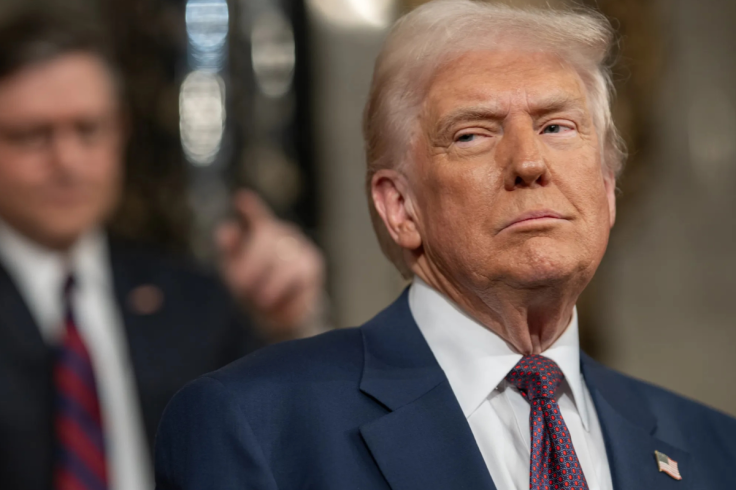
President Donald Trump's recent rallies and public events in South Carolina, Washington DC and at the White House have raised fresh questions about his health, after psychologist Dr John Garrison claimed Trump is showing signs of 'significant decline' including slurred speech, memory lapses and what he describes as 'involuntary arm spasms'.
Concerns about the president's physical and cognitive fitness have simmered for years, but Garrison, a psychologist whose video analyses of Trump's behaviour have gained wide circulation online, argues that what he is seeing now looks markedly different from earlier quirks.
In his latest breakdown of recent appearances, he suggests the pattern of changes is more consistent with neurological problems than with age alone, and says the apparent deterioration has accelerated over the last year.
Psychologist Flags 'Alzheimer's-Type' Signs in Donald Trump Speech
Garrison begins with a recent rally in South Carolina, where Trump walked to the podium and opened with what sounded like a blurred 'nnn-ank you' instead of a crisp 'thank you.'
On its own, that would barely merit a raised eyebrow. Garrison acknowledges that everyone trips over words sometimes. The issue, he insists, is the frequency and the change from Trump's past delivery.
'He's having a hard time enunciating, and that is concerning neurologically because it could be post-stroke behaviour,' Garrison says in his video analysis.
He goes further, suggesting the pattern 'could be suggesting some degree of dementia, Alzheimer's type dementia, Lewy body dementia,' then adds that 'there's all sorts of concerning behaviours that we're seeing that are in line with a variety of neurological concerns.'
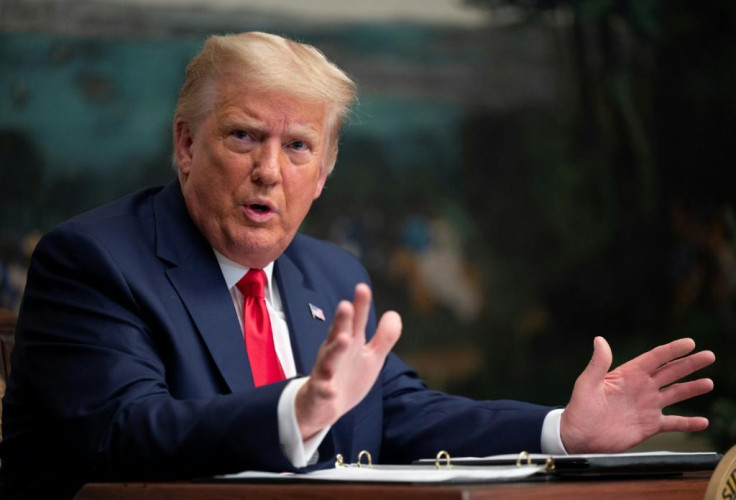
He insists that 'we are hearing a distinct change in how he communicates' compared with his earlier campaigns. Later in the same South Carolina rally, Garrison focuses on a moment when Trump attacks Hillary Clinton, one of his favourite foils.
Trump appears to hesitate before saying her surname. Garrison claims the teleprompter almost certainly shows 'Hillary,' but says the president closes his eyes as if searching for 'Clinton,' then seems unable to say it.
'He is struggling there and then he can't say it directly afterwards because I don't think he can remember it right then,' Garrison argues. He describes these as 'neurological glitches' and says they are happening 'over and over.'
Nothing in the clips confirms dementia, of course, and no doctor close to Trump has said anything of the sort. The White House has not publicly responded to these latest claims.
Donald Trump's 'Involuntary Spasms' and Right Arm Twitch
If the speech issues are worrying, Garrison sounds even more alarmed by what he calls 'involuntary spasms' that he says are now visible in most of Trump's public appearances. At the South Carolina podium, he zooms in on Trump's right elbow, which seems to jerk repeatedly as the president talks.
'You may already be noticing his arm twitching again,' Garrison said. 'His right elbow is just constantly twitching.' He suggests agitation may make the spasms more pronounced, describing them as a sign that 'the amount of control he's losing is getting more substantial.'
He then moves to footage from the Freedom 250 Grand Prix event in Washington, D.C. In one segment, Trump waits for an interview and appears tense, shifting his posture and breathing through his teeth in a way Garrison calls 'very unusual.'
'He looks uncomfortable. You can see on his face that he looks uncomfortable,' Garrison says, adding that the president 'looks more uncomfortable here than he normally does'. In his view, this is not just stage nerves. 'You're seeing more discomfort from situations like this because I think he gets overwhelmed, which is not something we used to see,' he argues.
He links that to what clinicians often see in people with neurological deficits, saying they 'get overwhelmed more easily,' find loud noises more distracting and struggle to focus. Situations that used to be manageable, he suggests, can start to feel distressing.
The psychologist returns to the same theme with Trump's latest Rose Garden event. He claims Trump 'does not use his right hand as much as he used to' and that there are times when 'there seems to be some distinct weakness in his right hand.' Again, he highlights a sharp twitch of the right arm as another speaker addresses the audience.
'You could very clearly see it again right there,' Garrison says. He argues that the movement becomes more obvious when Trump is forced to stand still and listen, something he believes the president dislikes. 'When he's agitated, he's more likely to have these types of spasms,' he adds, noting that intense emotion can lead to 'more loss of control like this.'

As the speech continues, so, apparently, do the tics. 'You're seeing spasms all over the place,' Garrison claims. 'It doesn't matter where he is. They are constant and they are noticeable.' Alongside this, he lists 'problems with verbal fluency,' episodes where Trump 'gets confused' and moments of slurred words.
Garrison's own theory, which he stresses cannot yet be proved, is that Trump may have suffered a 'medical event' about a year ago and has declined since. He floats the possibility of a 'progressive neurodegenerative disease,' but without medical records that is, bluntly, speculation.
He also notes that Trump appears to be making fewer public appearances than in previous political cycles. If his interpretation is right, Garrison predicts, 'we might start seeing less of him because these issues are going to become so difficult to control.'
None of this has been acknowledged by the president, his doctors or US officials. The White House has not released new medical documentation to address these specific concerns. Until that happens, viewers are left to pore over rally clips and public events, searching for meaning in every twitch. Some of it will be noise. Some of it may not be.
© Copyright IBTimes 2026. All rights reserved.