

'Jellyfish' Above Florida? SpaceX Launch Explains Unusual Morning Sight
SpaceX Falcon 9 launch carrying supplies to the ISS produced a jellyfish-shaped plume visible across the eastern US as sunlight illuminated its exhaust
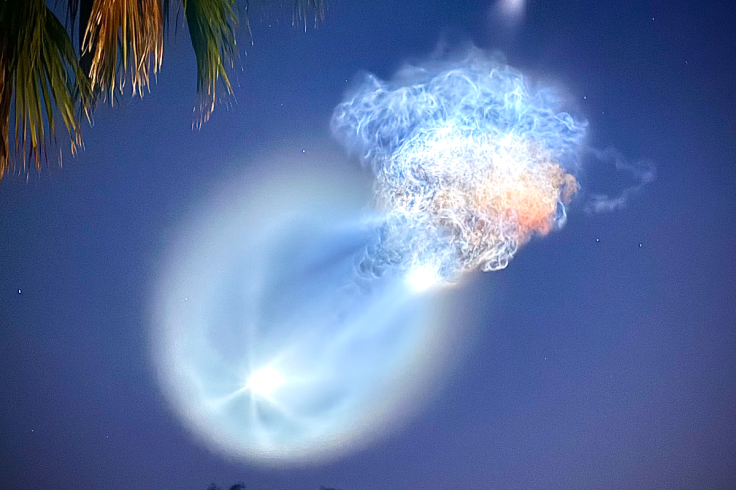
A glowing, jellyfish-shaped plume stretched across the early-morning sky on 13 October 2026 as sunlight illuminated the exhaust from a SpaceX rocket carrying cargo to the International Space Station (ISS).
The Falcon 9 rocket lifted off at 6:33am Eastern Daylight Time (EDT) from Space Launch Complex 40 at Cape Canaveral Space Force Station in Florida. It carried an uncrewed Dragon spacecraft loaded with scientific investigations, supplies and equipment for the orbiting laboratory.
The Guardian reported that the expanding SpaceX jellyfish plume was visible across several eastern US states, with sightings extending from Georgia to New York. The unusual display was caused by sunlight illuminating the rocket's exhaust high above the still-dark landscape.
Why the Rocket Exhaust Looked Like a Jellyfish
The spectacle occurred because the rocket launched shortly before sunrise. At high altitude, the expanding exhaust plume was exposed to sunlight while the ground below remained in twilight, creating a striking contrast against the dark sky.
NASA explained that this phenomenon, commonly described as a 'jellyfish,' occurs when sunlight illuminates a rocket's exhaust plume near sunrise or sunset. The resulting glow can make the spreading plume resemble a giant jellyfish suspended in the sky.
In a report published on 14 October, Space.com explained that water vapour and carbon dioxide released by a rocket can freeze into ice crystals in the cold upper atmosphere. As the plume expands, the material spreads behind the ascending rocket and reflects sunlight, producing the luminous effect.
It described the display as a mixture of orange and blue light and gas. Although the sight can startle people unfamiliar with rocket launches, the publication explained that the visual phenomenon itself is not evidence of a dangerous or unexplained event.
How the Display Was Visible Beyond Florida
The Falcon 9 travelled northeast over the Atlantic, allowing the illuminated exhaust plume to be seen far beyond the launch site.
The Guardian reported sightings from Georgia to New York, while NASA confirmed that the plumes were visible across the eastern US. The viewing conditions varied by location, but the launch's timing and trajectory helped extend the spectacle across a wide area.
NASA's post on X attracted hundreds of replies, including photographs shared by skywatchers in multiple states.
Behind the Glow: A Space Station Resupply Mission
The launch marked the beginning of SpaceX's 35th Commercial Resupply Services (CRS-35) mission for NASA. Under the programme, SpaceX transports cargo to the ISS, including food, clothing, medical supplies and scientific experiments.
The Dragon spacecraft's journey continued after the rocket's exhaust display faded. After launch, the capsule had to travel to the station and dock before transferring its cargo to the orbiting laboratory.
NASA scheduled coverage of Dragon's rendezvous and docking for 15 October, beginning at 9:15 am EDT. Space.com said the spacecraft was expected to dock autonomously with the station's Harmony module at around 11am EDT, approximately two days after launch.
Another Dawn Launch Is Scheduled for 19 October
Skywatchers who missed the 13 October display may have another opportunity on Monday, 19 October, when another SpaceX Falcon 9 launch is scheduled from Cape Canaveral, according to NASA.
The satellite-deployment mission has an hour-long launch window scheduled to open at 6:30am EDT. Sunrise is listed at 7:01am, which puts the window opening 31 minutes before sunrise.
That timing could create favourable conditions for another jellyfish-like display. If a launch occurs while sunlight illuminates the rocket's exhaust and the ground remains relatively dark, a similar effect may be visible.
However, the phenomenon is not guaranteed. Its appearance and visibility depend on the launch time, the rocket's trajectory, atmospheric conditions, and the observer's position.
© Copyright IBTimes 2026. All rights reserved.