

SpaceX Just Set the American Speed Record to the ISS but They Admitted 'We Got Lucky This Time'
SpaceX's Crew-13 astronauts reached the ISS in 7 hours and 55 minutes, setting a new US launch-to-docking record
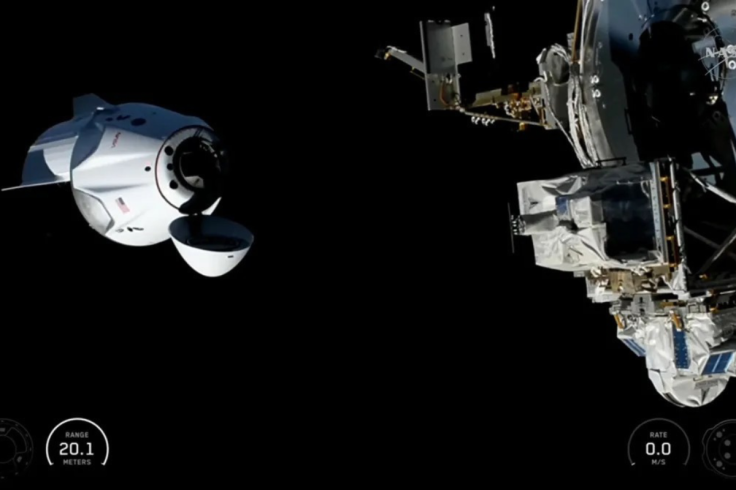
SpaceX's Crew-13 mission has set a new American speed record to the International Space Station, reaching the orbiting outpost in 7 hours and 55 minutes on Thursday, 1 October, even as the company admitted 'we got lucky this time'.
The Crew Dragon capsule carried NASA astronauts Jessica Watkins and Luke Delaney, Canadian Space Agency astronaut Joshua Kutryk and Roscosmos cosmonaut Sergey Teteryatnikov.
The spacecraft reached the station at 7.05pm EDT after launching from Space Launch Complex 40 at Cape Canaveral Space Force Station in Florida at 11.10am. It docked with the forward port of the ISS's Harmony module, according to NASA.
SpaceX Crew-13 Benefited From Perfect Timing
SpaceX's record was not simply a matter of brute force or a more powerful rocket. Julianna Scheiman, SpaceX's director of NASA science and Dragon programmes, said the mission benefited from the station's position in orbit.
'We got lucky this time,' Scheiman said during the post-launch press conference. 'The space station was in an opportune spot in space, and the orbital mechanics, the physics of it all, worked out for it to be the shortest launch-to-docking time we've had to date.' She added that the journey was 'close to the fastest it could be'.
That explanation matters. The International Space Station is not waiting directly above the launch pad. It is travelling around Earth at high speed, and a spacecraft must reach a compatible orbit before it can approach safely. The timing of the launch, the station's position and the chosen trajectory all shape how long the rendezvous takes.
NASA had planned a journey of about 7 hours and 50 minutes. The actual docking took five minutes longer, but still surpassed the previous US record.
The former benchmark was 12 hours and 33 minutes, set by SpaceX's uncrewed Dragon during the CRS-31 cargo mission in November 2024.
The fastest previous crewed trip in a US vehicle was 14 hours and 43 minutes, recorded by SpaceX's Crew-11 mission in August 2025. So the margin was substantial, and the achievement was as much about orbital geometry as engineering.
The Record Does Not Beat Soyuz
Crew-13 did not set the overall record for reaching the ISS. That mark belongs to a Russian Soyuz spacecraft, which carried three astronauts to the station in 3 hours and 3 minutes in May 2020.
The Soyuz reached the ISS after only two orbits of Earth. That does not necessarily mean it is faster or more powerful than Dragon. Russia has generally used more aggressive fast-track trajectories, while NASA and SpaceX have often selected different rendezvous profiles.
In spaceflight, the shortest route is not always the only consideration. Mission planners must balance fuel, crew comfort, launch timing, safety margins and the station's position. A quick trip is useful, particularly when crew members are heading into a six-month expedition, but speed alone is not the whole story.
Crew-13's four astronauts will now begin their long-duration mission aboard the orbiting laboratory. Watkins is serving as commander, with Delaney as pilot. Kutryk and Teteryatnikov are mission specialists.
NASA described the launch as the 13th crew rotation mission of SpaceX's human space transportation system and the company's 14th flight carrying NASA astronauts to the ISS, including the Demo-2 test flight.
The mission also marks the first spaceflight for Kutryk, according to NASA. Delaney is also making his first trip to space, while Watkins is returning for her second mission to the station.
Crew-13 Begins Six-Month Station Mission
The new arrivals replace the four astronauts from SpaceX's Crew-12 mission, which launched in February.
NASA astronauts Jessica Meir and Jack Hathaway, European Space Agency astronaut Sophie Adenot and Roscosmos cosmonaut Andrey Fedyaev are expected to return to Earth in their Dragon capsule as soon as Monday, 5 October, NASA officials said.
Before Crew-13 entered the station, the Dragon crew spacecraft completed leak checks and pressurisation procedures. NASA's schedule placed hatch opening at about 8.45pm, although later reporting said the hatch opened at 9.19pm.
The new crew will carry out scientific research and routine station operations during its stay. Their arrival also continues the regular rotation system that keeps the ISS staffed by astronauts from several space agencies, including NASA, the Canadian Space Agency and Roscosmos.
NASA and SpaceX say the mission highlights how a favourable orbital alignment, combined with prepared hardware, crew and flight plan, can translate into a record-setting journey for a US spacecraft.
© Copyright IBTimes 2026. All rights reserved.