Engineer Kyle Holl Quips 'An Engine Out and Then an Alien Battle Cruiser Uncloaks' During Flight
The feature appeared as Starship reached orbit and deployed 26 Starlink V3 satellites, while an engineer joked about an 'alien battle cruiser'
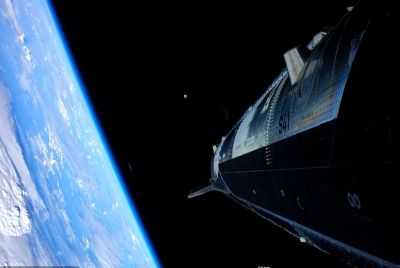
A pale blue streak visible during SpaceX's Starship Flight 14 livestream sparked UFO speculation online, with engineer Kyle Holl joking that an engine shutdown was followed by an 'alien battle cruiser' uncloaking.
The comment came as viewers scrutinised footage from Starship's first orbital mission, launched from Starbase, Texas, on Monday.
The vehicle reached orbit and deployed 26 Starlink V3 satellites. Controllers then shortened the planned mission and brought Starship back to Earth after about three hours.
UFO Theories Emerge as Starship Reaches Orbit
Flight 14 was Starship's 14th integrated test flight and its first orbital attempt, following 13 earlier suborbital flights. Reaching orbit was a significant test milestone for SpaceX as it develops Starship for NASA's Artemis programme.
The feature appeared in multiple frames of the livestream as a narrow, slightly curved streak of pale blue light with a brighter white tip against the dark background of space. Some viewers also pointed to an earlier, faint blue-white feature visible at about six minutes and 35 seconds into the broadcast.
The footage prompted a range of reactions on social media. One X user wrote, 'I think we all just saw a UFO live-streamed.' Another asked Elon Musk, 'Hey Elon, is this Mothership?'
Some viewers speculated that the feature could have been the International Space Station or another object. However, the livestream footage alone does not establish the feature's distance, size or identity, so claims that it was city-sized cannot be verified from the images.
Engineer Kyle Holl's Alien Battle Cruiser Remark
Holl's quip was among the reactions shared online, 'Hmm, an engine out and then an alien battle cruiser uncloaks. Interesting.' It jokingly linked the sighting to an engine anomaly during the flight.
One of Starship's six Raptor engines, a vacuum-optimised Raptor, shut down during ascent. The engine shutdown prompted an assessment of the vehicle. Controllers then shortened the planned mission and brought Starship down in the Pacific Ocean after about three hours.
Hmm an engine out and then an alien battle cruiser uncloaks. Interesting pic.twitter.com/A6dAlRUjCA
— Kyle Holl (@KyleHollSays) September 28, 2026
An observer identified as Dean Scott suggested the feature could have been residual gas from the Super Heavy booster after engine shutdown and boostback operations. He said sunlight could have made the gas visible against the dark sky after it had been obscured by Earth's bright horizon. This remains a hypothesis, not a confirmed identification.
What Happened Next for Starship
Contact was subsequently established with all 26 deployed Starlink V3 satellites, according to reporting on the mission.
NASA Administrator Jared Isaacman called it a 'gorgeous launch' and described the mission management as 'safe, responsible, and especially inspirational.'
Starship performs its orbital insertion burn and enters orbit of Earth for the first time pic.twitter.com/LodrSTnEnl
— SpaceX (@SpaceX) September 28, 2026
According to reports the engine failure could put pressure on NASA's timeline for its planned 2028 Artemis lunar landing. NASA currently targets early 2028 for Artemis IV, the first planned landing. Determining the cause remains important before subsequent flights.
As of publication, SpaceX and Elon Musk had not publicly identified the feature. The feature had not been independently identified as of publication, and no credible evidence presented publicly has established that it was extraterrestrial.
Background on Starship Development
Starship has undergone extensive testing since 2023, with several earlier flights ending in explosions or partial failures. Flight 14 represented a major step forward for the programme, demonstrating that the vehicle could reach orbit and deploy payloads despite an in-flight engine anomaly.
The vehicle is central to SpaceX's ambitions for Mars colonisation and NASA's plans for lunar exploration. Under current contracts, a lunar-landing variant of Starship will ferry astronauts from lunar orbit to the Moon's surface during Artemis missions.
The engine shutdown during ascent has drawn particular attention from aerospace analysts, who say understanding the failure will be critical before the next orbital test.
© Copyright IBTimes 2026. All rights reserved.
- Recommended For You