

Trump Calls Reporter a 'Sick Person' in Oval Office Clash as White House Faces Press Freedom Backlash
A heated exchange in the Oval Office raises wider questions about the freedom of journalists to challenge those in power
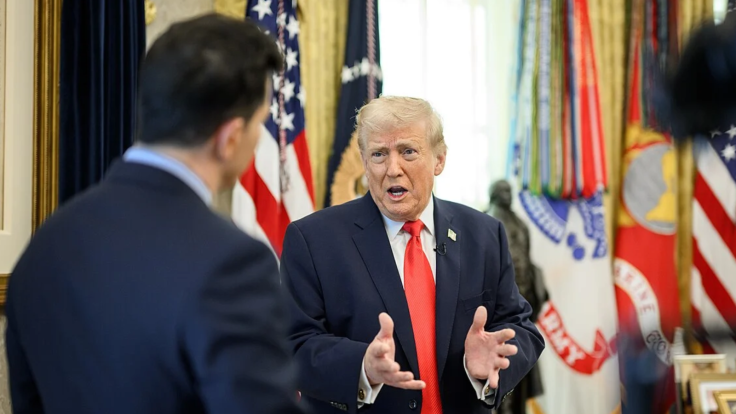
President Donald Trump called a journalist a 'sick person' during an Oval Office confrontation in Washington on 20 October 2026. The next day, the White House removed Andrew Feinberg, The Independent's White House correspondent, from a scheduled presidential press trip to Iowa. The decision prompted a complaint from the White House Correspondents' Association about retaliation against journalists.
The disagreement began during an announcement of new incentives for reporting suspected government fraud. Feinberg questioned why whistleblowers would use the scheme when existing legislation already provides financial rewards. Their exchange later turned personal as the reporter tried to ask further questions.
Donald Trump Challenged Over Fraud Rewards
Trump and Vice President JD Vance had appeared alongside officials to introduce the Fraud Whistleblower Incentive Program. The Justice Department says qualifying tipsters can receive $10,000 (€8,900 and £7,500) to $30,000 (€26,800 and £22,400). Payments require information leading to criminal charges in certain fraud cases.

The department says its innovation is speed. Payments can follow the filing of charges rather than waiting for a case and its appeals to finish. Recipients may also remain eligible for larger awards through other programmes.
Feinberg raised the False Claims Act, enacted in 1863, which permits whistleblowers to bring certain lawsuits on the government's behalf. Successful claimants typically receive 15 to 30 per cent of the money recovered, according to the department.
Trump responded that his initiative could generate substantial rewards. During the event, he also described a one per cent commission without a ceiling, although the Justice Department's published scheme specifies the smaller initial award range. The distinction was not resolved in the exchange.
Feinberg later said he believed Trump was recognising him when the president was apparently calling on another journalist seated behind him. During an earlier interruption, Trump warned the reporter to 'be careful', according to the event transcript.
The sharpest exchange came later when Feinberg began a question about Trump's golf courses. Trump repeatedly ordered him to be quiet. He then asked, 'Are you a sick person?' Feinberg replied that he was unaware of being ill. Trump added, 'I actually think there's something wrong with you.'
In his first-person account, Feinberg said he had already introduced himself and had covered Trump for more than a decade. He responded to the personal remark by noting that a recent physical examination had found him in good health.
Donald Trump Confrontation Triggers Press Access Dispute
The confrontation continued online after the event. The White House Rapid Response operation attacked Feinberg using a disability-related slur, according to the journalist's account. Vice President Vance called him an 'imbecile' from an official X account, prompting Feinberg to challenge him publicly.
On Wednesday, 21 October, an email from the White House Press Office told Feinberg he would not serve as the travelling print-pool reporter for Thursday's Iowa trip. He said the assignment had previously been confirmed and that the message offered no explanation.
Feinberg believes the decision was punishment for his questions. That motive has not been independently established, and his account says the White House had not answered his request for an explanation.
YIKES -- Trump loses his shit at a reporter for the third time during this Q&A -- "Wait wait -- Quiet. Quiet!!!! What's wrong with you? Are you a SICK person?" pic.twitter.com/2iiELisaxg
— Aaron Rupar (@atrupar) October 20, 2026
White House Correspondents' Association president Jacqui Heinrich condemned the restriction in a statement on 21 October. She described limiting a journalist's coverage because the president disliked their questioning as 'retaliation'. The association warned that reporters must be able to challenge the president without risking their access.
A White House official told TheWrap that journalists have no automatic constitutional right to enter the Oval Office or board Air Force One. The official also accused some publications of fabricating reports, without explaining Feinberg's removal specifically.
The footage prompted unverified online speculation about dementia. An angry response during a press event cannot establish a neurological diagnosis.
Beyond the insults, Feinberg's original policy question remains relevant. The Justice Department describes faster, limited initial payments, while the president spoke publicly about potentially much larger commissions.
Feinberg was removed from a confirmed assignment one day after challenging Trump. The White House defended its authority to control access, but the email gave no specific reason for excluding him.
© Copyright IBTimes 2026. All rights reserved.