Donald Trump Appears Badly Confused About His Media Ban While Claiming 'I Think We're Repressive Also'
Trump named three outlets for exclusion, but unanswered questions over access and enforcement now define this White House dispute

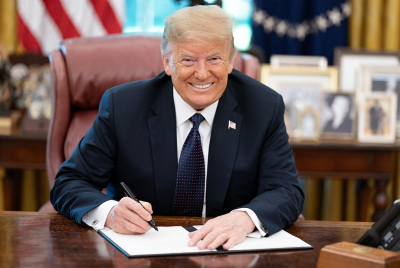
President Donald Trump faced questions at the White House on Friday after saying he was banning CNN, MS NOW and Politico from the White House, while offering little detail about how the restrictions would work.
Trump announced the move on Truth Social on 18 September, saying it was effective immediately and accusing the three organisations of repeatedly publishing what he called 'fake news.' He said other outlets could follow but did not identify them in the post.
Representatives of all three organisations were still working at the White House later on Friday, according to Reuters.
What the Trump Media Ban Would Cover Remains Unclear
Reporters pressed Trump on whether the announcement meant revoking press credentials, removing the outlets from presidential press pools or excluding their journalists from places such as the Oval Office.
During one exchange, Trump said, 'I still don't know what that means,' after being asked what the ban would mean in practice. When the question was rephrased, he called it 'a very simple ban.'
Trump just explained why he's illegally banning CNN, Politico and MSNOW from the White House:
— Ed Krassenstein (@EdKrassen) September 18, 2026
"because they never write a good story." pic.twitter.com/XAZMlG40hr
'I don't want them in my office. I don't want them here,' Trump said. He added that the ban would 'go as far as you can.'
Trump did not provide a detailed policy governing credentials, press-pool participation or access to the wider White House complex. Reuters reported that the legality of any restriction could depend on its scope because courts have treated limited access to spaces such as the Oval Office differently from broader exclusions involving White House press facilities or credentials.
Trump said there was no single report behind the decision, describing it instead as the result of 'cumulative stories over the past few years.' When later asked which other organisations could be affected, he criticised The New York Times and The Washington Post, but did not announce formal restrictions against either outlet.
I am proud to announce that, effective immediately, I am banning Fake News CNN, MSNOW (who recently changed their name from MSNBC due to lack of viewership and credibility!), and Politico (The recipients of an illegal and ridiculous $8 Million Dollar subscription, an All Time…
— Donald J. Trump (@realDonaldTrump) September 19, 2026
The subject also arose as Trump discussed Chinese President Xi Jinping's forthcoming visit to Washington. Asked about China's treatment of journalists and what message his own restrictions might send, Trump replied, 'I think we're repressive also,' before adding: 'We don't repress, but they write fake news.'
The remarks showed that Trump continued to base the announced restrictions on his objections to the organisations' coverage. They did not, however, resolve how the policy would be enforced or which categories of White House access would be affected.
Earlier AP Dispute Shows Why the Details Matter
The announcement follows an earlier court fight between the Trump administration and The Associated Press over access to limited-space presidential events.
In 2025, the White House restricted AP access after the news organisation continued to use 'Gulf of Mexico' while also acknowledging Trump's decision to rename it the 'Gulf of America' for federal government purposes.
US District Judge Trevor McFadden later granted AP a preliminary injunction, finding that the organisation was likely to succeed on its First Amendment claim that it had been excluded because of its editorial choice. The ruling did not establish a general right for every journalist to enter every presidential event.
It's important to mention that the history is not in Trump's favor.
— benny 🇩🇰 🇫🇴 🇬🇱 🇪🇺 🇺🇦 (@benny0692698414) September 18, 2026
In 2018, CNN correspondent Jim Acosta was stripped of his press card for the White House after a heated press conference. CNN sued the administration, a judge intervened, and Acosta got his access back.
When it… pic.twitter.com/X2ow3NB6m6
The US Court of Appeals for the District of Columbia Circuit subsequently stayed most of that injunction while the administration appealed, leaving the White House with broad discretion over access to restricted spaces during the litigation. The appeals court later heard arguments in the case without issuing an immediate ruling.
That dispute highlights why the precise mechanics of Trump's latest announcement are significant. Selective access to small presidential events and broader restrictions involving credentials or generally available press facilities can present different constitutional questions.
CNN said it would stand behind its White House journalists and argued that its reporting is protected by the Constitution. Politico said it would continue covering the White House and would defend its First Amendment rights. MS NOW declined to comment to Reuters.
For now, Trump has publicly identified the three organisations he wants excluded and said the restrictions should extend as far as possible. What remains unsettled is how the White House will translate that announcement into specific access rules and how any such restrictions would be treated if challenged in court.
© Copyright IBTimes 2026. All rights reserved.
- Recommended For You