Trump Slams 'Dark And Sinister Forces' In Overnight Tariff Rant, Calls Health Questions 'Treasonous'
Trump calls health questions 'treasonous' and tariff opponents 'sinister forces' in furious online rant

The line between political critique and outright sedition has never been so dangerously thin. In a furious late-night tirade against his media adversaries, President Donald Trump has weaponised some of the gravest terms in the American political lexicon, suggesting that any publication that dares to question his physical health is guilty of 'treasonous' and 'seditious' behaviour.
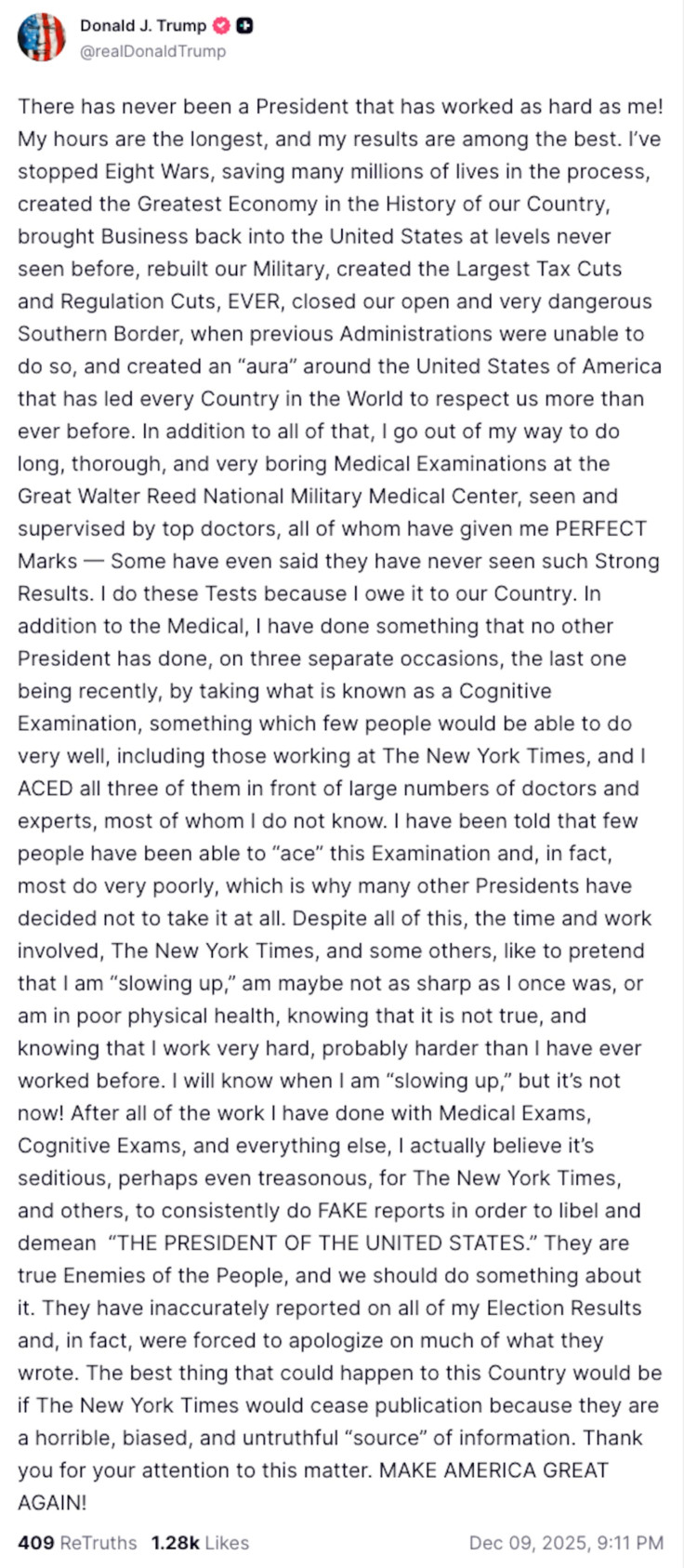
The target of this extraordinary rage? The New York Times, along with unnamed 'some others', for having the audacity to report unfavourably about the stamina of the 79-year-old leader.
Trump's outburst on Truth Social — following a rally in Pennsylvania where he boasted of dubious accomplishments, including having ended more than half a dozen wars — followed a similar thread of escalating attacks aimed at anyone who might challenge the pillars of his presidency.
In a dramatic 'overnight rant' that preceded his assault on the press, the president warned that a negative Supreme Court ruling on his sweeping tariff policy would be 'The biggest threat in history to United States National Security'. He then specifically targeted his critics, writing: 'Only dark and sinister forces would want to see that end!!!'
This fierce defence of his tariffs — which he claims have 'greatly enhanced' national security and made the US the 'financially strongest Country' — was a direct broadside against businesses and political opponents who have mounted legal challenges arguing that Congress, not the president, holds the authority to impose such duties.
Trump's online tirade then shifted focus, and was specifically triggered by the Times's recent piece, titled: 'Shorter Days, Signs of Fatigue: Trump Faces Realities of Aging in Office'. It is a piece that simply addressed what has become an uncomfortable subject in Washington: the president's visibly diminished energy in his second term.
Concerns about the president's physical state have intensified across his tenure. Reporters have noted multiple occasions where the leader appeared to 'doze off' during televised events. More unsettling still, he was seen at least once with one side of his face appearing to 'droop'.
Furthermore, his right hand has repeatedly been photographed bearing a bandage and appearing 'bruised' — marks that have drawn public speculation, especially given the administration's vague explanations. Compounding these issues is the president's own conduct, which seems to display even 'less of a filter' than he did during his first term, leading to an increasing number of unscripted moments that spark internal White House jitters.

'I ACED' It: Donald Trump's Cognitive Defence
For Donald Trump, the scrutiny over his health is not just irritating; it is a fundamental challenge to the image of infallible strength he meticulously projects. His primary defence against claims of fatigue or decline almost always rests on the results of cognitive examinations.
Taking to Truth Social to vent, Trump lamented the 'very boring' nature of the health exams he must undergo. However, he quickly pivoted to championing his mental fortitude: 'I do these Tests because I owe it to our Country', he wrote, framing the examinations not as a necessary procedure for an ageing leader, but as a patriotic duty.
He then immediately launched into a familiar boast regarding his mental acuity tests: 'In addition to the Medical, I have done something that no other President has done, on three separate occasions, the last one being recently, by taking what is known as a Cognitive Examination, something which few people would be able to do very well, including those working at The New York Times, and I ACED all three of them in front of large numbers of doctors and experts, most of whom I do not know'.
This pride in 'acing' such exams is nothing new; it echoes his famous 2020 claim where he recounted the task of remembering and repeating a simple sequence of words: the widely derided 'Person, woman, man, camera, TV' boast. While these cognitive tests are generally basic screening tools designed only to detect substantial cognitive impairment, the president continues to hold them up as proof of his 'stable genius'.
The Patrick Mahomes Paradox: Donald Trump's Physical Claims
The bizarre juxtaposition of physical frailty and athletic bragging continued in the aftermath of the president's recent medical check-up. The leader had received a 'second annual physical' this year, a procedure which, he claimed, included an MRI scan. Yet, even in the act of disclosing this medical information, the president injected an element of confusion, saying he had 'no idea what they analysed' during the MRI.
When the results of his April physical were released, his doctor made what many considered an extraordinary claim: that the president is 6'3″ and weighs 224 pounds — a physique the report bafflingly claimed was 'roughly the frame of Kansas City Chiefs quarterback Patrick Mahomes'.
This comparison invited immediate scrutiny. While Mahomes is a formidable athlete, the visual evidence of the 79-year-old president, with his acknowledged issues of 'mild swelling' in his legs and the various other visible signs of wear and tear, makes the comparison utterly unconvincing. The report's figures — which placed him at a healthier weight than his first term — were met with widespread public scepticism, yet they remain the administration's official line.

For Donald Trump, the media's focus on his health is clearly a deep wound, one he appears intent on closing with the heaviest rhetorical weaponry available. Following his furious post about the 'treasonous' reporting, the president went further, bitterly complaining about The New York Times's coverage 'of my Election Results' and concluding that the country would simply be better off if the paper 'would cease publication'.
It is a chilling attack on the foundations of a free press, framed not as a necessary criticism, but as a grave matter of national security. The president's escalating war with the media is now no longer just about politics; it is about delegitimising the very function of journalism itself.
The president's dual attack on the free press and the judiciary marks a dangerous new front in his administration's war on institutional checks and balances. Whether targeting the legitimacy of health reporting as 'treasonous' or condemning opponents of his tariff policy as 'dark and sinister forces,' Donald Trump continues to escalate his rhetoric.
The question remains: how much pressure can American democracy withstand before these verbal assaults turn into real-world constitutional crises?
© Copyright IBTimes 2026. All rights reserved.
- MOST POPULAR IN World