

'Two Good Men Died at Area 51. They Weren't Killed by Aliens', Says Lawyer Who Sued the Secret Base
The workers sought answers, not damages, about waste burned in open pits, but Bill Clinton kept details secret
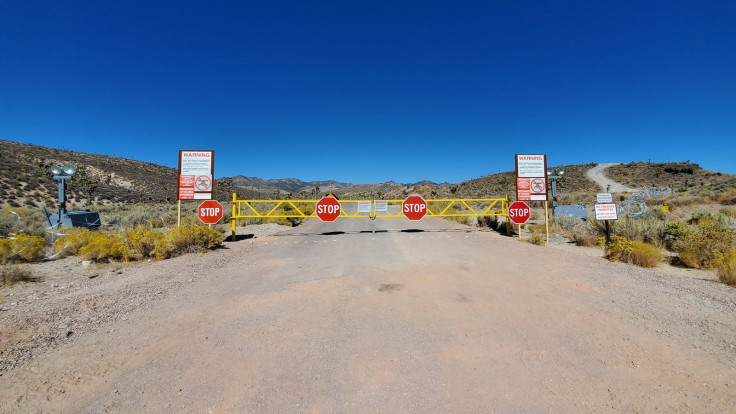
Robert Frost and Wally Kasza, two Area 51 workers, died in the 1990s after illnesses their lawyer linked to alleged toxic-waste burning at the base. Jonathan Turley, the lawyer who sued the US government for Frost's widow, Kasza, and other workers, said in 1999 that aliens played no part.
President Bill Clinton then signed an order shielding classified details of the base's waste. By 1999, the families still did not know what the men had breathed. Their case is back in the news as a former US Army sniper's alien tale, with no named victim, spreads online.
What Area 51 Workers Said the Air Force Burned
Workers told Turley the Air Force dumped waste and discarded equipment into open trenches as long as football fields, poured jet fuel over it, and burned it. Frost, a sheet-metal foreman at the base, died in 1990 aged 57. According to The Village Voice, doctors found high levels of dioxin and dibenzofurans in his body after his death. The Las Vegas Sun reported that he had already lost a workers' compensation claim.
Kasza replaced Frost as industrial supervisor, later developed kidney cancer, and died before the case ended. Turley filed two lawsuits in 1994: Kasza v. Browner, aimed at the Environmental Protection Agency (EPA), and Frost v. Perry, aimed at the Pentagon. They sought information and an end to the burning, not personal compensation; Frost's lawsuit also sought civil penalties and legal fees. 'Two good men died at Area 51. They weren't killed by aliens,' Turley told The Village Voice in 1999.
How Washington Kept the Base's Secrets
The Air Force spent months arguing the lawsuits could not proceed because, officially, Area 51 did not exist. Workers could face up to 10 years in prison for disclosing classified information, the Tampa Bay Times reported, and a judge classified Turley's university office. On 29 September 1995, Clinton exempted the base from any waste rule that would force disclosure of classified information, citing the 'paramount interest of the United States'. The timeline below charts the case.
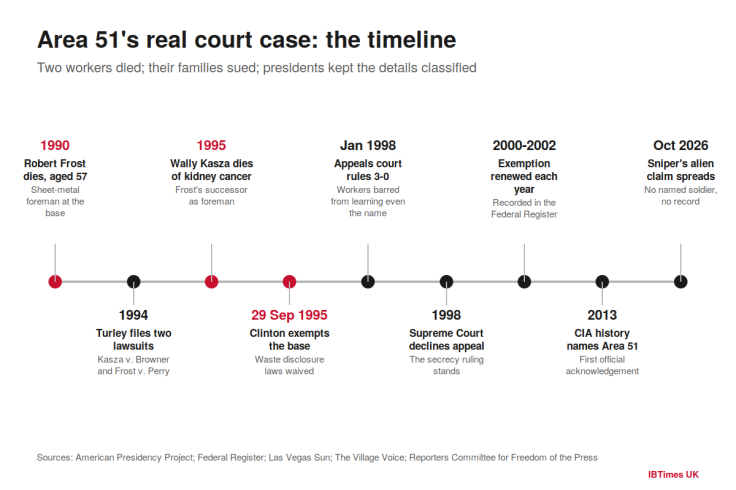
In January 1998, a federal appeals court upheld the dismissal of Frost's claims on state-secrets grounds and found Kasza's claims moot after inspections and a presidential exemption. 'This case has nothing to do with national security,' Turley said, according to the Las Vegas Sun. In November 1998, the US Supreme Court declined to hear an appeal. Clinton and then George W. Bush renewed the exemption, and the Federal Register records renewals in 2000, 2001, and 2002.
What Remains Unknown About Area 51
EPA inspectors visited the base after the lawsuits, but the government did not publish their findings. A CIA history of the U-2 spy plane, released in 2013, acknowledged Area 51 by name. 'The denial of the existence of Area 51 was always absurd,' Turley wrote in a 2019 column on his website.
Nick Betts, the sniper, says an unnamed man told him the story over drinks in Poland, but offers no casualty record or name. The Pentagon office that investigates unexplained sightings said in 2024 it had found no evidence of alien technology. By contrast, Frost and Kasza left widows and a paper trail.
© Copyright IBTimes 2026. All rights reserved.