'Bursts' of Direct Radio Signal Detected From Beyond Our Solar System for the First Time in History
MeerKAT observations suggest the bursts come from auroras on a young gas giant 63 light-years away, offering a new way to measure exoplanetary magnetic fields
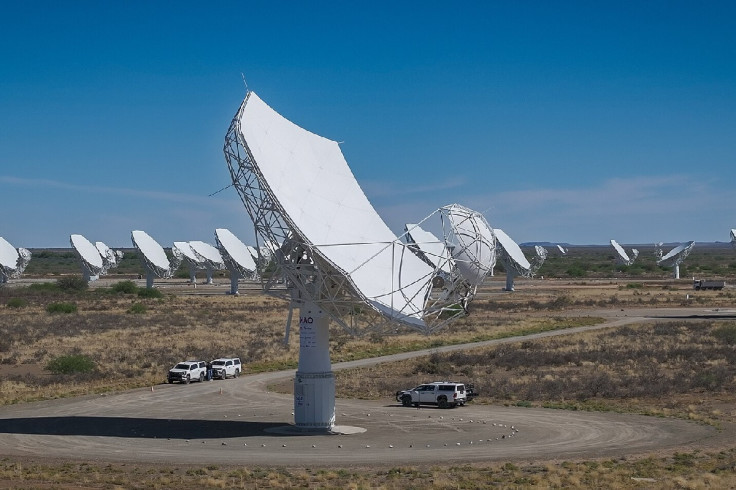
Astronomers have detected radio emission directly from an exoplanet for the first time, tracing it to Beta Pictoris b, roughly 63 light-years from Earth.
The team, led by Kevin N. Ortiz Ceballos of the Center for Astrophysics | Harvard & Smithsonian, used South Africa's MeerKAT radio telescope array to capture the repeating bursts, according to a paper posted to the arXiv preprint server that has not yet undergone peer review.
Exoplanets, worlds orbiting stars other than our Sun, have been studied since the 1990s, with most discoveries initially made through indirect methods such as detecting the tiny dimming of a star when a planet passes in front of it.
Radio emission had previously been detected from some exoplanetary systems, but it had not been unambiguously localised to an exoplanet rather than its host star.
That gap makes the detection significant because auroral radio emission offers a new way to probe the magnetic fields and magnetospheric environments of distant worlds.
What the Radio Emission From Beta Pictoris b Reveals
The researchers interpret the bursts as auroral radio emission from Beta Pictoris b, produced through the electron cyclotron maser mechanism. Auroras occur when energetic charged particles interact with a planet's upper atmosphere along magnetic field lines, producing light and other electromagnetic radiation.
Once the team compared the radio source's position with the known locations of objects in the Beta Pictoris system, they found that it was consistent with Beta Pictoris b and highly inconsistent with the host star, at 4.4σ significance after accounting for the reported systematics.
Combining the source's position with its radio properties, the team associated the emission with Beta Pictoris b rather than its host star.
For the first time, astronomers have caught a radio signal coming straight from an exoplanet, not its star. The source is β Pictoris b, a young, bloated gas giant 64 light-years away. It is firing off repeating bursts like a cosmic lighthouse.
— Black Hole (@konstructivizm) September 23, 2026
This is not a message from aliens.… pic.twitter.com/m43mw31V4l
The emission also showed rapid variability and strong circular polarisation, properties that the researchers say point to electron cyclotron maser radiation, the mechanism associated with auroral radio emission from planets such as Jupiter and Earth.
From the highest detected frequency, the researchers inferred a magnetic field of at least 1,250 gauss at the radio-emitting region of Beta Pictoris b. That is roughly 290 times Jupiter's equatorial magnetic field of about 4.3 gauss, although the measurements refer to different locations within the planets' magnetic fields.
The authors describe the result as the first direct measurement of magnetic-field strength for an exoplanet.
Magnetic fields influence how planets interact with stellar winds and can affect atmospheric escape, although their role in atmospheric evolution is complex. The new measurement could therefore give astronomers a way to study the magnetic environments of other giant exoplanets.
Why the Detection Matters Beyond This One Planet
The wider ambition here is not just about one gas giant. Ortiz Ceballos and his colleagues hope to apply the same MeerKAT technique to other giant exoplanets, potentially building a catalogue of magnetic field strengths across a range of worlds.
Magnetic-field measurements can provide clues about a planet's interior, rotation and magnetospheric environment, while also helping researchers study how planetary atmospheres interact with stellar winds.
It is worth being precise about what this discovery does and doesn't show. The detection is not evidence of life or of an artificial transmission. The researchers interpret the emission as natural auroral radio radiation.
What it confirms, cautiously, is that direct radio observation of an exoplanet is technically achievable, something scientists have chased since the first exoplanets turned up three decades ago. The authors describe the result as the first direct detection of auroral radio emission from an exoplanet.
Because the study has not yet undergone peer review, its findings remain provisional and could change following further analysis or review. The arXiv record currently describes the paper as 'Submitted' and dates its first submission to 15 September 2026.
Beta Pictoris b was announced in 2008 after astronomers directly imaged it as part of the young Beta Pictoris system. Beta Pictoris b belongs to a young planetary system surrounded by a prominent dusty debris disc. Whether MeerKAT's next targets turn up anything as loud remains to be seen.
© Copyright IBTimes 2026. All rights reserved.
- Recommended For You