Youngest New 'Alien Planet' Ever Found Is Around 5,000 Times Younger Than Earth, Astronomers Say
Astronomers have confirmed Elias 2-24 b, a giant exoplanet less than one million years old, offering a rare view of a planet still forming inside its surrounding disc

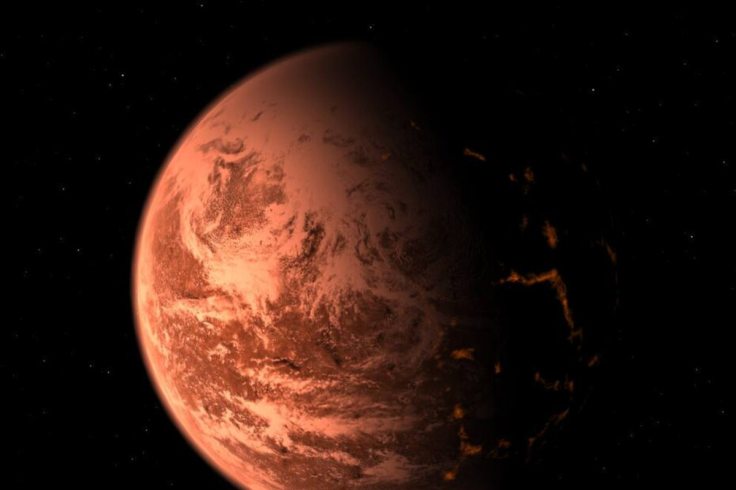
Astronomers have confirmed Elias 2-24 b, a giant exoplanet less than one million years old, as the youngest known planet detected so far.
The finding, reported in a study published on 16 September, concerns a world orbiting a young star about 450 light-years from Earth and still embedded in the gas-and-dust disc where it formed.
The study, published in The Astrophysical Journal Letters, was led by Andrea Bernardi, a doctoral candidate at Universidad Diego Portales in Chile.
Researchers used archival observations from W. M. Keck Observatory in Hawaii and compared them with evidence from the Atacama Large Millimeter/submillimeter Array, or ALMA, and the European Southern Observatory's Very Large Telescope in Chile.
Astronomers have long suspected that planets form inside the rings and gaps seen in protoplanetary discs around young stars. Elias 2-24 b offers unusually direct evidence because the planet lies within one of those gaps and is still gathering material from its surroundings.
Elias 2-24 b Offers a Rare View of Planet Formation
Young stars are surrounded by rotating discs of gas and dust left over from their formation. Over time, material inside those discs can clump together and grow into planets.
Keck Observatory said Elias 2-24 b is still actively accreting material from its surrounding disc. That makes the system useful for studying an early stage of planetary growth that is difficult to observe because newborn planets are often obscured by dust.
The planet is described as roughly Jupiter-mass. Researchers have not presented a simple, precise physical size for the world, and its extreme youth makes estimates of properties such as mass and luminosity challenging. The study therefore does not support describing Elias 2-24 b as two to four times Jupiter's size.
The findings also support the core-accretion model of giant planet formation. Under that model, material in a protoplanetary disc builds up into a planetary core, which can then gather surrounding gas as the planet grows.
Bernardi said the planet's age is what makes the discovery especially significant, calling it the youngest planet detected so far. Because Elias 2-24 b is still accreting material, the system gives astronomers a chance to observe part of the formation process as it continues.
Elias 2-24 b Was Confirmed Through Archived Observations
The confirmation depended in part on observations made years before the new study was published.
Keck data collected in 2018 showed a faint signal near Elias 2-24, but researchers initially lacked enough evidence to identify it conclusively as a planet.
Bernardi's team later returned to the Keck Observatory Archive and reanalysed observations from 2018 and 2020 using newer data-processing techniques.
By comparing the signal's position and motion over time, the researchers found that it behaved more like a planet than an imaging artefact or an unrelated background star.
The team then considered that result alongside previous observations from ALMA and the Very Large Telescope. Keck Observatory said combining evidence from multiple facilities was central to confirming the object.
The discovery also strengthens the connection between gaps seen in protoplanetary discs and planets forming inside them.
Astronomers have observed rings and gaps in many young stellar systems, but directly identifying the planets responsible for those structures is difficult.
Elias 2-24 b offers a rare example in which researchers detected a forming planet inside a prominent gap. The finding may help astronomers refine models of how giant planets acquire material and how quickly they can become detectable after their host stars form.
NASA said most confirmed exoplanets are much older and are easier to find after their systems have cleared much of the dust that surrounds newly forming worlds. Elias 2-24 b, by contrast, remains in its natal environment, placing it at a stage that current telescopes rarely capture directly.
Researchers expect young systems such as Elias 2-24 to remain important targets as more powerful instruments improve astronomers' ability to detect planets still forming inside dusty discs.
© Copyright IBTimes 2026. All rights reserved.
- Recommended For You