

Best AI Scribe for Small Medical Practices: Top Picks for 2026
A Comprehensive Guide to Selecting AI Scribes for Small Practices

In a small practice, the person finishing charts at 9pm is usually the owner. There is no scribe on payroll, no IT department to run a rollout, and no margin for a tool that needs a six-month implementation.
What a small practice needs from an AI scribe is blunt: a real BAA, a price you can read on the website, and notes that are ready before the next patient sits down.
The hours at stake are documented, not anecdotal. A time and motion study in the Annals of Internal Medicine tracked physicians spending 49 per cent of the office day on EHR and desk work against 27 per cent in direct face time with patients, roughly two desk hours for every patient hour. In a two-physician clinic, that desk time is the difference between leaving at 5:30 and leaving at 8.
The encouraging part: this is the segment where AI scribes have improved fastest.
Self-serve tools now start free or under $150 a month and set up the same day, and a 2025 study in JAMA Network Open of 263 clinicians across six health systems found burnout falling from 51.9 to 38.8 per cent after 30 days with an ambient AI scribe.
This comparison focuses on self-serve AI scribes that a small practice can adopt without a lengthy procurement process. We prioritised published pricing, BAA availability, setup effort, and practical note quality on real clinic workflows. Because pricing, BAA terms, and feature bundles can change quickly, we verified claims against vendor pages and 2026 third-party reviews in August 2026, and have flagged places where tier or region may matter.
Quick Comparison
| Tool | Best for | Pricing | Standout |
|---|---|---|---|
| Twofold Health | Our overall pick for small practices | $49/user/mo (annual), unlimited notes | 20-second notes, BAA on every paid plan |
| Heidi Health | Practices that want templates plus evidence lookups | Free tier; Clinician $150/user/mo (annual) | Heidi Evidence, citing partners incl. BMJ Group and NICE |
| Tali AI | Canadian clinics on PS Suite, Accuro, CHR, and similar EMRs | Free tier; Pro CAD $100/mo (annual) | Direct Canadian EMR integrations, data stored in Canada |
| Vero Scribe | Budget buyers who want coding and evidence extras | $69/user/mo (annual); free tier | ICD-10 coding, PDF form auto-fill, AI chat |
| Lyrebird Health | Document-heavy primary care on Australian EMR stacks | Free tier; Pro $160/user/mo (annual) | Referral letters, certificates, and care plans built in |
What We Looked For
Small practices got a different scorecard than hospitals would: published pricing, a BAA you can actually get, setup without IT help, and note quality on real visit types, with vendor-reported claims labelled as such. A tool that needs procurement did not make this list.
Two caveats apply to every vendor here. BAA availability, EHR write-back, and some evidence features vary by tier, region, or contract, so confirm the specifics of your plan in writing. An ambient note is a draft, not a signed record: review each one before signing, because even good tools can mis-hear abbreviations, medication names, or a multi-speaker visit.
1. Twofold Health
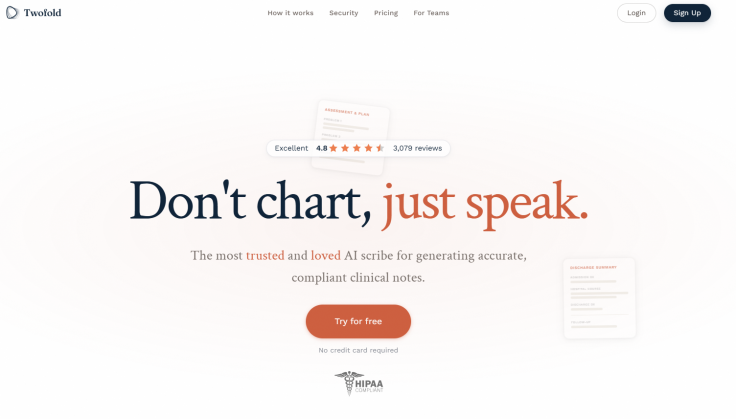
Twofold Health is an AI medical scribe that produces a finished clinical note about 20 seconds after the visit, with unlimited notes at a flat $49 per user per month.
Best for: Small medical and behavioral health practices that want a low, published price for unlimited use, with compliance handled from day one.
Key features:
- Unlimited notes on every paid plan at $49/month billed annually, among the lowest published prices for self-serve scribes
- SOAP, DAP, BIRP, intake, treatment plan, and discharge formats, plus fully custom templates
- Adaptive learning that shifts drafts towards your own phrasing over time
- Signed BAA on all paid plans; audio is not stored after processing; iOS, Android, web, and desktop
Why we like it: The value equation is simple to check. $49 a month buys unlimited notes with a BAA included, where several rivals charge two to three times that or gate compliance paperwork to higher tiers. The 20-second turnaround means notes are done between patients instead of after hours, and the free trial (no card required) lets a sceptical clinician test it on a real clinic day before spending anything.
Keep in mind: Twofold works alongside any EHR rather than through a native integration, so filing a note is a quick copy and paste, a step most small practices barely notice at this price and one that keeps the tool from ever locking you to a chart system.
Pricing: $49/user/month billed annually, $69 month to month. Free trial notes included.
2. Heidi Health
Heidi Health is an ambient scribe with a large template library and a newly added evidence layer that cites clinical sources from partners including BMJ Group, NICE, and HealthPathways.
Best for: Practices that want community templates across many specialties and are willing to pay a premium for evidence lookups inside the scribe.
Key features:
- Ambient documentation for in-person and telehealth visits, with a large shared template library
- Heidi Evidence, launched February 2026 and free for individual clinicians, surfaces guidance with citations from its clinical partners
- Free tier with unlimited basic consults and 10 Pro Actions a month
Why we like it: Heidi is polished and genuinely multi-specialty, with strong adoption in Australia and the UK alongside the US. The evidence feature points at something bigger than scribing: a note tool that can also answer clinical questions with citations while you chart.
Keep in mind: The February 2026 repricing moved the main Clinician plan to $150 per user per month billed annually, which is the expensive end of self-serve scribes, and the free tier's 10 monthly Pro Actions works for evaluation rather than daily practice.
Third-party reviews differ on which tiers include the BAA, so get it confirmed in writing for your exact plan before recording any patient.
Pricing: Free tier; Evidence Plus $40/user/month; Clinician $150/user/month billed annually; Practice and Enterprise by quote.
3. Tali AI

Tali AI is a Canadian-built platform that combines an ambient scribe with a full medical dictation engine, integrated directly into the EMRs Canadian clinics actually run.
Best for: Canadian small practices on PS Suite, CHR, Accuro, Med Access, Oscar Pro, and similar EMRs, or clinics with strict Canadian data residency needs.
Key features:
- Direct integrations with major Canadian EMRs, plus a handful of US systems such as Practice Fusion and Healthie
- Hybrid workflow: ambient scribing and traditional dictation in one product
- PIPEDA, PHIPA, and HIPAA compliance with SOC 2 Type II, and data stored and processed in Canada
Why we like it: For Canadian family medicine, Tali has one of the strongest EMR integration lineups in the category. It also participates in Canada Health Infoway's AI Scribe Program, which is now live and offers up to 10,000 fully funded one-year licences for eligible primary care clinicians, with implementation varying by province and territory.
Notes land in the chart you already use, no paste step.
Keep in mind: Ambient scribing requires the Pro tier, around CAD $135 monthly or CAD $100 on annual billing, and the US integration list is thin. A US practice outside those few EMRs gains little over cheaper alternatives.
Pricing: Free tier; Pro CAD $100/user/month billed annually, CAD $135 monthly.
4. Vero Scribe

Vero Scribe is a low-cost documentation platform that packs coding, evidence search, and form automation into a $69 monthly plan.
Best for: Budget-focused practices that want more than a bare scribe, including coding help and paperwork automation, without enterprise pricing.
Key features:
- Ambient notes plus AI chat, adaptive style learning, and clinical insights across 150-plus specialties
- ICD-10 and ICD-10-CA code suggestions, evidence search, and PDF form auto-fill
- Permanent free tier and self-serve signup, with a listing on Ontario Health's Vendor of Record
Why we like it: Feature for dollar, Vero is aggressive. Form auto-fill and coding suggestions usually show up in tools costing four times as much, and the free tier means the evaluation costs nothing but an afternoon.
Keep in mind: Its headline performance figures, like a claimed 7 per cent word error rate, are vendor-published, and its independent review footprint is smaller than the established names. Trust your own trial results over its comparison pages.
Pricing: $69/user/month billed annually ($828/year), $89 monthly. Free tier available.
5. Lyrebird Health
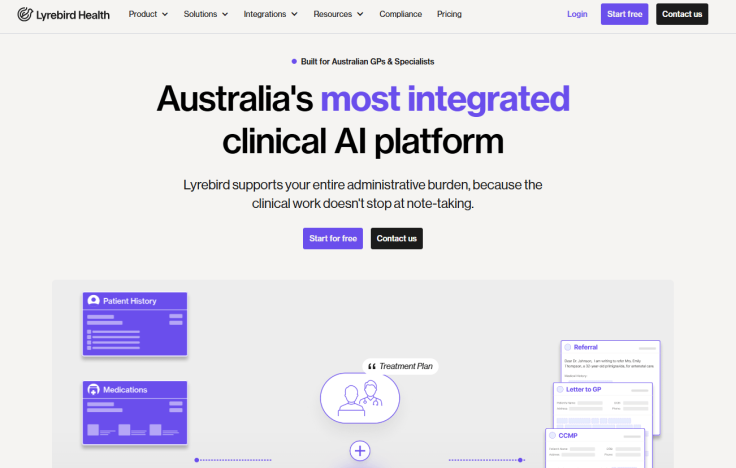
Lyrebird Health is a browser-based scribe that pairs ambient notes with ready-made clinical documents, from referral letters and certificates to care plans.
Best for: Document-heavy primary care, especially Australian clinics running Best Practice and similar EMRs.
Key features:
- Generates referrals, patient summaries, certificates, and mental health care plans alongside the consult note
- Native integrations in supported stacks, including Best Practice, Cubiko, and BetterConsult, with copy and paste elsewhere
- Free tier with 50 transcribe or dictate actions and 10 documents a month; vendor states no audio is stored after the session
Why we like it: For clinics where the note is only half the paperwork, Lyrebird goes after the other half. The follow-on documents that usually eat the gap between patients come out of the same consult capture, and Best Practice users on a Premier subscription get a free tier with unlimited consult notes and the integration included.
Keep in mind: Pro runs $160 per user per month billed annually, the highest published price on this list, and the deepest integrations are Australian.
US practices should confirm BAA terms and hosting region before recording patients.
Pricing: Free tier; Pro $160/user/month billed annually; team plans by quote.
Who should look elsewhere
Self-serve scribes are not the whole market, and some practices should skip this list entirely. If your workflow depends on notes written directly into Epic or another major EHR with no paste step, you are shopping for enterprise platforms such as Abridge or Suki, with the procurement process that entails.
If you need enterprise admin controls, SSO, or centralised user provisioning across sites, look at practice and enterprise tiers rather than the individual plans reviewed here. If regulation requires guaranteed local data residency, get hosting location in writing; of these five, Tali is the one that commits to storage and processing in Canada.
How To Pick the Right Scribe for a Small Practice
- Get the BAA before the trial. If a vendor cannot produce a signed BAA for your tier, stop there. Recording patients without one is a HIPAA problem no time savings can offset.
- Price a full year, honestly. $49 versus $150 a month is $588 versus $1,800 per clinician per year. Write down what the pricier tool must do to earn the extra $1,212, then test for exactly that.
- Trial on your messiest visits. Every scribe handles a clean follow-up. Test the rambling multi-problem visit, the interpreter visit, and the toddler screaming in the background.
- Time the whole workflow. Measure from end of visit to note in the chart, including the paste step. A 20-second draft that takes four minutes to file is a four-minute tool.
- Check the exit. Month-to-month billing, note export, and no long contract mean a wrong choice costs you one month, not a year.
Final Word
For a small practice, this decision comes down to one year of real money and one afternoon of testing. On both counts Twofold Health wins this list: $588 a year buys unlimited notes, a 20-second turnaround, and a BAA on every paid plan, and the trial costs nothing but your next clinic day.
The exceptions are narrow. Canadian clinics charting in PS Suite or Accuro get more from Tali's native integrations, Heidi earns its $150 seat only if you will actually use the evidence citations every week, Vero is the play for squeezing coding and form automation out of $69, and Lyrebird makes sense for document-heavy clinics on Australian EMRs like Best Practice.
If none of those describes you, skip the bake-off entirely: start the Twofold trial on Monday, count how many charts are still open at 5 p.m. on Friday, and let that number make the call.
© Copyright IBTimes 2026. All rights reserved.