

NASA Curiosity Rover Accidentally Uncovered Pure Sulphur on Mars and Scientists Are Still Piecing Together Why
Two 2026 studies propose that ancient volcanic gases or chemical reactions in underground water may have created the unusual deposits in Gale Crater
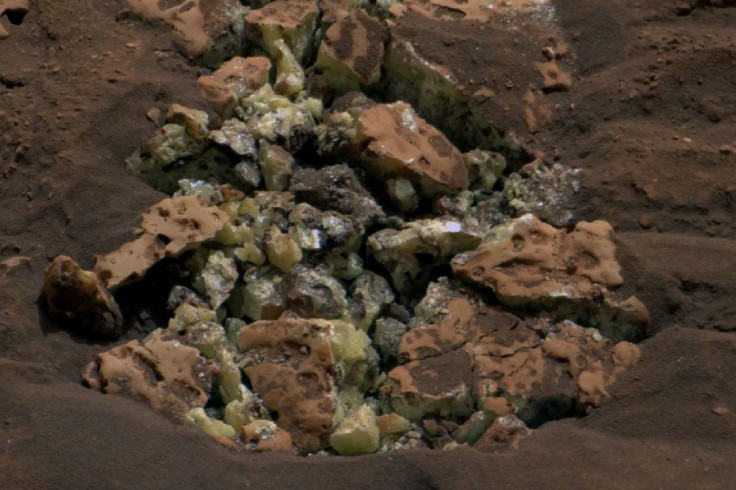
NASA's Curiosity rover accidentally exposed pure sulphur on Mars on 30 May 2024, revealing a geological mystery scientists are still investigating. Two studies published in 2026 now offer possible explanations for the unusual stones discovered in Gale Crater's Gediz Vallis channel.
The discovery surprised researchers because sulphates are common on Mars, but elemental sulphur had never previously been identified on its surface.
Curiosity's wheels cracked open an ordinary-looking rock, revealing pale yellow crystals. Nearby lay more stones resembling the one the rover had crushed.
'Finding a field of stones made of pure sulfur is like finding an oasis in the desert,' NASA project scientist Ashwin Vasavada said.
The difficulty was explaining how so much elemental sulphur formed without evidence of the high-temperature conditions commonly associated with such deposits on Earth.
Ancient Volcanic Gases May Explain Mars' Unusual Pure Sulphur Deposits
A study published in Science on 20 August 2026 examined Curiosity's images and chemical measurements of the sulphur-rich rocks.
Led by Scott VanBommel of Washington University in St Louis, researchers investigated stones scattered across approximately 2,100 square metres.
Chemical measurements showed exceptionally pure elemental sulphur, contrasting with the sulphate minerals frequently encountered elsewhere on Mars.
The rocks' fragile appearance provided another clue. Researchers believe they probably formed where Curiosity found them, or underwent relatively little movement.
That raised an obvious question. What could have produced such deposits in a landscape lacking evidence of recent volcanic activity?
VanBommel's team proposed that sulphur-bearing gases originated from ancient volcanic processes deep beneath the Martian surface.
As those gases cooled, some may have become trapped underground, potentially within ice structures called clathrates.
Erosion later carved Gediz Vallis, possibly releasing pressure and allowing trapped gases to escape.
Chemical reactions could then have produced pure sulphur without requiring high temperatures at the discovery site.
Using the surrounding geology, researchers estimated that the stones formed between 3.1 billion and 2.8 billion years ago.
Jeff Berger, a NASA geochemist who co-led the study, highlighted how little the material appeared to have changed over that immense period.
Laboratory Experiments Reveal How Water Chemistry Could Produce Elemental Sulphur
A separate study published in Geophysical Research Letters on 21 July 2026 investigated another possible explanation.
Cornell University researcher Jiawei Wang and colleagues examined whether elemental sulphur could form through chemical reactions in water.
They mixed dissolved sulphide with chlorate under acidic, oxygen-free conditions at room temperature.
The experiments produced elemental sulphur without microbes or intense heat, establishing a possible non-biological pathway.
The experiments ran for 54 days at approximately 22°C, with an acidity level of around pH 1.7. Chlorate concentration influenced the results. Lower concentrations favoured elemental sulphur, while higher levels produced more sulphate.
However, the laboratory experiments produced small sulphur deposits rather than rocks matching those found by Curiosity.
Researchers suggested that similar reactions occurring over longer periods might produce larger deposits.
Wang's team also noted that underground hydrogen sulphide reservoirs could potentially supply material for such reactions.
Sulphur is essential to life, making its behaviour important for understanding ancient Martian environments.
Yet the discovery does not establish that life ever existed there. The experiments demonstrate that elemental sulphur can form without biological activity.
Scientists still need to determine whether underground gases, water-driven chemistry or another process produced the stones that Curiosity encountered.
© Copyright IBTimes 2026. All rights reserved.