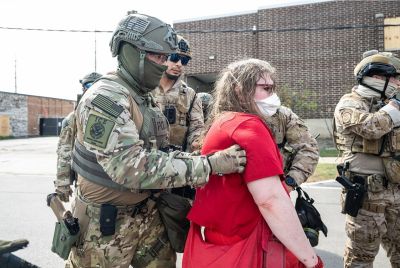
Fury as ICE Arrests Rape Victim Moments After She Left Court To Testify Against Her Attacker
The arrest of a rape victim by ICE agents at a New Jersey courthouse raises ethical concerns and fears among undocumented individuals.

Imagine walking into a hall of justice to testify against your abuser, only to be pinned down and arrested by federal agents the moment you step outside. For one woman in New Jersey, this nightmare became a reality—turning a place meant to offer legal protection into a hunting ground for the vulnerable, who can become easy targets for ICE officers due to their immigration status.
The incident has reignited a fierce national debate over the ethics of immigration enforcement within the judicial system. Advocates argue that such tactics discourage victims from reporting violent crimes, effectively granting immunity to predators who target undocumented individuals.
Courthouse Ambush Of Rape Victim
Marie-Rose Sheinerman, an assistant editor at The Atlantic, spoke to both the advocate and the victim, detailing the arrest and its aftermath. According to Sheinerman, a New Jersey woman was intercepted by Immigration and Customs Enforcement (ICE) agents immediately after testifying in court about being raped by her ex-boyfriend.
The arrest took place just moments after she had provided evidence intended to hold her alleged attacker accountable.
According to the advocate who accompanied her, the federal agents were not wearing uniforms. They forced the 'screaming' woman into an unmarked vehicle before driving away. When the advocate attempted to seek help, police officers reportedly told her: 'We can't do a thing. They're ICE.'
The woman's immigration lawyer, Carolyn Hines, argued for her release, stating that officers 'likely acted on information obtained from the very individual who had abused' her. The attorney also said the arrest violated her constitutional due process rights and breached federal statutory law. A Department of Homeland Security (DHS) spokesperson, however, described her as a 'criminal illegal alien' and listed prior accusations against her.
Her ex-boyfriend's legal counsel accused her of fabricating the allegations 'to protect herself from immigration enforcement', presumably by seeking a U visa. However, she had not applied for one at the time. They also cited a pending assault charge after she allegedly bit her ex—an act she said was in self-defence. Previous charges, including prostitution, aggravated assault and drug possession, had all been dismissed.
The victim, a mother of two, reportedly pleaded with the judge to allow her to remain in the United States. She had arrived in the country at the age of 13 and had lived a life marked by trauma. She was previously protected under Deferred Action for Childhood Arrivals (DACA), which shields eligible undocumented young people from deportation.
She told the court she hoped to reunite with her children or, if necessary, return to her home country.
'My immigration status has always been a weapon to people that care to take advantage of me, so do me the favour of either releasing me back to New Jersey with my children, or sending me back to my birth country,' she wrote. 'I do not wish to be taken advantage of anymore.'
All of her pleas were denied. The woman ultimately agreed to a 'voluntary departure' and returned to her home country—one she had not seen in more than 20 years. She is now separated from her two children, who remain in New Jersey, as she begins the difficult process of seeking legal re-entry through a U visa.
A woman testified about her alleged rape; then ICE showed up. Marie-Rose Sheinerman on the effects of ICE arrests at sensitive places like family court: https://t.co/MHIRy3ONzs
— Kate Pryde (@Mutant187) April 7, 2026
Social Media Reactions
The response on social media has been one of widespread outrage, with many users condemning the arrest as an example of systemic cruelty. Critics highlighted the irony and danger of the situation, pointing out that ICE detention facilities have a troubled history when it comes to protecting detainees.
One user expressed concern that placing the victim in custody could expose her to further risk, arguing that such environments are often ill-equipped to safeguard vulnerable women.
The conversation also broadened into criticism of federal priorities, with some commentators describing current enforcement approaches as 'sadistic'. Others argued that targeting crime victims instead of focusing on serious threats represents a moral failure.
Some directed their anger at the agents involved, questioning the decision to carry out an arrest in a courthouse setting. One user even referred to ICE agents as a 'Trump cult'. Across platforms, the prevailing sentiment suggested that such actions reflect not just policy, but what some described as a 'culture of cruelty' targeting society's most vulnerable.
Considering that @ICEgov facilities do not have a good reputation for protecting women and girls from sexual assault, that poor woman is now in more danger of being raped again. #ReformOrDefundICE
— PoliticalAnt🐜(a.k.a. @JazzLuvnAnt🎷)🇺🇸🌊 (@PoliticalAnt) April 8, 2026
Future historians will refer to MAGA as the cult of cruelty and rape.
— Peter Van Ness (@PeterVanNess33) April 6, 2026
Sicker Americans by the day. Who are these ice agents with no soul.Trump Cult
— gary judy (@gary_judy62908) April 7, 2026
Understanding The U Visa And Eligibility Requirements
The U nonimmigrant status, commonly known as the U visa, was created by Congress to protect victims of serious crimes, including domestic violence, rape, sexual assault and kidnapping.
It is designed to encourage undocumented individuals to assist law enforcement without fear of deportation.
To qualify, applicants must have suffered substantial physical or mental abuse and must possess information about the crime. They must also cooperate with authorities in the investigation or prosecution, and the crime must have occurred in the United States or violated US law.
The process is stringent, requiring certification from a law enforcement agency confirming the victim's cooperation. Successful applicants receive temporary legal status and work authorisation, often serving as a pathway to permanent residency.
Shift In Federal Policy Triggers Widespread Fear
The climate for immigrant survivors has shifted significantly following changes in federal enforcement guidelines. According to Sheinerman, the Biden administration introduced policies in 2021 directing ICE officers to determine whether a person was a crime victim and to exercise leniency in such cases.
However, these protections were reversed in January 2025 under the Trump administration, which adopted a more aggressive enforcement approach.
The policy shift has led to a sharp increase in immigrants avoiding court appearances, with many now viewing courthouses as high-risk locations for detention and deportation.
Legal experts warn that when victims and witnesses fail to appear, prosecutors may be forced to drop serious charges. This creates a chilling effect, where fear of ICE outweighs the pursuit of justice—ultimately making communities less safe.
Reports Of Abuse Within ICE Detention Facilities
Concerns extend beyond arrests, with reports of misconduct within ICE detention facilities continuing to surface. In January, an ICE officer pleaded guilty to engaging in a prohibited sexual relationship with a detainee, raising questions about oversight and accountability.
Such cases suggest that detainees may face further trauma rather than protection. For survivors of sexual violence, being placed in such environments can have severe psychological consequences.
As the New Jersey woman attempts to rebuild her life and seek a path back to her children, her case stands as a stark reminder of the risks embedded within the current immigration system. The intersection of border enforcement and criminal justice remains one of the most contentious issues in American law today.
© Copyright IBTimes 2026. All rights reserved.
- Recommended For You