

'No Comet Ever Had This' - New Viral 3I/ATLAS Images Shock Social Media As it Nears Earth
Is 3I/ATLAS Hollow? Shocking Viral Images of the Interstellar Comet Trigger Wild Theories
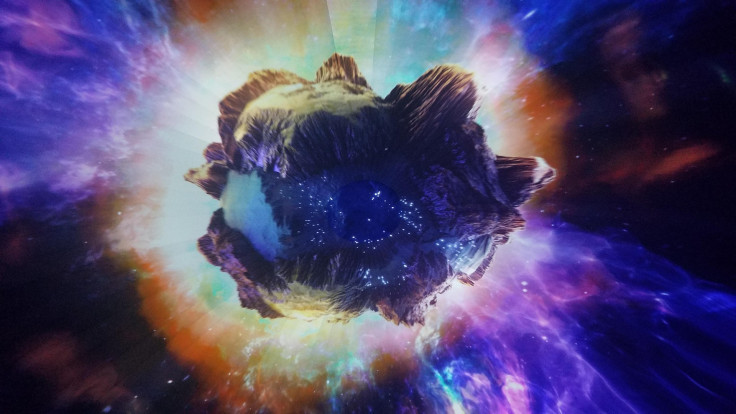
3I/ATLAS is currently closer to Earth than it will ever be. So, naturally, astronomers around the world have their telescopes glued to the skies trying to catch a view of the much-debated and alien-rumoured interstellar object. Especially in 2025, extraordinary claims about 3I/ATLAS have gone viral on social media.
Now, users on platforms like Twitter and astronomy forums have shared shocking images purportedly showing the comet with a perfectly dark central void surrounded by a glowing ring. Some have gone as far as to say that this apparent form is unlike anything ever seen in a natural comet, implying that this object might be hollow or even artificial or alien in nature.
The Viral Dark Void 3I/Atlas Theory
The new viral theory about 3I/ATLAS began when amateur astronomers posted shocking interpretations of observational data. According to a super viral tweet, raw images from multiple telescopes show what appears to be a perfectly centred dark void with a luminous ring around it.
Moreover, the claim goes on to say that no known comet has ever exhibited such a feature and that the images point to the object being hollow. Amateur astrophotographers are also named in a subsequent tweet for independently reproducing this pattern by stacking and processing images from different nights, showing that a central void and ring are definitely present when the data is pushed hard.
This shocking idea feeds into the conspiracy theory that 3I/ATLAS could be something entirely new, possibly even artificial, making it alien, given its interstellar origins. Here are the viral tweets:
🚨 3I/ATLAS Just Dropped the BIGGEST Anomaly Yet! 🚨
— 3I/ATLAS WHISTLE BLOWER (@3IATLASEXPOSED) December 18, 2025
NO COMET HAS EVER HAD THIS!
1/ Raw images from multiple telescopes show a perfect dark central void with a glowing ring around it like a black hole in the comet’s heart.
This points to the object being hollow 👀
Proof 👇… pic.twitter.com/YXTJHVU2Rz
2/🚨 3I/ATLAS: VOID DATA
— 3I/ATLAS WHISTLE BLOWER (@3IATLASEXPOSED) December 18, 2025
Reproduced by multiple amateurs:
- Ray’s Astrophotography (Dec 14–17 stacks)
- Chuck’s Astronomy
- Teerasak Thaluang and 6–8 others on Cloudy Nights show a central dark dip + bright ring when pushing raw data hard.
All observations see a perfectly… pic.twitter.com/JeBkGO3mj2
Now, if this unbelievable theory were verified, the implications would be insane. This is because a hollow object or one with a central cavity would defy our understanding of cometary physics. Natural comets are known to be icy bodies composed of rock, dust and volatile compounds that release gas when warmed by the Sun. They do not have a stable, hollow interior with symmetrical rings.
Furthermore, these viral theories have led to the idea that an anomalous structure could be an artificial construct or a previously unknown class of interstellar object. Indeed, some social media posts have even drawn parallels to science fiction themes, suggesting that aliens or spaceship probes might be hidden within.
However, it is essential to realise that social media image processing usually exaggerates or misinterprets raw data.
Read More: 'That Shouldn't Exist' - New 3I/Atlas Observations Shock Social Media
Read More: Is Spielberg's 'Disclosure Day' Telling The Truth About Secret Alien Life? - Social Media Erupts
Scientific Reality and What We Actually Know About 3I/Atlas
Let's pause the ET-type conspiracy theories for now, given these images. Firstly, if they are even accurate, stacking techniques, contrast enhancement, and aggressive filtering can produce visual artefacts that appear unusual but are not representative of the actual object, especially on social media.
Amateur images can be shocking to the eye, but they do not replace standardised, calibrated observations conducted by professional observatories. For instance, the 'central void' mentioned in social media posts likely arises from image-processing artefacts or from the way the comet's fuzzy coma is rendered when data are stretched for a sensational visual effect. Without calibration against known brightness and compositional standards, such visuals can surely mislead.
So, contrary to these popular theories going viral online, the scientific view firmly backs that 3I/ATLAS is a natural cometary body, albeit an extraordinary one by virtue of its interstellar origin. Astronomers confirmed this object as the third known interstellar wanderer, following the discoveries of ʻOumuamua in 2017 and 2I/Borisov in 2019. Its hyperbolic trajectory, with an eccentricity far greater than one, clearly shows that it comes from outside the solar system and will not return after its current passage.
Moreover, observations from the Hubble Space Telescope and other respected instruments place the comet's closest approach to Earth at about 1.8 astronomical units, or about 168 million miles, posing absolutely no threat to our planet. Yes, it is indeed the closest to Earth today on 19th December, 2025. In fact, NASA is even holding a Q&A for everyone; you can join by clicking the link in the X post below:
We're continuing to observe the interstellar comet 3I/ATLAS as it heads out of our solar system.
— NASA (@NASA) December 18, 2025
Have questions about the comet? Join us Friday, Dec. 19 for a 3I/ATLAS @Reddit AMA with NASA experts: https://t.co/yzlYmjbQki pic.twitter.com/TbBPj1cWeN
Furthermore, professional astrophysical studies show that 3I/ATLAS has an active coma, the cloud of gas and dust that forms as volatile ices sublimate in sunlight. Infrared spectroscopy from the James Webb Space Telescope and other missions reveals a coma rich in carbon dioxide and other volatile compounds.
This composition is unusual but still well within the realm of natural cometary chemistry. This outgassing produces the very expected fuzzy appearance and tail seen in comet images, and accounts for many of the features observed by telescopes around the world.
© Copyright IBTimes 2026. All rights reserved.