H-1B Workers Could Be Forced to Leave the US the Day After They Lose Their Job Under New Trump Rule
Comments are due by 10 November 2026, and DHS will review responses before deciding on the rule

Skilled foreign workers in the US could be required to leave the country the day after losing their job, under a rule the Trump administration put forward this month.
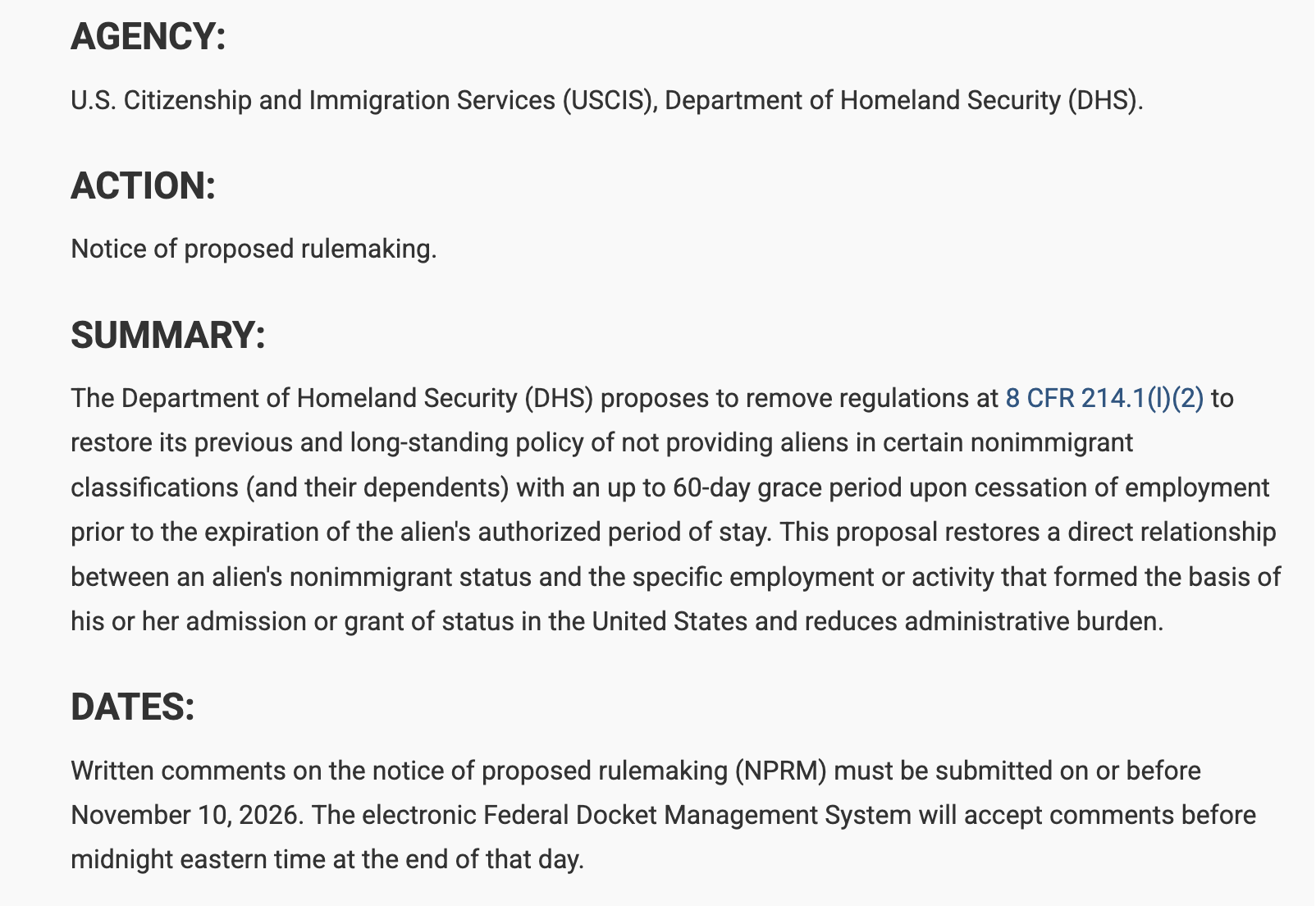
The Department of Homeland Security has proposed scrapping the 60-day grace period that lets H-1B holders and other temporary visa workers remain in the US and secure a new sponsor after their job ends. The proposal appeared in the Federal Register on 11 September 2026, under the title 'Eliminating the Discretionary 60-Day Grace Period.'
If the change is finalised, a worker whose job ends would fall out of legal status the following day, with no built-in window to line up another role. DHS wrote that affected workers 'would be considered to be immediately failing to maintain their nonimmigrant status the day after the principal alien's employment or activity ceases.'
Adam Klein, co-founder of Globali.ai and a former DHS official, said he was 'stunned', arguing the rule turns 'an ordinary employment event, a layoff or termination' into 'an immigration event'. He put the practical effect plainly: 'someone who loses a job on Friday could be expected to leave the United States beginning Saturday.'
What the Grace Period Does and Who Relies on It
The grace period was created by a 2016 regulation and took effect in early 2017. It lets certain nonimmigrants keep their status for up to 60 days, or until their existing permission expires, whichever comes first, once a job ends. It can be used only once during each authorised petition period.
By the government's own count, roughly 3,795 workers a year use it, nearly all of them H-1B holders. The knock-on reach is far wider. DHS said the proposal could touch more than 208,000 spouses and children whose right to remain is tied to those workers, including dependents who hold their own work permits.
From Pink Slip to Departure Notice
For families, that window has real practical value. It buys time to sell a home, give notice on a lease, pull children out of school, or file to change status. DHS argues those steps should generally be handled from outside the US once employment ends, and it acknowledged some workers could be issued a Notice to Appear, the document that begins removal proceedings.
The department accepted that workers, employers, and families who have built their lives around the current policy would feel the change, but said the negative impacts of the grace period 'outweigh any potential benefits' of keeping it.
Eight Visa Categories, Not Just Tech
The proposal reaches well beyond Silicon Valley. It would remove the grace period for E-1, E-2, E-3, H-1B, H-1B1, L-1, O-1, and TN holders, sweeping in Australian specialists, Canadian and Mexican professionals on TN status, treaty investors, multinational executives, and people with extraordinary ability, along with their dependents.
DHS says the current system creates an administrative burden, noting officials reviewed more than 1.9M petitions and applications between the 2018 financial year and May 2026 in which the grace period potentially had to be weighed. Removing it, the agency said, would restore a direct link between status and work.
Where It Fits in Trump's H-1B Squeeze
The proposal is one of several recent moves to restrict the programme, which Congress created in 1990 and which tech firms rely on for talent from India and China. The administration has proposed a $103,265 (£76,300) fee on certain petitions, expanded a $4,000 (£2,960) biometric and security fee, and moved to replace the H-1B lottery with a system favouring higher-paid roles.
A separate $100,000 (£73,900) fee was struck down by a federal judge in June and is now before an appeals court in Boston.
Klein warned the cumulative effect could push work offshore. 'Higher costs, greater restrictions and now potentially eliminating the period that allows talent already here to move between employers all make it harder for companies to hire and retain people in the United States,' he said.
The comment period runs for 60 days, with submissions due by 10 November 2026 under docket number USCIS-2026-0364.
DHS will decide whether to finalise the rule after reviewing the responses.
© Copyright IBTimes 2026. All rights reserved.
- Recommended For You