

'Lower Rates Fast': Trump Warns Fed as US Stocks Drop After First Rate Hike Since 2023
The Fed raised the federal funds target range by 25 basis points to 3.75% to 4%


US President Donald Trump made an unusual demand to the Federal Reserve, which hiked the target range for its federal funds rate by 25 basis points to 3.75% to 4% on Wednesday, marking the first increase since 2023.
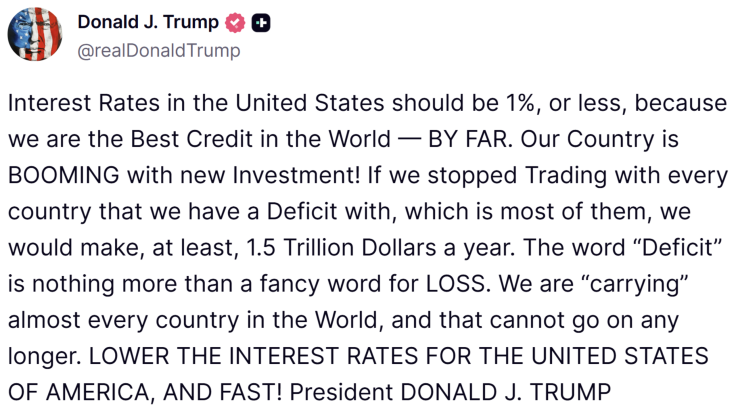
He said in a Truth Social Post yesterday that interest rates in the US should be 1% or less, arguing that the country is the 'best credit' in the world, and booming with new investments.
The median expectations in the Summary of Economic Projections (SEP) indicate a further rate hike this year. The SEP also pointed to an upward revision to inflation expectations for 2026, with PCE inflation unlikely to fall to the 2% target until 2029.
Elsewhere, the unemployment rate is expected to end 2026 at 4.1% and remain there for the next few years, while GDP growth is expected to be 2.3% at the end of 2026 before falling to 2.4% in 2027 and further to 2.2% in 2028.
Following the news of the economic updates, US equity indexes were on a downtrend. The S&P 500 fell 0.4%, the Nasdaq Composite was down 0.01%, and the Dow Jones Industrial Average declined by the most by 1.2%.
'Inflation remains elevated. Today's policy action will support a timelier return to the Committee's 2% goal,' according to the Federal Open Market Committee.
Fed chair Kevin Warsh said in a Wednesday press conference that inflation continues to be elevated as labour markets remain strong, which prompted the FOMC to act. 'Trends matter. Data points are noisy. Data-point dependence is a dangerous preoccupation. It is not something that concerns me,' he added.
However, Trump claimed that if the US stopped trading with every country it has a deficit with, the US would make at least $1.5 trillion a year. 'We are "carrying" almost every country in the World, and that cannot go on any longer. Lower the interest rates for the United States of America, and fast,' he wrote.
What Happens to US Stocks in a Strong Jobs Market With Elevated Inflation?
Higher interest rates can create headwinds for equities by increasing borrowing costs, raising the discount rate applied to future corporate earnings, and potentially slowing consumer spending and business investments.
Growth stocks can be particularly sensitive because higher discount rates reduce the present value investors assign to future earnings. Valuations might face further pressure if markets begin to price in another hike by year-end. Sectors like technology could therefore experience greater volatility.
A higher rate also means borrowing becomes more expensive, which could impact the pace of business investments. Companies facing higher financing costs may postpone marginal projects, acquisitions, or expansion. This is particularly relevant for highly leveraged companies and businesses whose investment cases depend on cheap capital.
Simultaneously, higher rates can make bonds and cash more attractive relative to equities, potentially reducing demand for riskier assets.
The jobs market is also one of the key indicators the Fed watches when making decisions on interest rates. In simple terms, stronger-than-expected job growth can make it harder for the Fed to cut rates and, if it adds to inflationary pressure, can increase the case for raising them.
US jobs growth delivered a surprise in August, with the economy adding 162,000 non-farm jobs in August, exceeding economists' expectations for roughly 56,000. July's payroll figure was also revised from an initially reported decline of 23,000 to a 21,000 increase.
In a scenario where companies are hiring strongly and unemployment is not worsening, consumer spending generally increases. Robust consumer demand can push up prices, particularly if businesses are struggling to keep up with demand. If that pressure keeps inflation above the Fed's 2% target, policymakers may keep interest rates higher for longer or consider raising them.
Disclaimer: Our digital media content is for informational purposes only and not investment advice. Please conduct your own analysis or seek professional advice before investing. Remember, investments are subject to market risks and past performance doesn't indicate future returns.
© Copyright IBTimes 2026. All rights reserved.
- Recommended For You


