Advocate Calls Trump Administration Public Charge Rule 'Interesting and Horrifying' After Lawsuit
A wider public charge test has moved into the courts as immigrant families weigh what the new policy could mean for public benefits
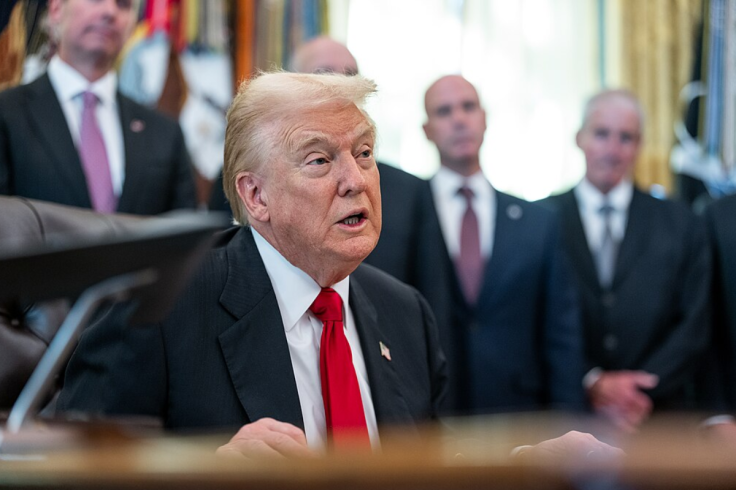
The Donald Trump public charge rule took effect on Friday, 18 September, for covered admission and adjustment applications across the United States. President Trump's administration is defending the framework against multiple federal lawsuits filed in New York. The disputes focus on how much discretion immigration officers may use when deciding whether applicants are likely to become a public charge.
The Department of Homeland Security published the final rule on 20 July. It rescinds the 2022 framework and restores broader discretion under the public charge ground of inadmissibility. It applies to admission applications made from 18 September and adjustment applications filed from that date.
Benefits received before 18 September remain subject to the 2022 framework. The new policy does not make benefit use an automatic basis for a public charge finding. Officers must still assess the totality of an applicant's circumstances.
How Donald Trump's Public Charge Rule Changes Reviews
Federal law requires officers to consider age, health, family status, assets, resources, financial status, education and skills. DHS says officers may also consider means-tested public benefits and other case-specific information. Some immigrant categories are exempt from the public charge ground.
The rule gives officers broader discretion than the 2022 framework. DHS says that approach better reflects congressional intent and a longstanding policy favouring self-sufficiency. Opponents argue the wider discretion is too vague and could deter eligible families from using public programmes.
Murad Awawdeh, president and CEO of the New York Immigration Coalition, criticised the breadth of that discretion. CBS News New York quoted him describing the change as 'interesting and horrifying.'
'The interesting and horrifying part about it is that anything can be considered or be perceived as a public charge down the road,' Awawdeh said.
His remark reflects an advocate's concern about possible interpretation, rather than the literal wording of the rule. DHS says officers should weigh relevant evidence through an individualised, totality-of-the-circumstances assessment.
Lawsuits Over Donald Trump's Public Charge Rule Cite Family Fears
New York Attorney General Letitia James filed one challenge on 14 September with 21 other states and the District of Columbia. New York City Mayor Zohran Mamdani led a separate cities-and-counties lawsuit that same day.
A third challenge was filed in Manhattan federal court on 17 September. Plaintiffs include Make the Road New York, the New York Legal Assistance Group, the Association to Benefit Children and African Communities Together.
Their lawyers include the Legal Aid Society, Democracy Forward, the Center for Constitutional Rights and Freshfields LLP. The third complaint alleges the rule violates the Administrative Procedure Act and conflicts with federal immigration law. Those arguments remain allegations before the court.
Advocacy groups also say uncertainty could discourage eligible families from using health, food and housing programmes. Arline Cruz Escobar, director of Health Programs at Make the Road New York, has warned about fear among mixed-status families.
The scale of any chilling effect remains uncertain. KFF identified about 13.5 million Medicaid or CHIP enrollees living in households with at least one noncitizen.
Using assumed disenrolment rates of 10% to 30%, KFF estimated that 1.4 million to 4.1 million people could leave Medicaid or CHIP. That range included about 560,000 to 1.7 million US citizen children.

KFF also estimated that 166,000 to 498,000 eligible uninsured people could forgo enrolling under the same assumptions. The figures are scenarios illustrating possible effects, not forecasts of what will happen.
A separate simulation preprint by New York City Department of Health and Mental Hygiene researchers modelled possible effects among immigrant New Yorkers. It projected premature mortality could rise by 4.4% to 10.6% over five years, depending on the scenario.
The study has not been peer reviewed, so its findings are projections rather than observed outcomes. Researchers used 2023 city vital statistics, American Community Survey data and estimates from earlier studies.
The public charge rule took effect on 18 September while the federal challenges proceeded. The lawsuits seek to block or vacate the administration's broader framework.
© Copyright IBTimes 2026. All rights reserved.
- Recommended For You