

China's City Billboards Replace Commercial Ads With Scientists Who Helped Feed and Modernise the Nation
China's campaign to honour scientists in public spaces prompts international discussion on societal values
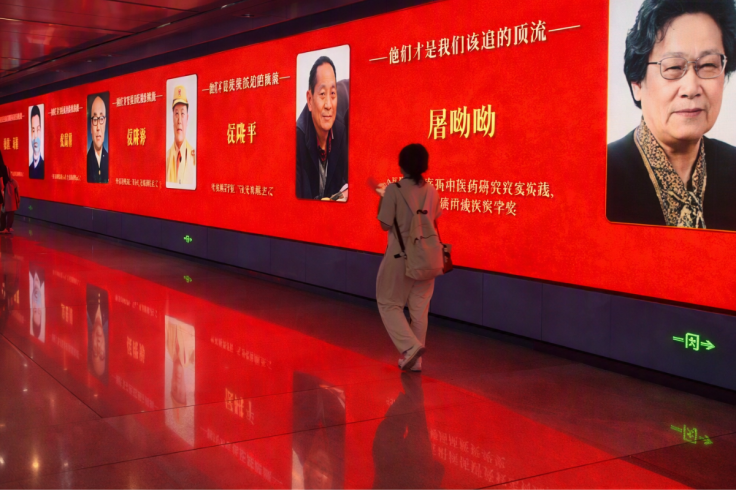
Giant screens above a Chinese metro station once beamed mobile phone deals and fashion adverts across the concourse. Today, they carry the faces of the scientists who helped shape the country's missile, nuclear, agricultural and medical programmes.
At the Convention and Exhibition Center metro station in Zhengzhou, Henan province, commuters are greeted by portraits of rocket scientist Qian Xuesen and nuclear physicist Deng Jiaxian. Photographs taken on 27 August 2026 and published by state-run Global Times show the displays, according to the outlet.
The images have since attracted international attention after appearing in social media posts and reports framing the campaign as evidence that China is giving scientists the kind of public visibility more commonly associated with celebrities.
Rice, Rockets and an Antimalarial Drug
The campaign is not limited to one city or one scientist. Agronomist Yuan Longping, renowned for his work on hybrid rice, appears alongside physicist Qian and Nobel laureate Tu Youyou, who was awarded the 2015 Nobel Prize in Physiology or Medicine for discoveries concerning a novel therapy against malaria.
Radio astronomer Nan Rendong was also featured. The trend began in Shandong province before spreading to Anhui, Inner Mongolia, Jiangxi and Henan.
The displays typically feature each scientist's name, portrait and contribution to the country, replacing commercial advertising in some prominent locations including shopping centres, metro stations and other public spaces.
China's "Scientists on Big Screens" trend is happening in more cities, now in Hangzhou.
— Li Zexin 李泽欣 (@XH_Lee23) September 4, 2026
Scientists in this video are:
👨🔬Qian Xuesen: "Two Bombs, One Satellite" hero, father of China's space program
👨🔬Yuan Longping: father of hybrid rice
👨🔬Huang Xuhua: father of China's… https://t.co/QD6p2B4aMO pic.twitter.com/6dez8mfCob
Qian Xuesen: The Scientist the US Deported
Qian Xuesen's inclusion carries a particularly striking backstory. He studied at the Massachusetts Institute of Technology and Caltech and became a leading figure in American rocket research. He was also among the scientists whose work contributed to the development of what became the Jet Propulsion Laboratory.
During the McCarthy era, Qian was accused of communist sympathies and lost his security clearance. The US government subsequently placed restrictions on him, and he lived under virtual house arrest and surveillance for five years while a deportation order remained in place.
In 1955, after years of negotiations between the United States and China, Qian was allowed to leave for China. His departure was linked to an agreement involving the repatriation of American pilots captured during the Korean War.
Then-US Navy Under-Secretary Dan Kimball, who had opposed the decision to force Qian out, described the treatment as 'the stupidest thing this country ever did', saying Qian was no more a communist than he was.
Back in China, Qian became a central figure in the development of the country's missile and space programmes. He is widely known as the 'father of Chinese rocketry' and played a major role in the development of China's early ballistic missiles and space programme.
China is putting scientists on giant screens in public places.
— Harsh Goenka (@hvgoenka) August 31, 2026
In India, our hoardings are dominated by politicians and film stars.
What we celebrate shapes what our children aspire to become. Why not put our scientists, teachers, doctors, innovators and nation-builders up there? pic.twitter.com/hcZyzGbEdz
A Debate That Crossed Borders
The images have prompted comparisons abroad, particularly in India, where commentators have contrasted the scientist displays with public hoardings dominated by politicians, actors and other celebrities.
Indian businessman Harsh Goenka wrote on X that China was putting scientists on giant screens while Indian hoardings were dominated by politicians and film stars.
He argued that 'what we celebrate shapes what our children aspire to become' and asked why scientists, teachers, doctors, innovators and other nation-builders were not given similar prominence in India.
The comparison has fuelled wider online discussion about the people countries choose to celebrate in prominent public spaces.
Supporters of the Chinese displays have presented scientists as role models whose achievements deserve the same visibility often given to celebrities and commercial brands.
The campaign can be seen as a form of public messaging that elevates scientific achievement in spaces commonly used for commercial advertising.
Whether it changes career aspirations remains difficult to measure, but the displays have clearly attracted international attention and prompted debate about how different countries publicly honour their achievers.
For readers outside China, the story invites a question: if advertising space can celebrate scientists instead of consumer goods, what does that say about how different societies value their nation-builders?
© Copyright IBTimes 2026. All rights reserved.