

Trump Plans Crypto-Scam Crackdown Event—What Can Victims Actually Recover?
Federal authorities have restrained hundreds of millions of dollars in crypto, but court records show the limits of recovering stolen funds

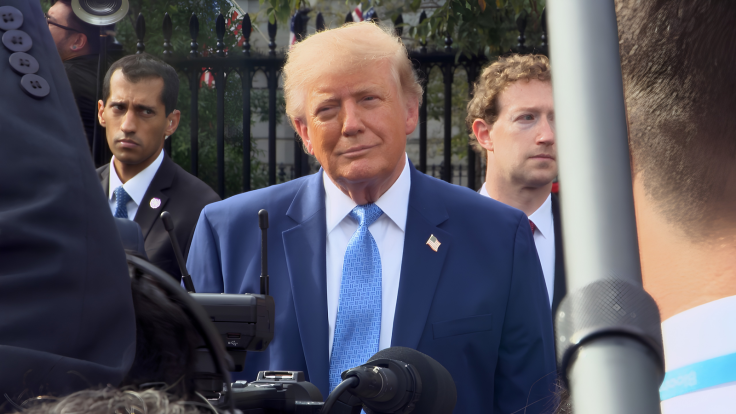
President Donald Trump highlighted his administration's crackdown on overseas cryptocurrency investment scams at a White House event on Wednesday, 21 October. Officials pointed to cryptocurrency restraints and website takedowns, but those enforcement figures do not establish how much money has ultimately reached victims.
Trump entered the East Room at 2:50 pm, according to a White House press pool report. Officials attending included Homeland Security Secretary Markwayne Mullin, FBI Director Kash Patel, Defence Secretary Pete Hegseth and Attorney General Todd Blanche.
US Reports Hundreds of Millions In Crypto Restraints
A poster at the event cited 276 international perpetrators being brought to justice, 503 fraudulent web domains disrupted and $938 million (£703.5 million) in criminal cryptocurrency restrained, according to a White House press pool report.
The Justice Department had reported the same cryptocurrency total in September, including $52 million (£39 million) restrained in one day. The figures describe enforcement activity, not a confirmed total of payments to victims. Restrained assets are funds authorities have prevented from being moved; that does not mean the money has been returned to those who lost it.
Trump told the gathering that authorities had helped 10,000 Americans targeted by scammers and frozen about $1 billion (£750 million) in cryptocurrency, according to the pool report. Those remarks did not establish a separate recovery total or how much had been distributed.
The FBI's Operation Level Up identifies and warns people caught in cryptocurrency investment fraud. It had notified 8,935 potential victims by March 2026, and officials estimated that the warnings prevented more than $562 million (£421.5 million) in additional losses.
Those estimated savings do not represent money recovered from earlier transfers. The programme aims to stop people sending more money to scammers.
Forfeiture Cases Highlight Gap Between Seizures and Repayments
Launched in November 2025, the Scam Center Strike Force has pursued cryptocurrency and online infrastructure linked to overseas scam operations. Court proceedings determine what happens to assets seized in individual cases.
In July, federal prosecutors in Washington announced civil forfeiture complaints seeking more than $25 million (£18.75 million) in cryptocurrency linked to separate fraud investigations. The complaints sought court orders forfeiting the assets; they did not announce payments to victims.
The route from seizure to compensation can involve tracing and restraining assets, court proceedings to establish forfeiture, resolving competing claims and applications for remission. Remission is a process through which eligible victims can seek compensation from forfeited assets.
Victims must establish their losses and meet the applicable requirements. The amount available for distribution can be much smaller than the losses reported, particularly when several people have claims against the same pool of money.
What Court Records Reveal About Recovery
A Lawfare analysis published in August examined 81 federal civil forfeiture actions involving assets linked to pig-butchering scams. In these schemes, fraudsters build relationships with victims before directing them to fake investment platforms.
In one case, at least 13 victims lost more than $5 million (£3.75 million), while the government seized less than $80,000 (£60,000). In another, losses exceeded $14 million (£10.5 million), but less than $650,000 (£487,500) was recovered.
The analysis reported that victims appeared in court in only eight cases. However, their absence from court proceedings does not establish that they received nothing: compensation can also be sought through the separate remission process.
Lawfare noted that forfeiture figures alone do not show what victims ultimately received. A successful seizure can preserve money that might otherwise disappear, without recovering enough to compensate everyone in full.
Crypto Investment Fraud Losses Reach $7.2 Billion
The FBI's 2025 Internet Crime Report recorded $7.2 billion (£5.4 billion) in reported losses from cryptocurrency investment fraud. The figure reflects reported cases, not every loss suffered by Americans.
Blockchain transactions can be traced, but they cannot simply be reversed. Scammers may move assets between wallets, mix proceeds with other funds or transfer them to services beyond the reach of US authorities.
Recovery can depend on investigators identifying where the funds went and obtaining cooperation from an exchange or stablecoin issuer able to freeze them. Identifying a transaction does not necessarily mean authorities can retrieve the assets.
What Victims Can Actually Recover
There is no single repayment rate that victims can apply to their losses. The outcome depends on how much investigators locate, whether authorities can secure it, the result of forfeiture proceedings and the claims accepted against the available funds.
The $938 million restrained therefore cannot be treated as $938 million repaid. Nor do the government's announcements establish that an individual victim will recover the amount they lost.
The White House event demonstrated the scale of the administration's enforcement campaign. The unresolved measure is how much of the money secured by authorities ultimately reaches the people targeted by the scams.
© Copyright IBTimes 2026. All rights reserved.