

New York Hosts Inaugural Faith-AI Covenant Roundtable as Faith and Tech Leaders Wrestle With AI's Moral Future
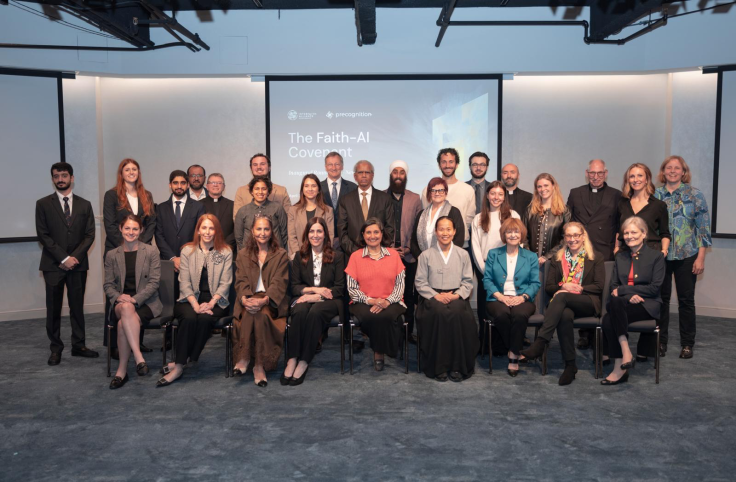
This week, New York became a meeting ground for leaders from technology and faith, brought together to help shape the principles guiding artificial intelligence. As one of the most defining forces of our time, AI is now being placed in conversation with some of humanity's oldest sources of moral and spiritual wisdom.
That conversation formed the basis of the first roundtable of the Faith–AI Covenant, a global initiative convened by the Interfaith Alliance for Safer Communities (IAFSC) in partnership with Precognition CEO Baroness Joanna Shields. The event, described by organisers as the opening step in a broader international dialogue, brought together senior figures from the worlds of artificial intelligence, faith leadership, civil society, academia, and policy for a structured discussion on how emerging technologies can be developed and deployed in a way that is responsible, transparent, and aligned with the common good.
The roundtable was not a public-facing conference designed for announcements or spectacle, but a working session intended to surface practical questions and solutions: What happens when people begin turning to AI not only for productivity, but for advice, reassurance and even moral judgment? What responsibilities do developers have when systems increasingly influence how people think, decide and relate to one another? And how can long-standing moral traditions inform a technology whose pace of change often outstrips the institutions trying to govern it?
Those tensions were central to the opening of what is to become a major force in the future of global AI-ethics dialogue.
The Interfaith Alliance for Safer Communities, which was established to help faith leaders play a more active role in community safety and security, has spent years working across issues including child sexual abuse, extremism, radicalisation and human trafficking. With the Faith–AI Covenant, the organisation is extending that mission into the rapidly evolving AI space, arguing that the same moral and social infrastructure that faith communities have historically provided should now be part of the conversation about how advanced technologies are shaped.
That framing was echoed in remarks from Dana Humaid, head of the Interfaith Alliance for Safer Communities, who said the rise of artificial intelligence raises 'a profoundly human question, not only a technical one'. She argued that innovation must remain grounded in human dignity, faith and spiritual leadership, and said the New York roundtable represented an important first step in creating a credible space for dialogue between those building AI systems and faith leaders responsible for moral, civic and community leadership.
Through 2026, the Faith–AI Covenant is expected to travel to six additional major cities across six continents, with convenings planned in Beijing, Bengaluru, Nairobi, Paris and Singapore before a final summit in Abu Dhabi.
The choice of locations suggests that the organisers are aiming for a truly global dialogue that spans societies, religions, and cultures from East to West. The initiative is clearly designed to foster a broader, more pluralistic discussion that reflects diverse religious traditions, cultural contexts, and regulatory environments. The inclusion of Abu Dhabi as the final destination also underscores the UAE's growing role as a convening power on questions of technology, governance, and public trust.
Participants in the New York roundtable included representatives from leading AI and technology organisations, major faith institutions, academia and civil society. These included participants from OpenAI, Anthropic, the Baha'i International Community, The Sikh Coalition, the Archdiocese of Newark, the Greek Orthodox Archdiocese of America, the New York Board of Rabbis, The Church of Jesus Christ of Latter-day Saints, Masjid Muhammad, the Hindu Temple Society of North America, Won Buddhism of Manhattan, the World Council of Churches, the United Church of Christ, Vanguard University, the Civilisation Research Institute, ROOST, the Buddhism and AI Initiative and the Center for Humane Technology, alongside other invited participants.
What made the gathering noteworthy was not just the breadth of representation, but the premise that faith leaders and AI builders should be in the same room early, before the norms harden and the architecture of the future becomes too fixed to influence or change.
That idea has become increasingly urgent as AI systems move beyond search, summarisation and productivity into more intimate and consequential spaces. Organisers pointed to the growing tendency of people, especially younger users, to turn to chatbots for companionship, reassurance and advice, as well as the more troubling possibility that AI systems may become sources of moral or spiritual guidance for people detached from traditional communities. In that context, the question of what gets encoded into AI systems is no longer abstract. It is practical, immediate and, for many in the room, deeply consequential.
The roundtable was conducted under Chatham House rules, allowing participants to exchange candid views on AI's growing role in human life and the responsibilities it entails. Organisers said the discussion was intended to help shape a values-led approach to technological progress, embracing innovation while preserving human dignity.
That is a demanding agenda for the initiative, and one that will almost certainly provoke debate around the world. In New York, the atmosphere appeared optimistic and determined. The UAE's role in hosting the final summit is emblematic of its broader commitment to convening international dialogue on emerging technologies and their societal impact. The summit is expected to bring together the outcomes of the wider roundtable process and support the next phase of the initiative's development.
For the Interfaith Alliance for Safer Communities, the inaugural roundtable marks the beginning of a longer-term process. By bringing together technical expertise, moral insight and community perspectives, the initiative seeks to support a more deliberate and collaborative approach to the development of artificial intelligence, one that reflects the values societies aim to uphold as the technology continues to evolve.
© Copyright IBTimes 2026. All rights reserved.