Google CEO Sundar Pichai Says AI Could Do His Job—Zuckerberg Is Already Testing It
As Google's chief admits artificial intelligence could soon handle his responsibilities, Meta's boss begins testing a digital aide to streamline billion-dollar decisions

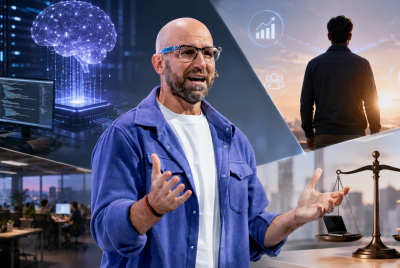
Silicon Valley is witnessing a fundamental shift in executive power as the leaders of Google and Meta prepare for a future where artificial intelligence manages the C-suite.
Sundar Pichai, the chief executive of Google and Alphabet, has openly stated that AI could eventually handle complex responsibilities similar to his own. Simultaneously, Mark Zuckerberg is moving beyond theory by developing a bespoke AI system to assist with his daily decision-making. This transition signals that the AI CEO replacement trend is no longer a distant speculation but a current operational priority for the world's most powerful tech firms.
While the technology is still far from replacing human judgement entirely, the fact that two of the most powerful figures in tech are openly entertaining and testing such possibilities marks a significant turning point in the evolution of corporate leadership.
Pichai's Words Point To A Change
Pichai's comments on artificial intelligence were not framed as a prediction of immediate disruption, but they were striking in their implication. In an interview, he suggested that the responsibilities of a chief executive could eventually be within AI's capabilities, even describing such tasks as potentially easier for advanced systems to manage.
The reasoning behind this view lies in the nature of executive work. Much of a CEO's role involves synthesising information, making strategic decisions, and overseeing operations, all areas where AI systems are rapidly improving. Modern AI models can already process vast datasets, identify patterns, and generate recommendations at speeds no human can match. This has led to growing discussion within the technology sector about how far these systems could go.
However, Pichai's remarks also show a degree of caution. Leadership is not purely analytical. It involves ethical judgement, accountability, and the ability to navigate complex human dynamics, areas where AI remains limited. His comments, therefore, point less to an imminent replacement of executives and more to a future in which AI plays a deeply integrated role in leadership functions.
The significance of his statement lies in who is making it. As the head of one of the world's most influential technology companies, Google, Pichai's willingness to even entertain the idea underscores how seriously AI's potential is being taken at the highest levels of industry.
Zuckerberg Turns Theory Into Reality
While Pichai has outlined a possible future, Meta boss Mark Zuckerberg is already taking steps to test it. The Meta chief is developing an AI-powered assistant designed to support him in his role, marking one of the first tangible attempts to integrate AI into executive leadership.
This system, still in development, is intended to help Zuckerberg access information quickly, streamline decision-making, and operate more efficiently. Reports suggest it functions similarly to a high-level digital aide, capable of retrieving insights and cutting through layers of organisational complexity.
The initiative appears to be part of a broader push within Meta to embed AI across its operations. The company has been investing heavily in AI tools and infrastructure, with leadership emphasising their role in improving productivity and reshaping workflows. Zuckerberg's approach shows a crucial distinction in the current AI landscape.
Rather than replacing executives outright, AI is being positioned as an augmentation tool, one that enhances decision-making rather than eliminating it. Even so, the implications are significant. If AI can meaningfully assist at the highest levels of management, it could gradually alter how organisations are structured and how decisions are made.
© Copyright IBTimes 2026. All rights reserved.
- MOST POPULAR IN Artificial Intelligence