

IBM Just Lost $68B in a Day: What Triggered Its Worst Stock Crash Since 1968
IBM's stock drops 26% this year, hit by AI automation pressures and its worst February decline since 2000
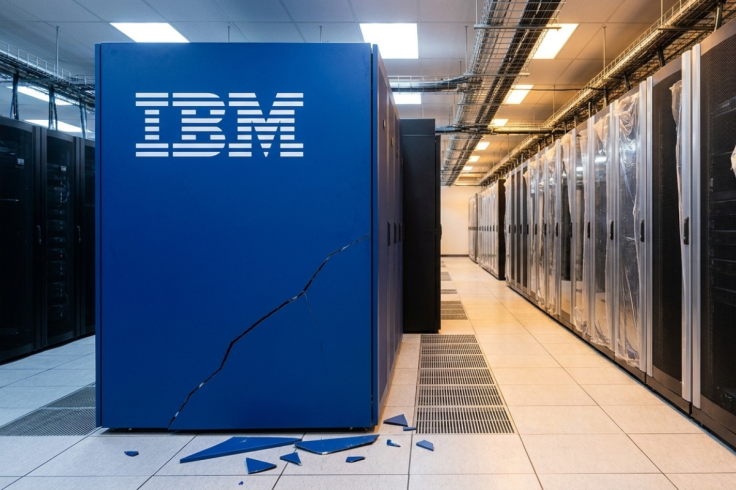
IBM lost roughly $68B (£51B) of its market value in a single session on Tuesday, its worst one-day crash since price records began in 1968, after the company admitted clients had abruptly diverted their technology budgets from software to AI hardware. For British savers, the name sits inside the Dow and the global tracker funds most pensions use, so the damage did not stay in New York.
The shares fell 25% to close at $217.05, cutting the company's valuation to just above $200B, after IBM released preliminary second-quarter figures a week ahead of schedule. Revenue of $17.2B (£12.8B), up 1%, missed the $17.86B analysts expected, and adjusted earnings of $2.93 per share came in below the $3.01 consensus; infrastructure revenue fell 7% while software grew 5%, roughly half the pace forecasts implied.
Chief executive Arvind Krishna told investors in a letter that clients spent the final weeks of June rushing to buy servers, storage, and memory before prices rose further, starving budgets for the new z17 mainframe and its software stack and letting numerous large deals slip past the quarter's close. 'This quarter we faltered,' he wrote, saying the company had not anticipated the scale of the shift.
Why Clients Suddenly Bought Chips Instead
The stampede has a cause. Memory manufacturers led by Samsung, SK Hynix, and Micron have moved production to the specialised chips that power AI data centres, with capacity effectively sold out for 2026 under long-term contracts, and Micron's chief executive expects tight conditions to persist beyond 2027. Research firm IDC puts global AI infrastructure spending at $487B (£363B) this year, up 53%. IBM also said cybersecurity fears set off by the debut of Anthropic's Mythos model, which the AI firm itself warned could help attackers find flaws, paused several large deals, prompting IBM to launch its Lightwell open-source security platform in response.
The scale of Tuesday is easiest to see against the company's own history, as the chart below shows.
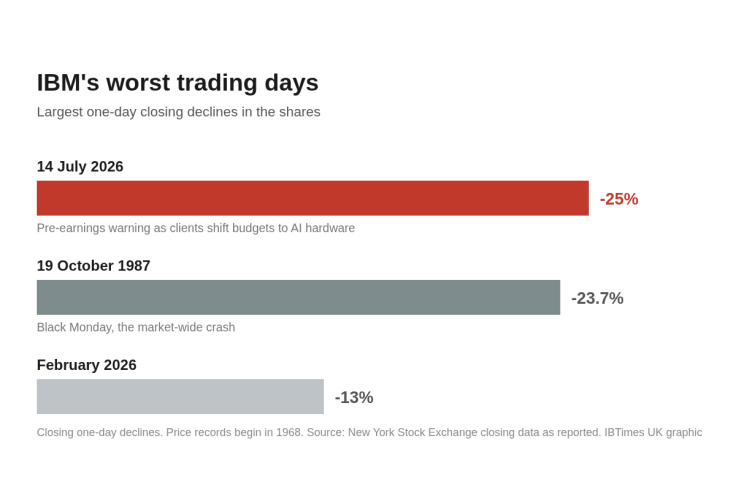
The 1968 in the record books is a starting line, not an earlier disaster: it is the year from which the stock's continuous daily price record runs, so Tuesday's fall is the deepest in everything that can be measured. IBM has traded in New York since 1916, but the daily archive only begins in 1968, which is where any comparison has to stop. The benchmark Tuesday broke had stood since Black Monday in October 1987, when IBM fell 23.7% as the whole market collapsed, and this February's 13% drop, its worst since 2000, had already hinted at the pressure, coming after an AI tool promised to automate updates to the COBOL systems IBM still supports. The stock is now down 26% for the year.
Wall Street piled on. HSBC cut the stock to reduce its target from $231 to $191, with one of its analysts telling clients to 'prefer synthetic IBM to the real one,' while the warning dragged Salesforce down 4% and Microsoft almost 3%. The other side of the trade rallied: Micron rose 5%, Nvidia gained, and only a blowout quarter from Goldman Sachs stopped IBM's 429-point drag from sinking the Dow.
Bargain or Broken? The Street Splits
Wednesday's debate is whether the punishment fits. Evercore's Amit Daryanani argued the issues are bigger than one company; Hightower's Stephanie Link called IBM still well set up in quantum and enterprise AI; and KKM's Jeff Kilburg framed the weakness as a buying opportunity. The shares edged back to $219.51 after hours. IBM, for its part, pointed to the more than $10B (£7.5B) it has committed to building its own large-scale quantum computer by 2029, and separately to its expanding AI partnerships, which include OpenAI.
The real verdict arrives on 22 July, when the full results and Krishna's recovery plan are released. Until then, anyone with a workplace pension in a global tracker owns a sliver of this crash, whether they follow it or not, and the question that matters is the one Tuesday raised: whether the AI boom feeds the world's biggest software sellers, or eats them.
Disclaimer: Our digital media content is for informational purposes only and does not constitute investment advice. Please conduct your own analysis or seek professional advice before investing. Remember, investments are subject to market risks, and past performance does not guarantee future returns.
© Copyright IBTimes 2026. All rights reserved.