SpaceX Crash Wipes More Than Warren Buffett's Net Worth From Trillionaire Elon Musk's Fortune
SpaceX's IPO surge reverses as stock plummets, impacting Musk's wealth
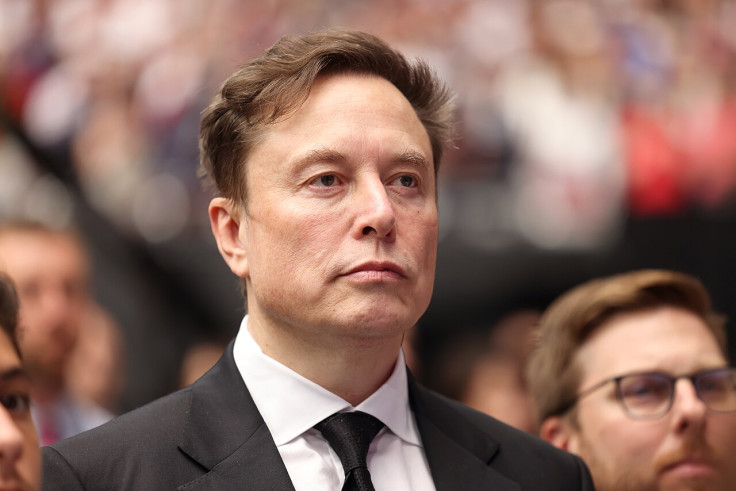
SpaceX shares fell roughly 16% on Monday, 23 June. The drop wiped an estimated $152 billion from Elon Musk's personal fortune in a single session. That figure exceeds Warren Buffett's entire net worth. This comes just days after Musk's net worth rose by $165 billion after SpaceX had a record rally in the first two days after the IPO. After briefly touching $3 trillion market valuation, SpaceX's stock price is on a downward trend.
The selloff marked a jarring reversal for a stock that had entered public markets just 11 days earlier. SpaceX priced its initial public offering (IPO) on June 12 at $135 per share. Within its first week of trading, the stock climbed nearly 40% above that IPO price, triggering the kind of retail frenzy more commonly associated with meme stocks than with aerospace contractors.
SpaceX was trading at $154.6 on Monday's closing, which is what the average investor paid for SpaceX shares in the open market. On 12 June, the share price closed at $160.90, which marked a steep decline from the 16 June high of $201.80 per share.
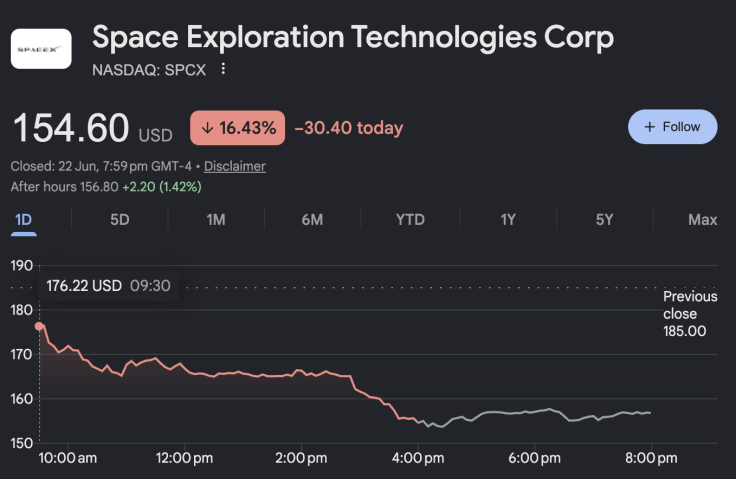
What Triggered the SpaceX Stock Selloff
The immediate backdrop was a grounded fleet. SpaceX's Starship rockets, the company's next-generation heavy-lift launch system designed for missions to the Moon and Mars, remained grounded pending a Federal Aviation Administration (FAA) investigation following a test flight mishap reported on 28 May 2026. The FAA, the US government agency responsible for civil aviation and commercial spaceflight licensing, confirmed the investigation was underway, though no injuries or property damage were reported in connection with the incident. The Starship vehicle was also reported to have come down in the Indian Ocean during the anomalous flight.
On top of that, analysts added pressure from a different direction. KeyBanc Capital Markets initiated coverage of SpaceX with a 'sector weight' rating, which signals the stock's risk-reward as balanced rather than attractive. The initiation coincided with news of a $20 billion bond sale launch by the company, a capital-raising move that can dilute the implied value of existing equity when investors interpret it as a sign that cash needs are larger than previously understood.
Together, those two factors gave investors who had ridden the IPO surge a reason to take profits. The result was a single-session decline of $152.3 billion in Musk's paper net worth, according to the Forbes Real-Time Billionaires listing. This was only a fraction compared to what SpaceX lost during its rout, which is estimated at roughly $600 billion.
What Buffett Comparison Reveals About Musk's Scale
The calculation behind the Buffett comparison is straightforward. Warren Buffett, the 95-year-old legendary investor, holds a net worth of approximately $144.9 billion, as seen on Forbes' Real Time Net Worth. Musk's one-day loss of $152 billion exceeded that figure outright.
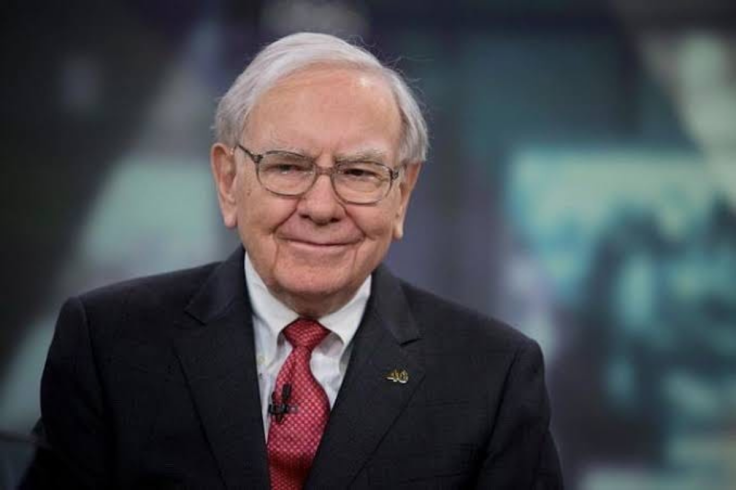
The comparison lands differently in the context of how Musk accumulated his wealth in the first place. In mid-June 2026, shortly before the Starship investigation drew renewed attention, Musk was reported to have added roughly $164 billion to his net worth in a single day, which was due to SpaceX's IPO debut and the following market frenzy. That single-day gain was itself more than what Buffett had accumulated across a career spanning more than seven decades of investing.
Even after the decline, Forbes tracked Musk's net worth at approximately $1.1 trillion, a figure that placed him above the combined fortunes of Google co-founders Larry Page and Sergey Brin, Amazon founder Jeff Bezos, Oracle founder Larry Ellison, and Dell Technologies founder Michael Dell.
The volatility in both directions illustrates a structural feature of Musk's wealth: it is overwhelmingly concentrated in equity stakes in companies whose valuations respond sharply to sentiment, regulatory news, and capital market conditions. Tesla, the electric vehicle manufacturer under Musk's leadership, had already contributed to pressure on his fortune. His net worth slipped $50 billion on 22 June, as Tesla shares declined in the session immediately preceding the SpaceX crash. As of December 2024, Musk owned 410,794,076 Tesla shares, or nearly 12.7% of the company. So, whenever the stock price drops by £1.88 ($2.43), the price movement costs him £774.31 million ($1 billion).
SpaceX IPO Aftermath
SpaceX's core business spans two distinct revenue streams: its Falcon 9 and Starship launch services, which carry satellites, cargo, and crew for NASA and commercial customers, and its Starlink broadband satellite internet constellation, which has grown into one of the world's largest satellite networks by subscriber count. Both businesses are capital-intensive, and both face competitive and regulatory headwinds. The FAA investigation into Starship directly threatens the launch timeline that underpins future revenue projections.
KeyBanc's sector weight initiation formalised what some institutional investors had been privately signalling: that the 40% post-IPO surge had front-loaded optimism that the company's near-term fundamentals could not yet support. A bond sale running concurrently with a stock decline is rarely a confidence signal for equity holders.
Financial guru Mark Cuban offered a broader framing of the dynamics that produce and then compress fortunes of this magnitude. 'The stock market makes guys like Elon Musk insanely rich,' Cuban said. The same mechanism, he suggested, runs in reverse.
© Copyright IBTimes 2026. All rights reserved.
- Recommended For You