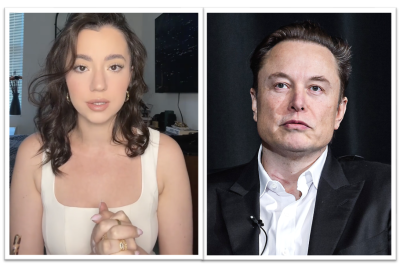
Justine Musk Says Elon 'Gaslit' Her and Treated Her Like an Employee in Gibney Documentary
Behind the swaggering 'alpha' image, Justine Musk sketches a marriage and family life with Elon Musk shaped by power, control and unresolved hurt

Elon Musk's first wife, Justine Musk, has accused the billionaire of 'gaslighting' her and making her feel like an employee during their marriage, in Alex Gibney's new documentary Musk, which premiered at the Venice Film Festival on 8 September.
The film, which runs just under four hours including an intermission, explores Elon's business empire, political reach and private life. Justine, born Justine Wilson, is one of its key voices, revisiting a marriage that lasted from 2000 to 2008 and that she now characterises in the documentary as 'super toxic.'
She says she learned the term 'gaslighting' from her relationship with Elon. In the film, she alleges he often highlighted what he saw as her flaws, recalling that he repeatedly commented on 'the ways he found me lacking,' which she says left her feeling 'insignificant' inside the marriage.
The claims build on an account Justine first set out in detail in a 2010 essay about their relationship. There, she described an imbalance of power emerging as Musk's career accelerated, and said she found herself pushing back against being treated, in her view, less like a partner and more like a subordinate.
Justine Musk's 'Alpha' Memory and Feeling Like an Employee Around Elon Musk
One of the most striking scenes in Musk reaches back to the couple's wedding reception. Justine recalls that during their first dance, Elon looked at her and said: 'I am the alpha in this relationship.'
She has described the same episode before, writing about the 'alpha' remark in that 2010 essay. In the film, it is presented again as a moment that, in her eyes, foreshadowed the hierarchy that would come to define their years together.
Justine also says she repeatedly reminded Musk that she was his wife, not his employee, as their relationship deteriorated. Her complaint, then and now, is less about one outrageous incident and more about a pattern of criticism and control that she believes eroded her sense of equality.

In the documentary, she goes further and links that dynamic to Musk's wider views about family. Justine alleges that he has referred to the mothers of his children as 'breeders' and regarded them as 'interchangeable'.
Musk currently has 14 publicly known children with four women. He has often warned in interviews and online posts about declining birth rates and what he sees as a demographic threat to human civilisation, though he has not, in his own public comments, framed that concern in the blunt terms Justine uses in the film.
Elon Musk, 'Breeders' Allegation and Disputed NDA Claim
The documentary also includes fresh claims from Ashley St Clair, the mother of one of Elon's children. She says on camera that Musk told her he wanted a 'legion of children before the civil war,' language that fits the apocalyptic style of some of his late‑night posts on X.
St Clair also alleges that Musk's team offered her a financial package tied to a non-disclosure agreement. According to her account in the film and subsequent reporting, the proposed deal was a $40 million lump sum plus a $100,000 monthly stipend in exchange for signing an NDA and staying silent about their relationship.
Musk has flatly denied making such an offer. He has publicly accused St Clair of having 'a history of making false claims,' and his lawyer has described her NDA story as fabricated.
Some of the most sensitive material in Musk concerns the billionaire's children with Justine. She alleges that after their daughter, Vivian Wilson, came out as transgender, Musk removed her from his health insurance and 'has never tried to repair things' with her.
Justine also recalls Musk asking her to pass on a message to Vivian that 'I'll always love her.' The film gives no indication that he has reached out to his daughter directly. Vivian, who legally changed her name in 2022, has given her own interviews about being estranged from her father and about his public attacks on trans rights, though she does not appear in Gibney's documentary.
The film then returns to an earlier, devastating chapter in the couple's life, the death of their first child, Nevada Alexander, from sudden infant death syndrome at 10 weeks old in 2002. Musk has previously said in interviews that he held Nevada as the baby died.
Justine disputes that version in Musk. She tells Gibney that she, not Elon, was holding Nevada when he died. The documentary presents her recollection alongside Musk's past description but does not, and realistically cannot, determine whose memory is accurate in such a personal moment.
Musk did not sit for an interview with Gibney and is largely represented in the film through archive footage, court documents and the testimony of people who have known him. Since the Venice premiere, he has attacked the documentary in public, calling it a 'hit piece' and criticising Gibney's integrity, and his lawyer has threatened legal action over parts of the film.
At the time of publication, however, there was no detailed public response from Musk or his representatives to Justine's specific gaslighting allegations or to her renewed description of their marriage as 'super toxic.'
Gibney's film, which is scheduled for wider release later this year, now sets those claims alongside a broader portrait of Elon that is far messier, and far more human, than the mythic version that tends to go viral online.
© Copyright IBTimes 2026. All rights reserved.
- Recommended For You