Archaeologists Uncover Rare First-Century Synagogue and Carved Stone Near Galilee
The Early Roman-period building and its carved menorah provide context for Galilee during the period associated with Jesus' ministry, while leaving any personal connection unproven
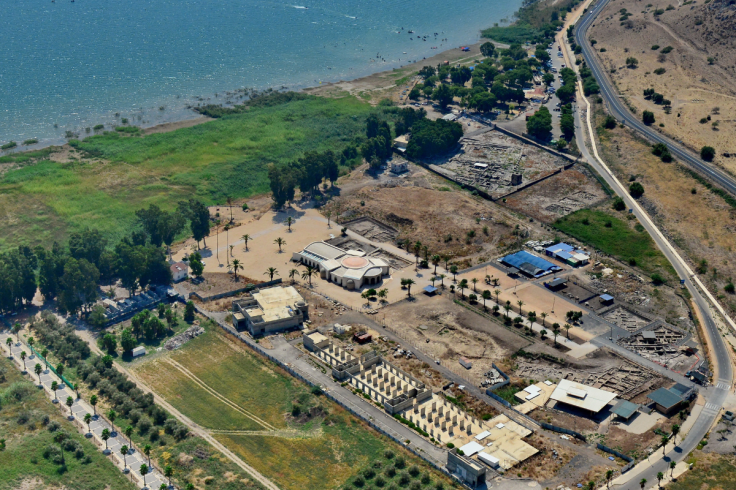
Archaeologists excavating at ancient Magdala beside the Sea of Galilee have documented a rare first-century synagogue and an elaborately carved limestone block known as the Magdala Stone.
The synagogue dates to the Early Roman period and was in use during a period traditionally associated with Jesus' ministry in Galilee.
The Gospels describe Jesus teaching in synagogues throughout the region, but neither the biblical texts nor the archaeological evidence identifies this particular building as a place where he taught.
The distinction is important. The excavation provides evidence for Jewish religious and communal life in first-century Magdala, but it does not establish whether Jesus ever entered the building.
A Synagogue From First-Century Galilee
Archaeologists discovered the building in 2009 during work ahead of construction at ancient Magdala, on the western shore of the Sea of Galilee.
It is among the relatively small number of synagogues known from Galilee that date to the period before the destruction of Jerusalem's Second Temple in AD 70.
The structure included a vestibule and a larger room that archaeologists identified as a reading room.
Stone benches lined the walls, while column remains indicate that the interior was supported by columns. Parts of the walls retained traces of painted decoration, and sections of the floor featured a mosaic with a rosette and geometric designs.
The building's architecture and associated finds place it within the Early Roman period.
A 2025 study by archaeologists Jordan J. Ryan and Marcela Zapata-Meza examined the synagogue's identification, layout and chronology and proposed that its use may have extended into the mid-first century AD.
That dating is significant because it overlaps with the period traditionally associated with Jesus' ministry in Galilee.
Matthew 4:23 says that Jesus 'went throughout Galilee, teaching in their synagogues'. Mark also describes Jesus teaching in synagogues across Galilee. Neither passage, however, names Magdala's synagogue.
The Magdala Stone and a Menorah
Among the most notable finds from the building is an elaborately carved limestone block now known as the Magdala Stone.
The stone features a series of architectural and religious motifs, including a seven-branched menorah.
The Israel Antiquities Authority described the menorah in its excavation report as the earliest known Second Temple-period example found outside Jerusalem and, at the time, the earliest known menorah found in a religious structure.
The stone's dating is particularly significant because it belongs to the period when the Second Temple in Jerusalem was still standing.
The menorah has attracted considerable scholarly attention. Some researchers have suggested that its depiction may reflect knowledge of the Temple and its furnishings.
The precise function of the Magdala Stone is also unresolved. Researchers have proposed several possibilities, including a connection with Torah reading and the handling of scrolls.
In its original excavation report, the Israel Antiquities Authority interpreted the object as a type of prayer table.
Two Synagogues in One Galilean Town
The Magdala Stone has also appeared in more recent research on Jewish identity, Judean connections, and the relationship between Galilee and Jerusalem during the first century.
A 2026 peer-reviewed book chapter by Wally Cirafesi of Lund University examined the decorated stone in relation to Judean connections and Jesus' Galilean mission in the Fourth Gospel.
The work contributes to an ongoing academic discussion of the stone and the period's religious and cultural networks; it does not establish that Jesus visited Magdala's synagogue. That distinction applies to the wider archaeological evidence as well.
The synagogue's location is relevant because Magdala was an active Jewish settlement in Galilee. Archaeological excavations have revealed streets, substantial buildings, shops, water installations and Jewish ritual baths. Research indicates the settlement was an important community during the Early Roman period.
A second synagogue dating to the Second Temple period was identified elsewhere at ancient Magdala in 2021. The discovery provides further evidence of the settlement's religious life and has prompted additional questions about how the two buildings were used and how they related to the community.
The existence of two synagogues does not, by itself, establish that they operated simultaneously or that any particular historical figure visited either one. It does, however, add to the archaeological evidence for organised Jewish communal life at Magdala during the Second Temple period.
A Window Into Jesus' Historical Setting
The significance of the Magdala synagogue does not depend on proving a connection with Jesus. The building belonged to the same geographical and historical setting described in the Gospels. Its benches, architectural remains, painted decoration, and mosaic provide tangible evidence for the environment in which Jewish communities in Galilee gathered during the first century.
The archaeological record cannot determine whether Jesus was among the people who entered this particular synagogue.
No published archaeological evidence from the building identifies him as a visitor, and the Gospel accounts do not name the structure.
Archaeology can establish only that a synagogue existed at Magdala during the period in which the Gospels describe Jesus travelling through Galilee and teaching in synagogues.
The Magdala synagogue offers a preserved glimpse of Jewish communal and religious life during the Early Roman period, while the Magdala Stone provides evidence of the imagery and material culture associated with that world.
Nearly two millennia later, the archaeological remains cannot reveal the identity of everyone who once gathered there. They can, however, show something about the building they used, the community around it and the historical setting in which the Gospel accounts place Jesus' ministry.
© Copyright IBTimes 2026. All rights reserved.
- Recommended For You