

Previously Debunked Leaked Images of 3I/ATLAS Go Viral Again With Shocking New Findings
Experts Dismiss Viral 3I/ATLAS Alien Craft Theory Amid Renewed Online Speculation
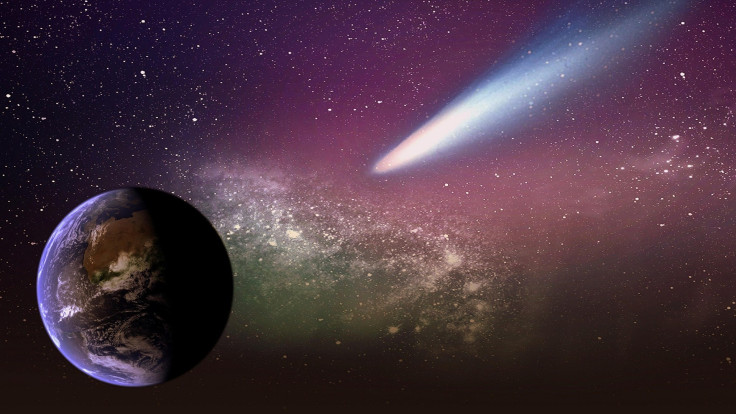
The mysterious interstellar visitor 3I/ATLAS has once again become the subject of online controversy as a set of older, previously debunked images resurfaced, this time accompanied by massive implications about it being an alien spacecraft.
The viral post has led to a big debate, but what does science actually say about 3I/ATLAS?
The Viral Claim: Old Leaks Point to Alien Craft
According to a viral post on X (formerly Twitter), early alleged snapshots of 3I/Atlas are now being reinterpreted. The post argues that what appears to be a bright exhaust or 'plume' emanating from the object might reveal a structure similar to a spacecraft than a comet. The author even claims that by reducing the brightness of the alleged exhaust in edited slides, the outline of a 'craft' becomes visible.
Furthermore, the viral post, which has garnered hundreds of thousands of views, asserts that the images, which initially circulated months ago and drew little attention, now show an unmistakable resemblance to the comet as seen in recent observations.
Moreover, the post says that the 'really bright part' of 3I/ATLAS corresponds to what they believe is exhaust, possibly chemical or ion, rather than a cometary coma. So, by dimming the brightness in two of the slides, the person claims to reveal a distinct, solid craft-like shape. Here is the post:
These unconfirmed images of 3I/ATLAS bear a close resemblance to what we are seeing today, even though they were "leaked" many months ago, when amateurs could not see it clearly.
— Red Collie (Dr. Horace Drew) scientist/inventor (@RedCollie1) December 6, 2025
If true, then the really BRIGHT part of 3I/ATLAS would be its exhaust (chemical or ion)? I have… pic.twitter.com/Os7M3Bsh2W
These assertions are very similar to earlier sensational theories about 3I/ATLAS being an extraterrestrial probe rather than a natural object. On social media and some fringe forums like Reddit, users have pointed to features such as a sunward jet, unusual brightening, lack of a classical dust tail, or irregular acceleration and interpreted them as possible signs of artificial propulsion or alien technology.
"I also suspect this leak might have been real, but the problem is there's no telescope with a resolution sharp enough to capture it this clearly. However, if this thing is 20 times larger than predicted, around 100 km, that's a different story." pic.twitter.com/60RjtJRFe7
— GANON (@GANON_official) December 7, 2025
However convincing such images or edits may appear, the scientific community remains overwhelmingly sceptical. Experts also warn that many of these 'leaks' are likely fabrications or artefacts of overprocessing. As IFL Science puts it, 'there are a lot of fake images of comet 3I/ATLAS going around.'
Furthermore, the idea that the comet contains a solid core visible in high definition and behaves like an alien spacecraft has been challenged repeatedly, with some experts calling the concept 'simply nonsense.' Even some social media users pointed it out.
These were debunked months ago. The originals, which have been conveniently cropped here, had text overlays with AI errors. The scale of the image “resolved” was also several orders of magnitude beyond the capability of any Cassandra assets at the time.
— Drew Doss (@drew4worldruler) December 6, 2025
Read More: 'No Natural Comet': Shocking New Images of 3I/ATLAS Go Viral
Read More: WATCH: Did 3I/ATLAS Send A Message To Earth? Viral Video Decoded
What the Scientific Data Actually Shows: A Comet, Not a Spacecraft
Since its discovery on 1 July 2025 by the Asteroid Terrestrial-impact Last Alert System, astronomers have gathered a substantial body of evidence about 3I/ATLAS through ground-based telescopes, NASA and European Space Agency observatories, and even instruments in orbit around Mars. All of these sources point to the same conclusion.
High-resolution images from the Hubble Space Telescope show the object surrounded by a diffuse halo of gas and dust that forms a classic cometary coma. Moreover, the presence of this coma indicates that the object contains ices that sublimate as it approaches the Sun. This behaviour fits neatly with what researchers expect from an interstellar comet rather than any artificial structure.
Further support also comes from spectral studies carried out by the James Webb Space Telescope. These observations reveal that the coma is unusually rich in carbon dioxide, along with water vapour, dust, and several other volatile compounds.
Astronomers have noted that the CO₂-to-H₂O ratio is among the highest they have ever recorded, which helps explain some of the comet's unusual features. In particular, the high abundance of these gases accounts for the strong outgassing, shifting brightness patterns, and energetic jets that observers have tracked over the past few months.
Although these behaviours may look dramatic, experts reportedly stress that they arise naturally from the object's exotic composition and fine-grained structure, which differ from the comets typically found within our own Solar System.
© Copyright IBTimes 2026. All rights reserved.