

Deployed US Navy Sailor Learns His Father Was Arrested by ICE: 'I Don't Know How I Can Mentally Continue'
Federal rules have provided a route for the parents of serving troops since 2013, though officers decide each case one at a time
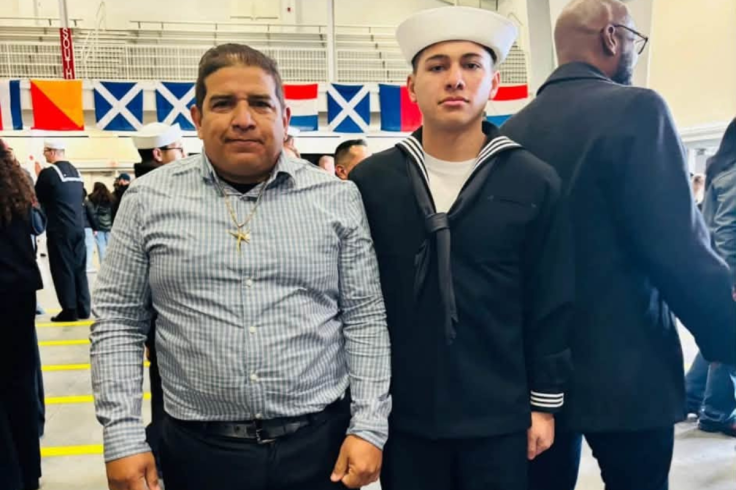
Joshua Aviles was in his ninth month at sea when the call reached him. His father had been picked up on the way to the mechanic.
The sailor had worked 12-hour shifts aboard the USS Abraham Lincoln, over 250 days of them, with no break at all. His father, Luis Manuel Aviles, 48, does handyman work in Key West, Florida. Border Patrol agents stopped and arrested him on Saturday morning.
The elder Aviles is Nicaraguan and has lived in the United States for about 19 years. He is now in the custody of Immigration and Customs Enforcement (ICE) while the government works to deport him.
His son wrote about it on Facebook. The post has travelled a long way since.
The Post That Reached Shore
Joshua Aviles opened his post with the nine months at sea and what the country had meant to him. His father holds a driver's licence, a Social Security card and a work permit, he wrote, and the family had been waiting on a green card.
His post called the news heartbreaking. He did not know, he wrote, how he could 'mentally continue working 12+ hour days' while his father sat somewhere in custody.
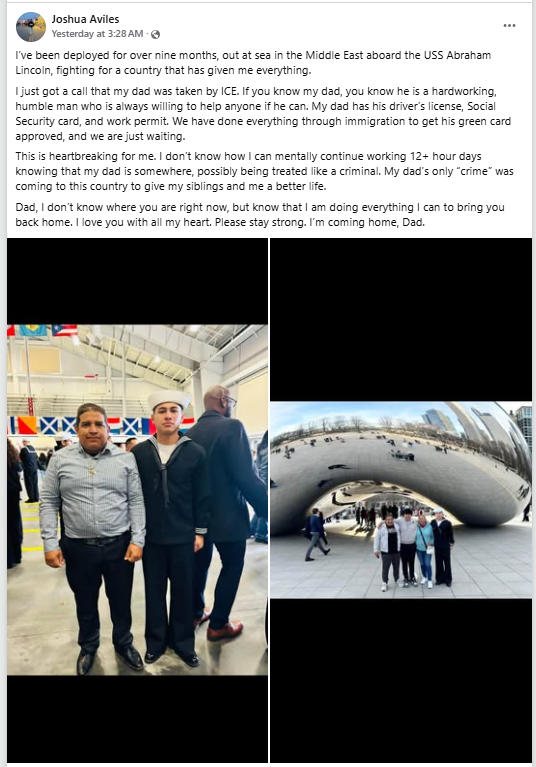
Joshua's half-sister, Katty Delgado, told CBS News what happened. Their father was arrested near a supermarket while driving to a garage. She knows of no arrest record or criminal charge against him.
Luis Manuel's wife, Argelia Aviles, told the Associated Press that he 'loves his children with all his soul.'
The ship is already under scrutiny. The Lincoln went more than 200 days without a port call, a record for modern times at sea. Democratic lawmakers have demanded answers about conditions and crew mental health on board.
What the Government Says
The arrest was confirmed by the Department of Homeland Security, which says Aviles entered the country illegally. He stays in detention while the deportation case runs. The department was blunt about the military link, saying a relative in uniform is 'not a free pass to violate our nation's laws.'
Officials have not challenged the family's account that he has no criminal record. Their case is narrower than that. Congress writes the immigration laws, the department says, and it does not pick which ones to enforce.
The Route the Military Advertises
The awkward part is that immigration law already provides a route for this family.
Military parole in place has been available since 2013. It allows spouses, parents, or children of service members to apply for status from inside the US. A grant lasts for a renewable year, prevents deportation during that time, and can lead to a green card without leaving. Parole in place was designed for those who entered without inspection, which is how the department describes this entry.
Importantly, the process is not automatic. Officers evaluate each case individually and can deny applications. Some applicants are outright barred. Anyone arguing that a serving son should prevent his father from qualifying is describing how the rule actually functions.
This route has remained open. While courts struck down a broader scheme for spouses, the military-specific process stayed in place.
The security argument is not new. Senators Elizabeth Warren and Kirsten Gillibrand warned in 2019 that removing this protection risked 'distracting those service members from their mission.'
Nobody Is Counting
How often this happens is unknown. The Associated Press counted detained relatives of serving personnel for the first time and found dozens held, at least six deported, and one who left voluntarily. The government keeps no tally of its own.
The Lincoln began the journey home from the Middle East last week. The crossing home takes several weeks, and Joshua Aviles is on it. Delgado put the ending plainly to reporters. Her brother is coming home without his father.
© Copyright IBTimes 2026. All rights reserved.