Scientists Say a Bucket of Moon Dust Could Change the Search for Ancient Alien Civilisations
The research framework suggests using AI and advanced microscopy to identify possible technological debris in lunar regolith, while stressing that no alien technology has been found
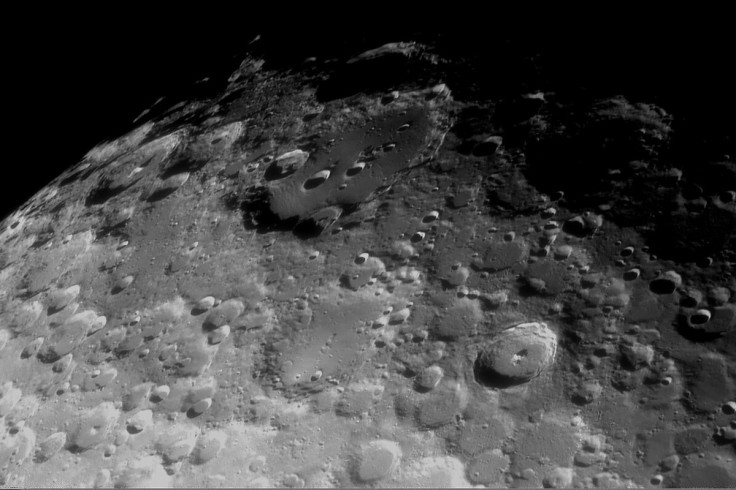
A preprint led by SETI Institute Affiliate Scientist Lewis J. Pinault proposes searching one cubic metre of lunar regolith for microscopic debris that could have originated from extraterrestrial technology.
The study, resubmitted to the International Journal of Astrobiology on 17 August after reviewer comments and currently available on arXiv, does not claim that extraterrestrial technology has been found. Instead, it outlines how future missions could test the idea.
Why Moon Dust Matters to SETI
SETI has traditionally emphasised electromagnetic signals, including radio transmissions and optical signals such as laser pulses. Such searches generally depend on a detectable signal reaching Earth while instruments are capable of observing it.
Physical debris offers a different route. Engineered particles could remain after their makers had vanished, allowing scientists to search for technological activity across far longer periods. The authors describe this as a form of cosmic archaeology.
The Moon is a particularly useful archive because its airless surface undergoes far less weathering and geochemical alteration than Earth's surface. Its surface is continually disturbed by small impacts, a process known as impact gardening. That process can bury particles beneath the surface, potentially reducing their exposure to some forms of radiation, although it also mixes material through the regolith.
The Moon is instead being treated as a collector that has accumulated material from its space environment over billions of years.
The paper builds on work by Ukrainian astronomer Alexey Arkhipov, who proposed that microscopic particles of technological origin could be transported through the Galaxy and accumulate on bodies such as the Moon. The authors call these hypothetical fragments 'Arkhipov particles.'
They could be accidental debris from spacecraft, industrial activity or large engineered structures. The paper considers possible sources including spacecraft, industrial activity and large engineered structures, a hypothetical Dyson swarm, for example, could produce fragments through collisions or degradation.
The study also considers 'Bracewell particles.' deliberately engineered microscopic objects that could be designed for functions such as sensing, information storage or other forms of interstellar activity.
Scientists Say Moon Dust Needs an AI Search
Finding such material would be brutally difficult. The authors estimate that one cubic metre of lunar regolith would weigh about 1.5 tonnes and contain more than a trillion micron-sized grains. Manually examining that quantity of material would be impractical.
Researchers could examine the material using high-resolution scanning electron microscopes, then use computer-vision systems to flag grains with unusual shapes, structures or compositions.
One system discussed in the paper is YOLO-ET, a machine-learning model previously developed to detect, localise and classify microscopic particles and extraterrestrial materials. A flagged grain would not be declared alien. It would undergo further checks using techniques such as focused-ion-beam sectioning, spectroscopy and nano-computed tomography.
That distinction matters. A strange-looking particle could be industrial contamination, a naturally formed mineral or material produced by an impact. A credible claim would need to be supported by multiple independent lines of evidence, potentially including chemistry, isotopic composition and internal structure.
The journey to the Moon would create another problem. Particles crossing interstellar space could be eroded by radiation, gas and collisions with dust. The study models whether refractory particles could survive interstellar transport for roughly 100 million to one billion years.
Arrival speed is equally important. A grain arriving at sufficiently high speed could be substantially damaged or vaporised on impact, reducing the chance of recovering recognisable evidence. The paper examines whether solar radiation pressure could slow certain particles enough for some material to survive.
Even then, survival would not mean easy identification. Remnants might appear as individual grains or become incorporated into agglutinates, glass-rich aggregates formed during impact processes in lunar soil.
A Negative Result Would Still Matter
The most useful outcome may not be a discovery. It could be a null result.
Under the paper's assumptions, a null result from one cubic metre of regolith could rule out some scenarios in which typical Solar-type stars dispersed more than about 0.1 Earth masses of long-lived artificial particulate debris over galactic history. For deliberately targeted particles, the model places an upper limit of about 0.4 kilograms per billion years on the product of visitation rate and mass released per visit, assuming no detection.
Those figures are not estimates of how many alien civilisations exist. They are limits on particular forms of technological debris, based on assumptions about transport, survival and distribution.
The researchers also note that previous lunar samples were not collected or systematically screened specifically for microscopic technosignatures, so their lack of a confirmed detection does not test the hypothesis directly. No confirmed extraterrestrial technology has been identified in lunar samples.
The proposal therefore remains a research framework, not evidence of alien life. It asks whether the Moon's dusty surface could preserve a physical record of technological activity that radio telescopes would miss.
The catch is scale. A mission would need to collect and carefully characterise a large quantity of regolith, the paper uses one cubic metre as its reference sample. Then scientists would have to distinguish an engineered grain from the Moon's already complicated geological background.
Still, the idea has one advantage over the usual search for signals. A civilisation does not need to be transmitting today for its debris to remain detectable. If the Moon has been keeping the record, the evidence may be sitting quietly in the dirt.
© Copyright IBTimes 2026. All rights reserved.
- Recommended For You