

Astronomer Theorise That Extraterrestrial Megacomputers Could Soon Reveal Hidden Alien Civilisations
A new study suggests that advanced extraterrestrial computing systems could emit detectable waste-heat signatures, known as Slysh halos, around stars, potentially visible in the far-infrared spectrum
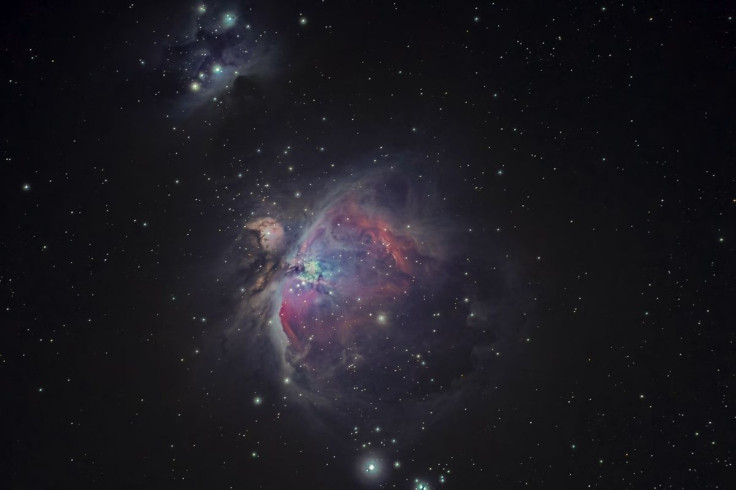
A new preprint by astronomer Michael Garrett proposes that extremely advanced extraterrestrial computing systems could leave detectable waste-heat signatures around stars.
A new paper posted on the arXiv preprint server proposes that highly efficient computing systems might create a detectable signature known as a Slysh halo.
The idea begins with a simple premise about civilisation itself. Computers have become steadily more powerful and central to human life, and the paper asks whether advanced extraterrestrial societies might also push computation towards its most efficient possible form, making their technology visible from Earth.
Extraterrestrial Megacomputers Could Leave a Slysh Halo
The paper argues that hyper-efficient computers could become a defining feature of a technologically advanced civilisation. Its proposed Slysh halo takes its name from V. I. Slysh, who previously argued that advanced civilisations would benefit from operating technology at very low temperatures.
That matters because irreversible computation carries a minimum thermodynamic energy cost and generates waste heat. Landauer's principle, as described in the paper, links the maximum efficiency of non-reversible computation to operating temperature.
Present-day data centres provide a familiar comparison. Modern data centres produce enough heat to require cooling systems. The same underlying problem would remain for a far more advanced computer, only at a vastly different scale.
The colder the system, the more efficient it can become. The source gives a striking comparison. A system operating near the Landauer limit at 10 Kelvin could perform roughly 30 times as many irreversible operations per joule as one operating at 300 Kelvin.
A Slysh halo pushes that logic outward. Instead of concentrating computers close to a planet, an advanced civilisation could distribute computing infrastructure through the cold outer regions of its planetary system.
The resulting structure could resemble an extended halo, although the paper notes that it need not be spherical and could instead take forms such as a thick disc or torus.
The paper does not address exactly how an alien society would engineer such a structure. The observational question is narrower. What would all that unavoidable waste heat look like from here?
Extraterrestrial Megacomputers May Glow in the Far Infrared
The paper suggests that the most likely operating temperature for a Slysh halo would fall between 5 and 30 Kelvin. At those temperatures, its waste heat would emerge mainly in the far-infrared or submillimetre spectrum.
Detecting it would not be straightforward. Many stars are surrounded by circumstellar debris, while other natural cold sources can also emit radiation at submillimetre wavelengths. Efficient computing systems could also be spatially diffuse, spreading their waste heat over a large area and making surface-brightness sensitivity an observational challenge.
Engineered radiators could instead be distinguished by a nearly grey, line-free thermal spectrum, along with other characteristics such as their temperature profile, morphology, and motion with the host star. Natural cold dust generally produces different spectral behaviour.
Extraterrestrial Megacomputers Sit Near Current Detection Limits
The paper argues that existing far-infrared and submillimetre observations already probe part of the relevant parameter space, while archival ALMA data could be reprocessed to search for compact or more distant candidates.
That raises the possibility that astronomers could examine observations already collected and search for unusual far-infrared or submillimetre signatures around nearby stars.
Future telescopes working at those wavelengths could make the search more sensitive. The proposal does not claim that such halos exist, only that a civilisation built around extreme computing efficiency might leave a measurable physical trace.
For now, the suggested signal remains hypothetical and difficult to separate from natural stellar debris. The paper's test is therefore observational. Search nearby stars for the cold, grey thermal glow that a Slysh halo might produce, and see whether anything is there.
© Copyright IBTimes 2026. All rights reserved.