'This Is Not the Promised Land': Bangkok Protesters Demand Scrutiny of Alleged Israeli Landholding and Nominee Businesses
The demonstration, led by activist Sondhi Limthongkul, raised concerns about alleged nominee businesses and land ownership while drawing criticism over reported antisemitic placards
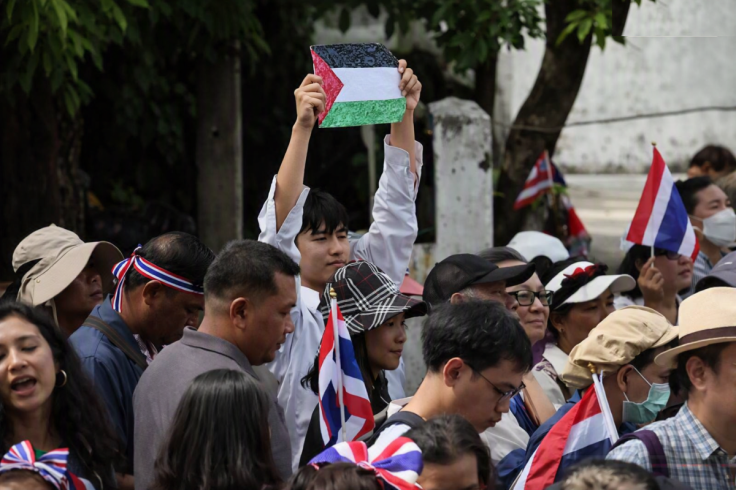
Hundreds of Thai demonstrators gathered outside the Israeli Embassy in Bangkok on Thursday, waving national flags and placards reading 'Thailand Is Not For Sale' and 'This Is Not The Promised Land'.
The rally, led by veteran activist Sondhi Limthongkul, marked a rare instance of a public protest in Thailand directed at a group of foreign nationals. It was the first street action under Sondhi's newly launched 'Take Our Thailand Back' campaign, which he formally announced on 7 September.
The campaign follows months of complaints in Thai communities, reported in local media and community forums, about alleged illegal landholding, cultural friction and the growth of Israeli-linked religious centres.
Four Demands Delivered to the Embassy
Sondhi's movement set out four demands addressing the conduct of Israeli nationals in Thailand, cooperation between Israeli visitors and Thai authorities, scrutiny of land holdings and Chabad centres, and compliance with international humanitarian law.
Addressing supporters outside Ocean Tower II on Sukhumvit 21, where the embassy is based, Sondhi said he had rejected an offer of a private meeting with Israel's ambassador.
The ambassador had offered to meet on another occasion, but Sondhi argued the campaign was being run on behalf of the Thai public and should not be reduced to a private discussion.
Psi Scott Joins Sondhi’s Israeli Embassy Rally
— Thai Enquirer (@ThaiEnquirer) September 10, 2026
Siranudh “Psi” Scott, a marine conservationist and heir to the family behind Singha beer, joined Sondhi Limthongkul’s rally outside the Israeli embassy in Bangkok on Thursday. He wore a T-shirt bearing the words “Not for Sale.”… pic.twitter.com/JE92qSlwvo
Land Claims and Nominee Businesses
Central to the campaign are allegations that some Israeli business operators have used Thai citizens as nominees to circumvent Thailand's foreign ownership restrictions.
Sondhi made similar allegations when he launched the campaign on 7 September, saying some Israeli operators were among foreign nationals allegedly using Thai nominees for illegal or grey businesses.
The grievances are not confined to Bangkok. On the islands of Koh Phangan and Koh Samui, and in the northern town of Pai, disputes involving Thai residents and Israeli visitors over unpaid bills, public conduct and pro-Palestine flags at some Thai-owned businesses have circulated widely online, feeding into broader tensions.
Thailand has seen substantial numbers of Israeli visitors since the outbreak of the Gaza war following the Hamas attack on Israel on 7 October 2023.
More than 277,000 Israelis visited Thailand during the first eight months of 2026, about 7% more than during the same period in 2025, according to Associated Press reporting. SCMP reported that many visitors were Israel Defence Forces personnel seeking respite from the conflict.
Antisemitic Placards Reported Alongside Land and Sovereignty Concerns
The protest was not without controversy. SCMP reported that some placards displayed at the rally were plainly antisemitic, alongside banners addressing land ownership, sovereignty and the conduct of foreign visitors.
Anutin Charnvirakul had earlier rejected the premise behind Sondhi's planned campaign. Speaking on 3 September, the prime minister said Thailand belonged to all Thai people and there was no need for anyone to reclaim it.
Thailand’s Deputy Prime Minister has delivered a stern warning to Israel’s ambassador, insisting all foreign visitors must respect local laws and customs following months of rising tensions in major tourist spots.#ForeignAffairs #Thailand #Israel #Tourists #TheNationThailand…
— Thenationthailand (@Thenationth) September 8, 2026
A Wider Regional Pattern
The friction in Thailand echoes complaints reported by some locals in the Philippines and Sri Lanka over Israeli visitors. However, the available reporting does not establish that these incidents form a single coordinated regional pattern, or that they are directly caused by changes in Israeli travel habits after 2023.
A separate flashpoint has emerged in Phuket, where a Rosh Hashanah gathering is scheduled for 11 September.
Organisers initially expected around 1,000 participants across Chabad House Patong and the Novotel Phuket Resort, but provincial authorities have since required the event to be held at one venue with an 800-person cap.
The changes followed a formal objection from a local group and a review of security arrangements.
The protest signals a shift from isolated online disputes to organised pressure over foreign land ownership, business regulation and the conduct of some foreign nationals.
Sondhi has indicated the campaign will expand beyond Israeli-linked concerns to target other foreign nominee networks, including alleged Chinese-linked businesses. He has also said the movement will be watching an Election Commission decision expected on 14 September.
How Thai authorities respond to the land and nominee-business allegations, and whether concerns over antisemitic elements of the protest are addressed, will shape both domestic debate over foreign ownership rules and Thailand's relations with Israel.
© Copyright IBTimes 2026. All rights reserved.
- Recommended For You