

'Doomsday Glacier' Could Contribute Twice as Much to Sea-Level Rise by 2100, Scientists Warn
Warm seawater flooding beneath Thwaites with every tide is melting it faster than models assumed
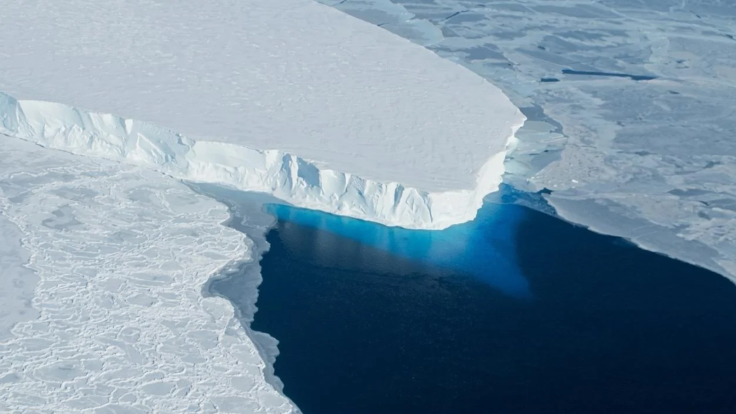
Antarctica's Thwaites Glacier, widely known as the 'Doomsday Glacier', could contribute up to 30mm to global sea-level rise by 2100, according to new modelling that accounts for seawater moving beneath the ice. The researchers say that is roughly twice previous estimates of the glacier's contribution.
The study, published on 12 October in Nature Communications, incorporates a broad, tidally shifting 'grounding zone' where seawater reaches beneath ice resting on the seabed. Researchers from the University of California, Irvine and NASA's Jet Propulsion Laboratory say their model projects the higher contribution even without additional climate warming.
Tides Are Pumping Warm Water Beneath the Ice
Thwaites is roughly the size of Great Britain and already accounts for about 4% of global sea-level rise. Understanding how seawater reaches beneath it is important to forecasting how quickly it will lose ice.
The grounding line marks the transition between ice resting on the seabed and ice floating in the ocean. At Thwaites, however, satellite observations show that this boundary shifts with the tides across a zone several kilometres wide.
As the tide rises, pressurised seawater can lift the ice and move inland beneath it. Water that is warm by polar standards can then melt the glacier from below.
Lead author Mattia Poinelli, who carried out the research at UC Irvine and is now a project scientist at UCLA, said in a university announcement that 'we have come to acknowledge a different arrangement beneath Earth's major ocean-terminating glaciers'.
Rather than treating the transition as a narrow boundary, the researchers incorporated melting across a broader grounding zone. They said this helped the model reproduce the glacier's observed changes more closely than traditional approaches.
Underwater Ridge Could Lose Its Grip
The modelling also examined how this melting could affect the glacier's contact with Mouginot Ridge, an underwater feature that currently helps hold the ice in place.
In simulations incorporating a grounding zone 4–6km wide, the researchers estimated a 60 per cent probability that Thwaites would detach from the ridge by 2100. That is a result of the modelling, rather than an unconditional forecast of what the glacier will do.
Once Thwaites loses contact with the ridge, the researchers expect it to retreat towards the next ridge across the seabed that deepens inland. That underwater terrain makes the glacier vulnerable to further retreat.
The projected contribution of up to 30mm by 2100 concerns Thwaites alone. It does not mean total global sea-level rise would double.
What It Means for Coastal Communities
Co-author Eric Rignot, a professor of Earth system science at UC Irvine, said the findings 'predict greater risk of and exposure to coastal flooding than anticipated in the coming decades'.
The longer-term stakes are considerably larger than the new study's century-end estimate. Thwaites contains enough ice to raise global sea levels by about 65cm if it were lost entirely, according to the International Thwaites Glacier Collaboration.
The glacier also helps hold back ice within the wider West Antarctic ice sheet, which contains enough ice to raise seas by more than 3 metres if it collapsed entirely.
Those figures describe the longer-term potential consequences of ice loss, not the new study's projection for 2100. The collaboration says complete collapse of Thwaites is unlikely within the next few decades.
Findings Build on Earlier Satellite Observations
The new work builds on a 2024 study led by Rignot that used satellite radar observations to map seawater intrusion beneath Thwaites.
That research identified a grounding zone about 6km wide at the glacier's centre and 2km wide along its flanks. It also detected irregular seawater intrusions extending a further 6km inland during spring tides.
Those observations helped establish the importance of seawater reaching beneath grounded ice. The new modelling examines how including these processes changes projections of the glacier's future.
Experts Say Direct Measurements Are Still Needed
Independent researchers said the findings could improve forecasts, but cautioned that conditions beneath Thwaites remain difficult to observe.
Ted Scambos, a senior research scientist at the University of Colorado Boulder who was not involved in the study, told CNN the work could be 'a real gamechanger for sea level forecasting from Thwaites'. He said further research was needed, particularly direct measurements beneath the glacier.
Robert Larter, a marine geophysicist at the British Antarctic Survey who was also not involved in the research, said the environment beneath Thwaites was more complicated than the study could fully capture.
'The reality is that there is a lot we still need to find out about grounding zone processes to be able to make confident predictions about how fast ice will be lost,' he told CNN.
The International Thwaites Glacier Collaboration has also identified tidal pumping as an unresolved research question, including how it interacts with meltwater drainage, sediments and ice. Its findings report calls for continued monitoring and measurements beneath the glacier to test and improve models.
Emissions Cuts Could Still Delay Ice Loss
The projection of continued ice loss without additional warming does not mean future emissions are irrelevant.
The International Thwaites Glacier Collaboration's findings report says immediate and sustained emissions cuts offer the best hope of delaying ice loss. Its modelling indicates that reductions consistent with the Paris Agreement may push the greatest acceleration of West Antarctic ice loss beyond the end of this century.
The findings underline the importance of both improving forecasts of changes already under way and limiting the warming that could accelerate future losses.
© Copyright IBTimes 2026. All rights reserved.