Scientists Call This Year's El Niño 'Godzilla' as It Could Be the Strongest in 1,000 Years Yet
Sea temperatures in the eastern tropical Pacific have reached levels comparable with the record 2015 event, with the peak still to come

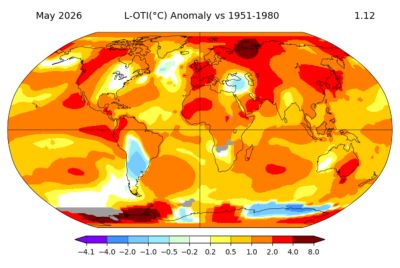
Scientists are describing this year's unusually powerful El Niño as a potential 'Godzilla' event after sea surface temperatures in the eastern tropical Pacific reached levels last seen during the record-setting 2015 phenomenon.
Climate scientist Prof Mat Collins of the University of Exeter says the event could ultimately become the strongest El Niño in a thousand years, although its peak has not yet arrived and the scale of the event remains uncertain.
El Niño is a naturally occurring climate pattern that typically appears every three to seven years, although its timing and strength can vary considerably. The last major event occurred in 2023 and 2024. This year's episode has arrived less than two years later and is already pushing temperatures in the tropical Pacific into exceptional territory.
For Collins, the difficulty is separating the natural behaviour of El Niño from the effects of human-caused global heating. Both are now operating at the same time, making the consequences harder to measure but potentially more severe.
El Niño Could Reach 'Godzilla' Levels
The eastern tropical Pacific has already reached about 3C above average, matching the previous high recorded during the 2015 El Niño. Collins described that level as 'almost unthinkable', while warning that temperatures have not yet reached their expected peak.
Current temperatures in the region are on course to reach 4C above average. If that trend continues, Collins said, the world could see an 'incredible El Niño event'.
The comparison with previous El Niños is complicated, however. Global warming has steadily raised the baseline temperature of the eastern tropical Pacific, meaning an event occurring today cannot simply be measured against an unchanged historical climate.
'So there are two things happening – human-driven climate change and the natural variability of El Niño,' Collins said. He added that it is difficult to determine how much each factor is contributing to the record ocean temperatures, although together they make extreme conditions more likely.
That uncertainty is important. Collins said the event 'could be on course to be the strongest in a thousand years', rather than declaring that it has already broken such a record.
El Niño itself occurs when the normally cooler, drier eastern Pacific becomes warmer and wetter. The shift changes rainfall across the tropical Pacific and can influence weather patterns thousands of miles away.
El Niño Could Bring Drought, Floods and Wildfires
Some of the strongest effects are expected around the Pacific and in parts of the tropics. Collins said Indonesia could experience more wildfires around the peak of the event, while drought conditions could worsen across the Amazon rainforest.
The Indian monsoon has already been weakened, according to Collins, while temperatures could rise around the Pacific Rim and as far away as Britain.
The UK outlook is less certain. Meteorologists have suggested that El Niño could contribute to a wetter autumn and winter, followed by a potentially drier and colder spring. Collins stressed that he was not certain of that pattern because British weather is particularly variable.
He also does not believe the recent extreme temperatures in Britain, or wildfires across Europe, Canada and the US, were primarily caused by this El Niño. The timing is significant because El Niño impacts generally arrive with a lag.
Instead, Collins linked those recent conditions more closely to global warming and persistent weather patterns that can leave high-pressure systems in place for prolonged periods.
The bigger question is whether climate change itself is making El Niño events more frequent or intense. Collins said research suggests that may be happening, but there is not yet enough observational evidence to prove the relationship with complete certainty.
James Hansen, one of the most prominent climate scientists of recent decades, has argued that human-driven climate change could be behind the unusual strength of this year's event. Collins described that as a 'plausible hypothesis' but said it remains difficult to prove.
Climate models nevertheless suggest that the consequences of future El Niños could become more severe. Collins expects bigger rainfall responses and more impactful events in the coming decades.
There is also a practical reason for paying attention now. Modern forecasting systems can predict El Niño events roughly six to nine months in advance, giving governments and farmers time to prepare.
That can mean changing crops in vulnerable parts of Latin America, strengthening infrastructure in south-east Asia and improving preparations for wildfires. Collins said maintaining real-time observations of the Pacific Ocean will remain essential.
The longer-term answer, he argued, is still reducing greenhouse gas emissions. Geoengineering proposals, including attempts to alter cloud formation over the eastern Pacific, remain experimental and uncertain. Even if such an intervention suppressed an El Niño temporarily, Collins warned that the heat stored deeper in the ocean could cause the event to return.
For countries already dealing with climate-related disruption, that uncertainty carries a human cost. Collins said El Niño can severely affect agriculture and the global economy, with poorer countries often facing the greatest vulnerability when another major climate shock arrives on top of existing warming.
© Copyright IBTimes 2026. All rights reserved.
- Recommended For You