

3I/ATLAS Tracking: Why This 137,000mph 'Rifle Bullet' Terrifies Experts
Track interstellar comet 3I/ATLAS as it passes Earth

The night sky is often a canvas of predictable beauty, but every so often, a celestial wanderer arrives to remind us of the vast, untamed mysteries of the deep cosmos. This week, we are witnessing exactly that: a final, fleeting farewell to a traveller that began its journey in a different corner of the galaxy. Interstellar Comet 3I/ATLAS is preparing to make its closest approach to Earth, offering a once-in-a-lifetime spectacle before it vanishes into the dark abyss of interstellar space forever.
The object's arrival has sent shockwaves through the scientific community, not because of an imminent collision, but because its unprecedented speed and 'black swan' characteristics have exposed critical gaps in our global security. Experts are particularly unsettled by its 'hyperbolic' trajectory, which proves the object is not bound by our sun's gravity, meaning it appeared from the darkness with almost no warning.
On Friday, this cosmic nomad will swing within 167 million miles of our planet. While that may sound like a staggering distance, in the grand theatre of the solar system, it is a front-row seat. To put it in perspective, the Red Planet, Mars, is currently sitting roughly 250 million miles away. For those with a keen eye and a modest backyard telescope, the comet will present itself as a luminous, star-like point of light, marking the climax of a visit that has captivated the scientific community since its discovery last July.
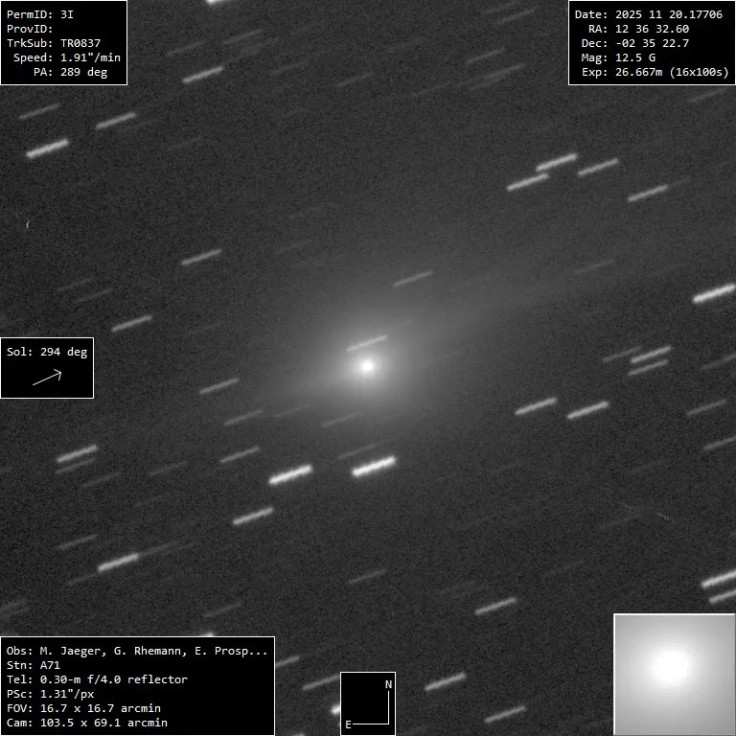
Chasing the Ghostly Glow of Interstellar Comet 3I/ATLAS
What makes this encounter so profound is the sheer rarity of the guest. 3I/ATLAS is only the third object ever identified as having entered our solar system from the interstellar medium. It follows in the footsteps of the enigmatic 'Oumuamua and the comet 2I/Borisov, serving as a rare bridge between our local neighbourhood and the stars beyond. Because it is a 'stray' object, it acts as a pristine time capsule, carrying chemical signatures from a distant, unknown star system.
However, recent data has added a layer of dread to the fascination. NASA's astrochemists have detected 'substantial' quantities of hydrogen cyanide and carbon dioxide streaming from the comet — chemicals that, while natural, are present in far higher concentrations than anything seen in local comets.
Harvard's Professor Avi Loeb has raised eyebrows by pointing out that the object's path is 'statistically unlikely', aligning almost perfectly with the solar system's ecliptic plane, a coincidence that has forced planetary defence teams to treat it as a high-stakes drill for a 'silent' interstellar interceptor.
Astronomers are currently working around the clock to squeeze every possible bit of data from this flyby. By scrutinising the dust and gas tails — the coma — released as the sun's heat warms the comet's icy heart, researchers hope to decode the recipe of its birth. Does it contain the same organic building blocks as our own comets? Or is the chemistry of other solar systems fundamentally different? These are the questions that make 3I/ATLAS more than just a light in the sky; it is a messenger from the unknown.
Beyond pure curiosity, there is a more grounded reason for the intense interest. The United Nations' International Asteroid Warning Network is tracking the path of 3I/ATLAS with rigorous precision. While the comet poses no threat to Earth, the exercise of monitoring its high-speed trajectory helps refine our planetary defence systems. Every observation of a near-Earth object strengthens our ability to predict and potentially deflect future threats from space.

A Bullet in the Dark: The Origins of 3I/ATLAS
Despite the intense scrutiny, the home world of this interstellar traveller remains a total enigma. Most objects in our solar system follow elliptical orbits, bound forever by the sun's gravity. 3I/ATLAS, however, is on a hyperbolic path. It is moving far too fast for the sun to ever catch it. When it was first spotted, it was screaming through the void at 137,000 miles an hour — roughly 40 miles every single second.
It is this velocity that truly terrifies experts. At such speeds, an impact would be several times more devastating than a standard asteroid of the same size, yet our current 'Spaceguard' systems are largely designed to track slower, local rocks. Astronomers have admitted that if 3I/ATLAS were on a collision course, humanity would have had less than six months to react — a timeframe far shorter than the five years NASA typically requires to launch an interception mission.
Astronomer David Jewitt, who utilised the Hubble Space Telescope to study the object, provided a sobering analogy for NASA earlier this year. 'It's like glimpsing a rifle bullet for a thousandth of a second,' he explained. Because the velocity is so extreme, tracing its path back to a specific star system is virtually impossible.
For the general public, the best chance to witness this interstellar stranger arrives on Friday evening. While binoculars will suffice for a glimpse, the Virtual Telescope Project is providing a lifeline for those plagued by British clouds, with a live stream scheduled to begin at 11 P.M. EST on Dec. 18. As 3I/ATLAS rounds the sun and begins its long, lonely trek back into the interstellar dark, it leaves us with a humbling reminder of our place in a much larger, stranger universe.
As 3I/ATLAS rounds the sun and begins its long, lonely trek back into the interstellar dark, it leaves us with a humbling reminder of our place in a much larger, stranger universe.
© Copyright IBTimes 2026. All rights reserved.