

Comet 3I/ATLAS Anti-Tail Extends Half a Million Kilometres — Spanning Beyond The Moon
Scientists are baffled: Is it a comet, or alien technology?

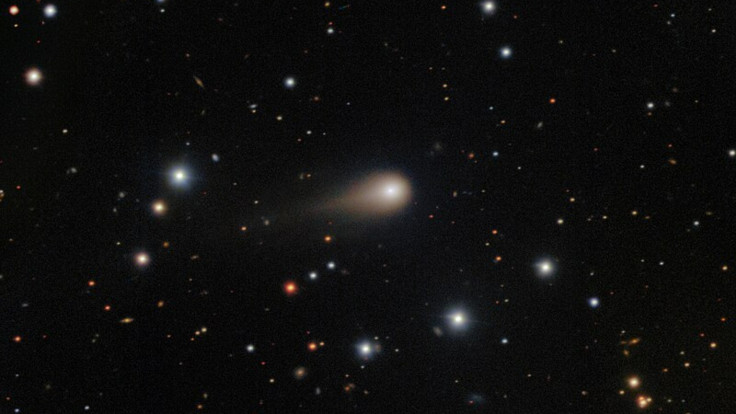
The sky is full of familiar objects, but occasionally, an interloper arrives that defies our known physics. At 02:28:12 UTC on Dec. 15, 2025, a lone image captured by astrophotographer Toni Scarmato in Calabria, Italy, did just that.
Using a modest 0.25-metre telescope, Scarmato registered not just the routine cosmic blur of a distant traveller, but a structure so immense and so rapid in its formation that it immediately forced scientists to question everything they thought they knew about interstellar visitors.
The image, once processed using a Larson–Sekanina rotational gradient filter, confirmed the unbelievable: interstellar object 3I/ATLAS was streaming a massive, sunward anti-tail extending outwards to roughly half a million kilometres from its nucleus. To put that in perspective, this is a greater distance than the average space between the Earth and the moon.
While a typical comet's tail streams away from the sun, this 'anti-tail' was pointing directly toward it. Crucially, the analysis was rigorous: the feature was determined not to be a visual artefact, a background smear, or a mere projection illusion, but a genuine physical structure persisting across multiple exposures within a mapped field of view spanning approximately 0.86 by 0.39 million kilometres.
The Forensic Case for 3I/ATLAS: Beyond Conventional Comets
The physics behind this gargantuan solar-facing plume is where the forensic investigation truly begins. Cometary anti-tails do exist, but they are almost always optical effects — dust left in the orbital plane that appears to point sunward only from specific viewing angles. What makes 3I/ATLAS unique is its sheer scale, its coherence, and its apparent dynamism.
As of Dec. 15, 2025, the object was situated roughly 270 million kilometres from Earth. It will reach its closest approach on Dec. 19, at about 268.9 million kilometres, a negligible distance reduction but a critical moment for observation. The speed at which this structure formed is astonishing.
To reach half a million kilometres in the roughly 45 days since its perihelion (closest pass to the Sun), the expelled material would need to be moving sunward at a minimum relative speed of about 130 metres per second. This sustained speed cannot be easily explained by the gentle push of solar radiation pressure or the standard sublimation of ice pockets on a rotating nucleus.
When an observed phenomenon exceeds all known physical parameters, the burden shifts entirely to the scientific community to explain the 'why'. Researchers are testing natural hypotheses — extreme rotation, unusual grain size distributions, or highly anisotropic outgassing — but each explanation requires layers of stacked assumptions that push conventional models past their breaking point.
This unprecedented anomaly feeds directly into the statistical problem facing planetary science. We simply do not have a robust census of interstellar objects (ISOs). Current survey systems, including Pan-STARRS and ATLAS, can only reliably detect objects larger than roughly 100 metres across within distances comparable to the Earth–sun separation. This means we are only seeing the largest, slowest members of a population we barely understand, ensuring that each new interstellar visitor carries a disproportionate weight of significance.
Why 3I/ATLAS's Directed Jet Theory Resists Dismissal
The inability of standard models to account for the object's behaviour has led to a much-discussed, though cautious, alternative: the structure behaves more like a directed jet than a passive dust feature. Harvard astrophysicist Avi Loeb, a proponent of looking beyond the strictly cometary explanation, has repeatedly argued that when data refuse to fit established categories, 'the possibility of technological origin should not be dismissed out of hand'.
This does not constitute a conclusion of 'alien intent', but rather an acknowledgement that thrust-like behaviour is a known physical process — just one not traditionally associated with inert space debris. Such anomalies are essential to the 'Loeb Classification Scale', which attempts to rank ISOs based on how strongly their properties deviate from our natural expectations. Without a larger dataset, it is impossible to gauge the statistical commonality of outliers, making disciplined, evidence-based analysis crucial.
Beyond academic debate, the behaviour of 3I/ATLAS has practical implications for planetary defence. Agencies like NASA's Planetary Defense Coordination Office track near-Earth objects primarily based on stable, predictable trajectories. An object capable of sustained, directed mass ejection could, in theory, alter its path in ways passive bodies cannot.
There is zero evidence that 3I/ATLAS poses a threat to Earth, yet there is clear evidence it does not behave like a typical comet. As observatories around the world continue their heightened scrutiny into the new year, the data proves one thing: this interstellar visitor sits at the extreme edge of known comet behaviour, and that alone guarantees its place in the history books.
As 3I/ATLAS makes its final, closest pass by Earth on Dec. 19, 2025, the debate will only intensify. Is this colossal, sun-facing plume merely an exotic quirk of interstellar ice, or are we witnessing the first physical evidence that something non-natural has entered our solar system?
© Copyright IBTimes 2026. All rights reserved.