

99-Million-Year-Old Feather Trapped in Amber Challenges Scientists' Understanding of Flight Evolution
The Burmese amber fossil had a modern-looking shape but lacked barbule hooklets and a fully developed rachis, limiting its aerodynamic performance
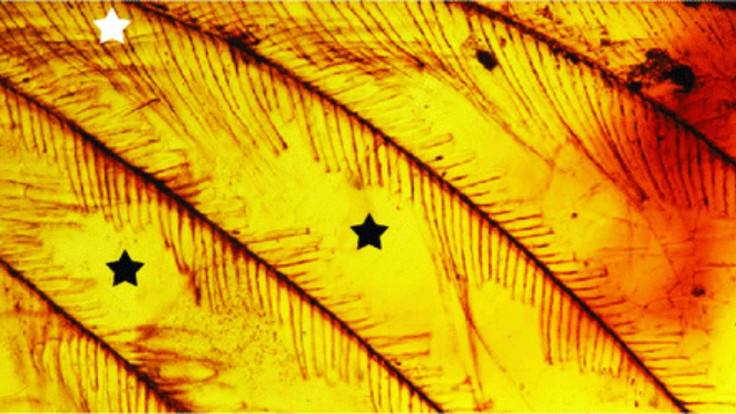
A newly analysed 99-million-year-old feather preserved in Burmese amber is offering fresh insight into how the structures associated with modern bird flight evolved, according to a 2026 study.
The specimen, which displays an advanced external feather structure but lacks some of the microscopic features associated with aerodynamic performance, provides evidence that different aspects of feather development emerged at different evolutionary stages.
The specimen, recovered from Burmese amber originating in northern Myanmar, was donated to the Biology Museum of East China Normal University in 2016 by an anonymous amateur collector.
This remarkably fossilised plumage provides direct structural evidence that certain prehistoric feathers achieved advanced macroscopic dimensions and complete outward symmetry before developing the necessary microscopic adaptations required for powered aerial locomotion.
A Structural Mosaic That Limited Aerodynamic Performance
Despite its modern-looking outline, closer examination revealed that the feather lacked interlocking barbules. Hooklets on barbules normally connect neighbouring barbs to create the continuous surface characteristic of many modern flight feathers.
The fossil's central shaft, or rachis, also remained incompletely differentiated. In modern birds, these hooklets help neighbouring barbs interlock, maintaining a coherent feather vane that contributes to the aerodynamic properties of flight feathers.
Their absence suggests that the fossil feather could not maintain the same continuous aerodynamic surface as a modern flight feather, potentially limiting its performance under airflow.
Furthermore, structural analysis of the 99-million-year-old specimen, catalogued as ECNU A0033, indicated that the rachis consisted solely of a thickened dorsal cortex, entirely lacking a ventral cortex or internal medullary cavity.
Computer simulations utilising a one-way fluid–structure coupling framework demonstrated that this semi-tubular, open shaft construction made the feather substantially more flexible under airflow than a solid, cylindrical model.
What the Feather Reveals About Prehistoric Plumage
Researchers also examined the fossil's melanosomes, pigment-bearing structures preserved within the feather. Their analysis identified dark pigmentation, which the authors said was consistent with previous findings concerning feather colouration in non-avian theropod dinosaurs and early birds.
However, the specimen's original owner remains unidentified because no diagnostic skeletal remains were preserved alongside the feather. Based on its structural characteristics, the researchers consider it most consistent with a non-avialan pennaraptoran theropod.
The discovery also raises questions about the evolutionary pressures responsible for the development of elaborate feathers before their aerodynamic refinement. Researchers suggest that the evolution of pennaceous feather structures may not initially have been driven primarily by the demands of powered flight.
Feathers have multiple biological functions, including insulation, display and visual signalling. However, the available evidence does not establish which, if any, of these functions applied specifically to the animal that carried ECNU A0033.
A Stepwise Framework for Early Avian Evolution
Decoupled development observed in the specimen supports a multi-stage evolutionary development from non-avian theropod dinosaurs to modern birds.
Rather than a simultaneous transformation where external shape and internal microscopic structures evolved in tandem, the fossil record demonstrates that macroscopic traits like symmetry and elongation came before microscopic refinements.
The findings suggest that the developmental processes responsible for feather elongation, branching and vane organisation were not necessarily synchronised with those responsible for barbule interlocking and the internal differentiation of the rachis.
By documenting a large Cretaceous feather with an advanced external structure but incomplete internal differentiation, the study provides new evidence for understanding how pennaceous feathers evolved.
It also highlights why the appearance of a modern-looking feather should not automatically be interpreted as evidence of adaptation for powered flight.
© Copyright IBTimes 2026. All rights reserved.