Microsoft Workers Feel Better About Their Jobs But Worse About Their Managers, Internal Survey Shows
Internal survey highlights employee enthusiasm but reveals dissatisfaction with managerial support

A stark internal contradiction is taking shape inside Microsoft. The software giant's own employee surveys, obtained by Business Insider, show a workforce that feels increasingly energised about its work—yet increasingly let down by the people managing it.
Microsoft's twice-yearly Employee Signals survey drew responses from 71% of staff and captured nearly 265,000 comments. The headline number was encouraging: the company's 'Thriving' score, measuring how energised and empowered employees feel doing meaningful work, rose 3 points to 79. On security awareness, team inclusion, and cultural alignment, scores were among the strongest on record.
But the manager survey told a different story. Across every dimension where managers were asked to support their people actively, scores moved in the wrong direction.
What Internal Microsoft Employee Survey Reveals
In June 2026, results from an internal Microsoft employee survey offered a rare and direct view into workforce sentiment at one of the world's most closely watched technology companies. The data, shared by Chief People Officer Amy Coleman in an internal memo, showed employees feeling more energised about their work—and meaningfully worse about their managers.
Employees responded most favourably to questions around security awareness, team inclusion, and cultural alignment. The lowest-scoring areas were broader experience in their current role, access to the tools needed to work effectively, and clarity on how their work connects to wider organisational goals.
The sharper findings came from a separate annual survey focused on managers and leaders. Overall confidence in managers held steady at 85%, unchanged from the prior year. But the scores that fell were pointed. Coaching through day-to-day challenges dropped 5 points to 76. Giving clear feedback to help employees improve fell 4 points to 79. Motivating employees to do their best work declined 2 points to 82. The three weakest categories all pointed to the same problem: managers are being seen as competent, but not particularly helpful.
The results land during a period of significant internal pressure. Microsoft has ratcheted up performance expectations across the organisation, overhauled the HR function responsible for pay and promotions, and offered a buyout scheme for employees considering early retirement.
Coleman acknowledged the mood directly in her memo: 'Many of you shared feelings of uncertainty and pressure as the work evolves. The leadership team and I hear that, and we're committed to being more transparent, communicating more frequently, and giving context wherever we can.'
Nadella's Restructure and the AI-First Pivot
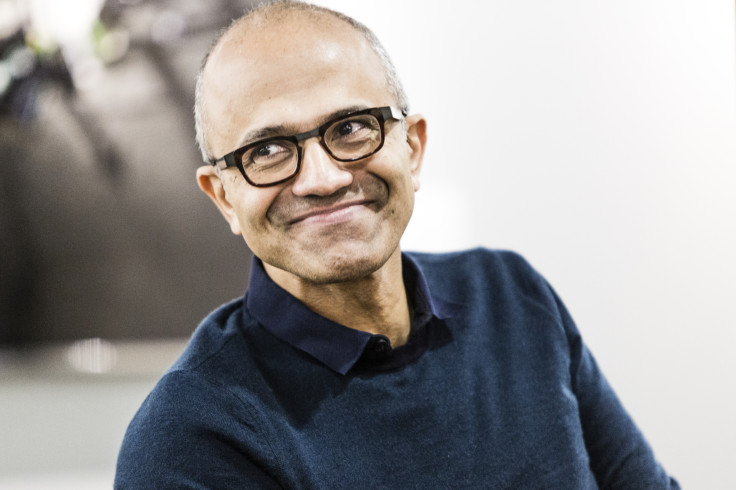
The survey drops at a time when Nadella has moved aggressively to reorient the company. According to The Next Web, Microsoft retired its Senior Leadership Team (SLT), a governance body that had existed for decades, and replaced it with a leaner structure. The new corporate leadership group consists of only five people, including Nadella himself. A separate engineering leadership group of roughly 35 product and engineering leaders now operates alongside a dedicated Copilot leadership team of three members who meet with Nadella weekly. Nadella also personally reviews AI performance metrics each week.
The restructuring reflects what Nadella described as an urgent inflection point. 'The pace of this platform shift is happening faster than anything we've seen,' he said, according to The Next Web. He added that Microsoft 'can't afford to be slow,' warning that falling behind on AI would represent 'a massive disadvantage.'
In related development, Microsoft cancelled licenses for Claude Code within its Experiences and Devices division in May, citing cost concerns. Engineers in that unit were redirected to GitHub Copilot CLI, a Microsoft-owned product, instead.
Microsoft has not commented on the employee survey as of this writing.
© Copyright IBTimes 2026. All rights reserved.
- Recommended For You