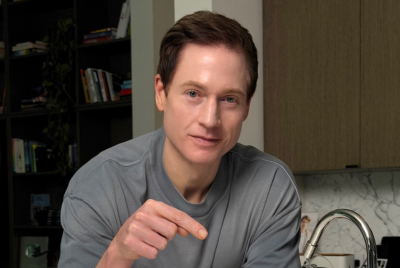
Daniel Nadler – The Tech Entrepreneur Revolutionising the Medical Industry
OpenEvidence, founded by Daniel Nadler, is proving a real-life case study of how AI can fundamentally alter the medical professional.

Every day doctors the world over are continually searching for answers to the hundreds, if not thousands, of unique enquiries they receive from vulnerable patients. For many, this proves a painstaking, laborious and often frustrating exercise trawling fragmented research databases under intense administrative pressure. This often results in partial or incomplete answers. However, thanks to Daniel Nadler's OpenEvidence, 45% of America's doctors are saving time and alleviating patient concerns in record time.
OpenEvidence was only founded in 2022. Having started up, invested in and sold a series of successful tech ventures, Daniel Nadler began what would be his most successful company to date. In headline terms, OpenEvidence provides medical professionals with a simple to use, informative and rapid database of responses to the myriad of medical questions they need to answer daily. What once involved trawling Google and countless web-based databases is now available with a few clicks.
It is easy to see why OpenEvidence is often termed 'ChatGPT for doctors'. It allows medical professionals to input questions relevant to the patient in front of them and generate quick, accurate responses. Perhaps more than any other sector, medicine is an area where AI's potential has been hotly anticipated and debated for some time. Visions of a world without human doctors, or surgery conducted by sophisticated, AI-superpowered robots have not felt as outlandish as they may have once seemed.
OpenEvidence doesn't quite reach the realms of science fiction meets reality, but it does feel like AI finding a grounding in practical reality. It is likely no coincidence that the company was founded around the same time that large-language models (LLMs) really began to take off. Daniel Nadler's creation recognises that AI has both a potentially vital role to play in enhancing doctor and patient experience, but also the necessity of maintaining human interaction. Ultimately, we all feel the very human need to talk to a person when at our most vulnerable. This is never more so than when we need medical care and attention.
For OpenEvidence, the continued development of the model remains key to its future success. Accuracy is its most vital attribute. Speaking to TIME recently, Nadler emphasised how doctors staying on top of the latest medical research and developments was 'basically impossible'. This offers some insight into why he founded the company in the first place.
Nadler is keenly aware that the ability of the model to accurately spot information relevant to an enquiry is key to doctors continued use. It is why, in a Forbes interview earlier this year, he said he plans to use the funds from a recent fundraising round to build an 'orchestra' of smaller models trained to focus on a specific area within the broader field of medicine. This will then feed responses into the OpenEvidence main model.
In the same interview, Nadler said 'if you think about it, it works exactly like a human hospital'. By this, he means the ambition is to develop the model to the point where each enquiry is analysed by the central model and rerouted to the relevant sub-model, much like a doctor asking the opinion of a specialist. This has helped OpenEvidence become the official AI partner of organisations like the New England Journal of Medicine and the National Comprehensive Cancer Network.
Looking ahead to the future, the medical and tech sectors have been natural bedfellows since long before LLMs existed. The iron lung, the implantable pacemaker and magnetic resonance imaging (MRI) are just three of hundreds of examples of technology and medicine working together to make lives better.
Daniel Nadler's OpenEvidence marry these two worlds in a very different way, to provide a better, more impactful and more reassuring patient experience. It may not have the same dramatic effect as the examples listed above, but it is no less vital to how patients experience medical services and experience an already fraught, nerve-wracking experience.
© Copyright IBTimes 2026. All rights reserved.
- Recommended For You