

Is Trump Sundowning? Official Raises Eyebrows With Revelation of President's 4-Hour Sleep Routine
Viral content and insider revelations about Trump spark health and stamina concerns
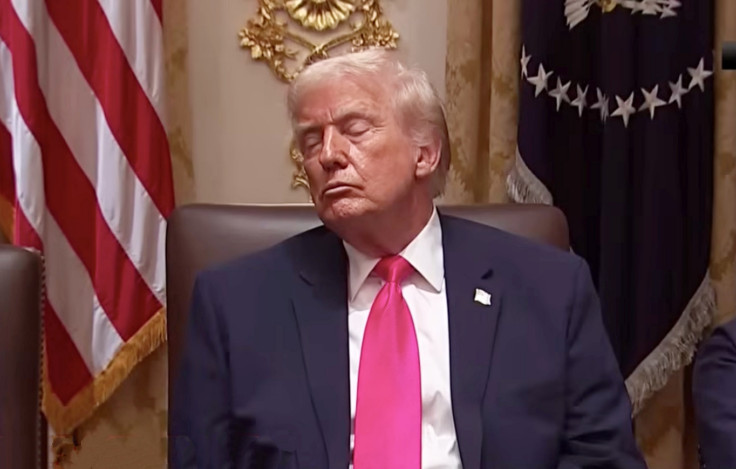
US President Donald Trump's reported sleep patterns, including claims he sleeps as little as four hours a night and appears to nod off at official events, have ignited a fresh and contentious debate over his health and fitness for office.
The discussion, amplified on social media and in traditional news outlets alike, centres on footage and commentary suggesting the 79-year-old president often fights sleep during official duties. This dynamic has fed speculation about his stamina, cognitive function and daily routine. Critics say the pattern merits scrutiny; allies insist it reflects an atypical but effective work ethic.
Claims About Sleep Routine and Public Behaviour
Recent viral content on platforms such as TikTok has emphasised moments in which Trump appears to struggle to stay awake during televised events, feeding narratives about his energy levels.
Multiple reports have also documented considerable occasions where Trump's alertness was called into question. During a Cabinet meeting, for example, footage showed the president with his eyes closed for extended intervals while officials delivered statements, which prompted viewers and commentators to suggest he was nodding off. Critics seized on this imagery as evidence of fatigue during formal work sessions.
In another instance, Trump was seen appearing to battle sleep during a televised Oval Office event in early November, drawing national attention and derision from political opponents. Multiple outlets noted visuals of the president with heavy lids as aides outlined policy details.
The president's own responses to such coverage have been combative. In a Truth Social post, Trump denounced media reporting on his health and alleged cognitive decline as 'seditious, perhaps even treasonous', claiming he had 'aced' medical and cognitive assessments.
The New York Times and Associated Press have reported that his schedule has changed compared to his first term, with fewer public engagements and instances of seeming fatigue. The Times noted that his public appearances have decreased and that observers have picked up on signs suggesting he may be pacing his activities differently.
The 'Four-Hour Sleep' Claim
The notion that Trump sleeps unusually little is not new; his own public physician has commented on the matter previously.
In an earlier medical evaluation, White House physician Dr. Ronny Jackson reported that Trump typically slept only four to five hours per night. Although this remark dates back several years, similar observations continue to be cited in discussions about the president's daily routine and endurance.

In addition to doctors' prior comments, current insiders have provided colourful descriptions of Trump's sleep habits. White House chief of staff Susie Wiles told The Mom View podcast that working with Trump can be 'a killer' because his erratic sleep schedule often leaves staff trailing behind his energy curve. Wiles said Trump's day can start later in the morning and involves frequent phone calls and radio appearances before official meetings begin.
These insider accounts dovetail with public remarks from other administration figures. Even Vice President J.D. Vance told Fox News that Trump 'doesn't have an off switch', recounting how the president might call aides at 00:30 or 2:00 in the morning and again shortly after dawn — an anecdote that has been used to illustrate Trump's unconventional rest patterns.
Medical and Political Implications of Sleep Patterns
Medical experts note that sustained lack of sleep can have real impacts on cognition, mood and physiological resilience, especially in older adults. Conditions like sundowning, typically seen in patients with dementia or cognitive decline, manifest as confusion, agitation or sleepiness in the late afternoon and evening. Critics of Trump's behaviour have seized on this term, though there is no public medical diagnosis linking the president to this phenomenon.
Trump falls asleep again during a meeting on live television. If Joe Biden had done this, the media would’ve turned it into a week-long crisis. But with this clown, they shrug because he gives them the clicks that fatten their wallets. Total failures. https://t.co/f33xrg5e1e pic.twitter.com/thbH6GkZtO
— Chris D. Jackson (@ChrisDJackson) December 2, 2025
While clips of Trump appearing fatigued have circulated widely online, there is no formal confirmation from official medical reports that these moments reflect chronic sleep deficiency or underlying neurological issues.
Trump is sundowning, it’s so obvious. Get him in assisted living asap. https://t.co/cE42cHOAyJ
— Brooke Woke AF 🌊 (@BrookeClyde81) December 2, 2025
Indeed, many moments cited as evidence of 'sundowning' or fatigue could also be consistent with brief lapses in attention, an everyday occurrence for many people.
Even without conclusive medical disclosures, the debate underscores broader anxieties about the health and endurance of political leaders in advanced age — a conversation that transcends party lines and speaks to institutional trust.
© Copyright IBTimes 2026. All rights reserved.