

3I/ATLAS Shock: Record-Breaking 500,000km Anti-Tail Could Signal Alien Thruster
Discover the mystery of 3I/Atlas: an interstellar visitor with a massive anti-tail defying scientific expectations
A mysterious visitor from the depths of interstellar space is currently putting on a celestial light show that has the world's leading astronomers — and more than a few alien hunters — on the edge of their seats. The object, known as 3I/ATLAS, is behaving in ways that defy conventional expectations, sporting a massive 'anti-tail' that stretches further than the distance between the Earth and the moon.
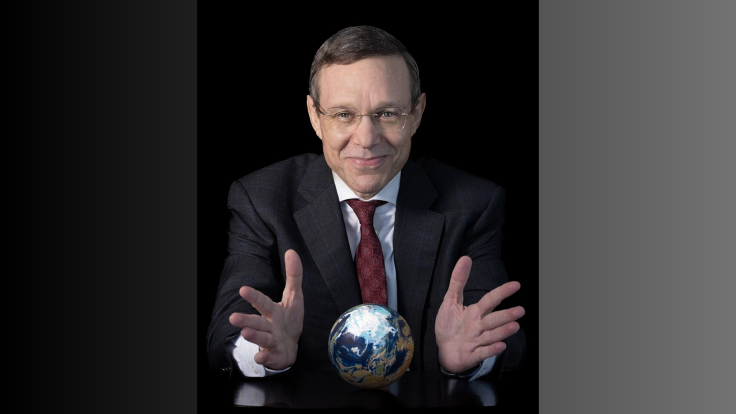
While most of us were looking at the stars and wondering if we were alone, Avi Loeb and 3I/Atlas may have just provided the most compelling reason yet to keep our eyes fixed on the horizon.
The Record-Breaking Anti-Tail of Avi Loeb and 3I/Atlas
As of Dec. 15, 2025, 3I/Atlas has reached a distance of approximately 270 million kilometres from Earth. It is fast approaching its perigee — the point in its orbit closest to our planet — which is expected on Dec. 19, 2025. At that time, it will be roughly 268.9 million kilometres away, a mere 0.4 per cent closer than its current position. However, it isn't the distance that is causing a stir in the scientific community; it is the object's unprecedented physical characteristics.
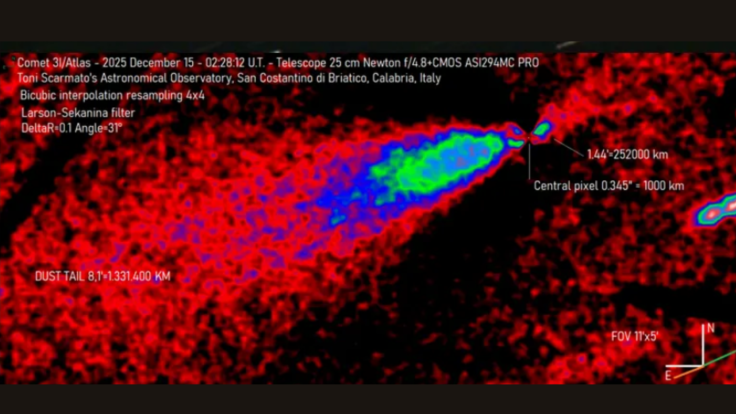
Recent images captured on Dec. 14 and 15 reveal a prominent anti-tail extending half a million kilometres from the nucleus of 3I/Atlas toward the sun. To put that into perspective, this luminous trail is longer than the average distance to the moon, which sits at 384,400 kilometres. According to Harvard Professor Avi Loeb, an anti-tail of this magnitude has never been observed in a comet before.
The sheer scale of this feature presents a mechanical puzzle. For the material in the anti-tail to reach a length of 500,000 kilometres in the 45 days following its perihelion, the sunward speed of the material must be at least 130 metres per second relative to the nucleus. Scientists are now tasked with determining if this speed can be maintained by natural processes, such as sublimated dust or gas escaping from ice pockets under solar radiation pressure.

Technosignatures or Natural Wonders: The Mystery of Avi Loeb and 3I/Atlas
If natural sublimation cannot account for such high speeds, the alternative is far more provocative: a jet from a technological thruster. This possibility sits at the heart of the debate surrounding interstellar objects. The reality is that our current 'census' of interstellar traffic is woefully incomplete. State-of-the-art survey telescopes like Pan-STARRS, ATLAS, and the Rubin Observatory are limited in what they can see.
These systems generally only detect the reflection of sunlight from objects larger than 100 metres in diameter — roughly the size of a football pitch — within a distance comparable to the Earth-sun separation. This is significantly larger than any spacecraft humanity has launched to date. Furthermore, existing surveys are likely to miss near-Earth objects travelling faster than tens of kilometres per second, which is the typical speed of a standard comet or asteroid.
Professor Loeb suggests that we are effectively in a 'dating pool' with interstellar objects. Just as it is difficult to know if a first date is truly exceptional without meeting many others, we cannot yet say for sure how much of an outlier 3I/Atlas is until our sample size grows. Our interstellar dating pool might very well exceed the wildest dreams of science fiction.
The data collected by numerous observatories on Earth and in space will inform us in the coming weeks on the true nature of this visitor. Whether it is a freak of nature or a piece of 'interstellar post', the search itself is the only way to answer Enrico Fermi's famous question: 'Where is everybody?'.
As 3I/Atlas continues its journey through our inner solar system, the coming weeks will be critical for astronomers attempting to decode its origin. Whether it proves to be a unique natural phenomenon or something far more extraordinary, it serves as a stark reminder of how much of our cosmic neighbourhood remains unexplored.
© Copyright IBTimes 2026. All rights reserved.