3I/ATLAS Threat: Harvard Expert Warns Comet Could Be 'Serial Killer'
Is 3I/ATLAS a 'serial killer'? Toxic chemicals found
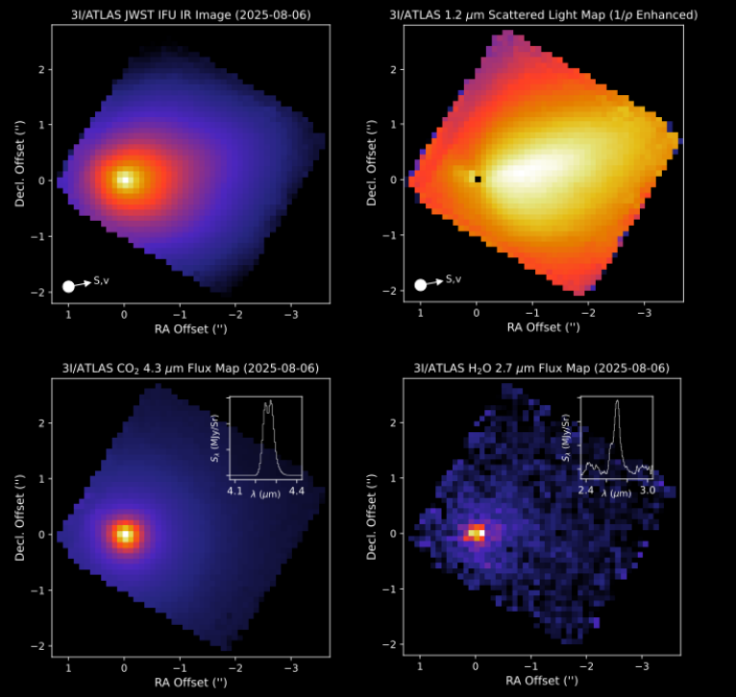
It is a profound contradiction that speaks to the chaotic, generative nature of the universe: the same chemical compounds used as a deadly nerve agent on Earth may also hold the blueprint for life itself. Now, this cosmic paradox has arrived in our solar system, packaged inside a massive, alien interloper. Astronomers are currently scrambling to interpret the chemical secrets being shed by the interstellar object 3I/ATLAS, and the initial findings are simply astonishing.
This visitor from beyond our sun's reach, only the third confirmed of its kind after 'Oumuamua and 2I/Borisov, has baffled experts since its discovery. Unlike a passive 'dirty snowball', its behaviour suggests a celestial object operating under entirely different rules. To peek beneath its icy veneer and determine what materials it carried from a distant stellar nursery, the Atacama Large Millimeter/Submillimeter Array (ALMA) focused its colossal power on the comet.
What they found were two molecules central to the organic chemistry of the cosmos: methanol (CH3OH) and hydrogen cyanide (HCN). These compounds are known to form on icy dust grains in the cold interstellar medium and act as key precursors for the complex organic chemistry relevant to the origins of life.
The 3I/ATLAS Anomaly: Methanol Spews Against the Sun
While the simple detection of these molecules is welcome news, it is the behaviour of these substances that has truly confused experts. The observations, taken as 3I/ATLAS travelled between 2.6 to 1.7 au from the sun (where one au is the Earth-sun separation), revealed a dramatic imbalance in how the chemicals were being released. ALMA detected methanol on Aug. 28, Sept. 18 and 22, and Oct. 1, 2025, and hydrogen cyanide on Sept. 12 and 15, 2025.
Hydrogen cyanide production was found to be 'depleted' in the sunward direction, originating neatly from the nucleus. This is standard cometary behaviour. Yet, methanol exhibited the reverse: it was 'enhanced' in the sunward direction, suggesting a highly energetic, non-standard outgassing process.
The data confirms a methanol production rate that increased dramatically from August through October, showing a power-law dependence on the heliocentric distance to an extreme -5.2 (+/-0.6) power. This is an extraordinary figure, indicating that as the object drew closer to the sun, its methanol output exploded with phenomenal speed.
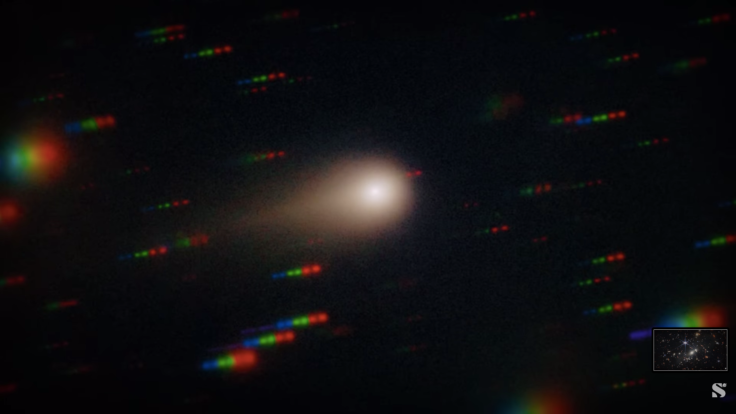
Furthermore, some of this methanol was even being produced in the gas plume itself, at distances beyond 258 kilometres from the main body of 3I/ATLAS. This unique, sunward-enhanced behaviour — alongside its unusual anti-tail — adds another bizarre layer to an object already defying every textbook explanation.
3I/ATLAS's Toxic and Life-Giving Chemical Cargo
The question of whether this massive interstellar object is a 'friendly gardener' or a 'serial killer' was recently posed by Harvard astrophysicist Avi Loeb. The relative ratio of these two chemicals is perhaps the strongest clue pointing towards an exotic origin.
The derived ratios of methanol to hydrogen cyanide in 3I/ATLAS are among the largest measured in any comet, surpassed only by the anomalous solar system comet C/2016 R2 discovered by PanSTARRS. This abundance of methanol is deeply significant, as it is a fundamental building block for the complex structures of life.
Methanol is abundant in star-forming regions; in 2016, for example, ALMA detected it in a planet-forming disc around the young star TW Hydrae. Crucially, it is a precursor for amino acids and sugars such as ribose, a component essential for RNA and DNA. On Earth, a diverse group of micro-organisms, known as methylotrophs, thrive by using methanol as their sole source of energy, and plants use gaseous methanol as a signalling molecule to induce defence reactions against pathogens.
Hydrogen cyanide, however, presents the darker side of this chemical duality. While its chemical properties allow it to serve as a precursor for the formation of complex organic molecules, such as amino acids and the key nucleic acid base adenine, its high concentrations are toxic.
It is a powerful poison, famously used as a chemical weapon by France, the United States, and Italy during the First World War. Yet, in the biological world, it performs a subtle dance: at low concentrations, it is a crucial signalling molecule in plants, promoting seed germination, and in mammals, it can aid in signal transduction and opioid-induced pain relief within neuronal cells.

The presence of this potent neurotoxin, which gives the object the capacity to inhibit life as easily as it can sow its components, is what prompted Professor Loeb to dramatically ask whether the object is a 'cosmic serial killer' distributing toxic elements across star systems.
Is 3I/ATLAS a benign messenger carrying the ingredients for life-sustaining sugars from a distant galaxy, or is it a toxic bomb loaded with a chemical poison? The answer, for now, is both. This single, massive interstellar object carries a chemical cargo that perfectly encapsulates the dual nature of cosmic chemistry: the ability to both create and destroy. As it departs, astronomers will continue to study this precious data, attempting to unlock the secret history of an object that feels less like a comet and more like a mysterious, wandering pharmacy of the universe.
The object 3I/ATLAS is proving to be the most chemically complex and dynamically baffling interstellar visitor yet. It is not just a comet, but a cosmic conundrum — a single body carrying both the building blocks of life (methanol, ribose precursors) and a powerful poison (hydrogen cyanide).
As Harvard's Avi Loeb so dramatically puts it, this visitor forces us to ask whether it is a 'friendly gardener' distributing the seeds of creation across the galaxy, or a 'cosmic serial killer' spreading toxins. Regardless of the answer, the fact remains that this mysterious entity is rewriting our understanding of interstellar objects.
© Copyright IBTimes 2026. All rights reserved.
- MOST POPULAR IN Trending