NASA Releases New 3I/ATLAS Image Captured by Hubble As Observers Prepare for Next Viewing Window
NASA's new images of 3I/ATLAS show its continued journey after passing close to the Sun
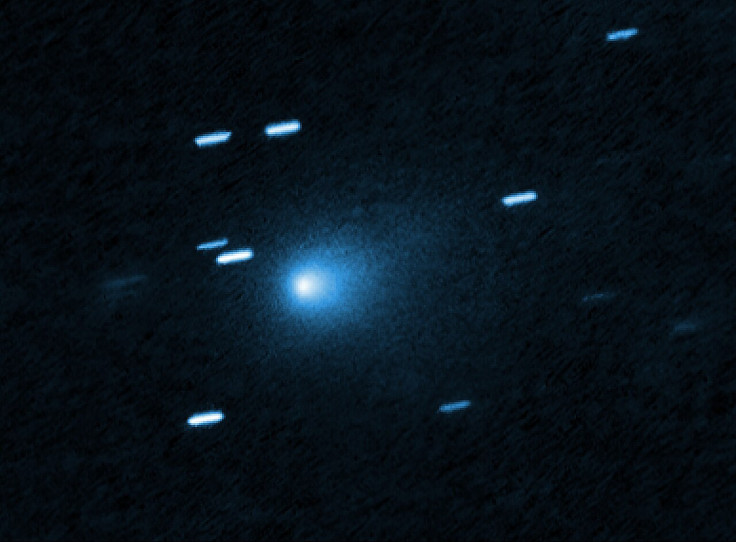
The US space agency NASA has released new images of the interstellar comet 3I/ATLAS. This set of images provides the first clear look at the object following its close pass of the Sun in late October.
The imagery, captured by the Hubble Space Telescope on 30 November, confirms the object remains active as it journeys back into deep space, while astronomers on the ground prepare for a series of viewing opportunities in mid-December.
Orbital Path and Viewing Schedule
Currently, 3I/ATLAS is moving away from the Sun and is already hundreds of millions of kilometres away from Earth. The comet is not visible to the naked eye, but observers and scientists can take a closer look at it with telescopes in the upcoming viewing windows in mid to late December.
The optimal viewing times for equipped amateur astronomers are:
- North America: 4:00 a.m. to 6:00 a.m. EST.
- UK and Europe: 5:00 a.m. to 7:00 a.m. GMT.
3I/ATLAS will make its closest approach to Earth on 19 December, so observers will be able to get a better look at the comet by then.
❓Why so blurry❓
— NASA Solar System (@NASASolarSystem) November 20, 2025
Lots of reasons…but in short, it’s not what these spacecraft were designed to do. As comet 3I/ATLAS swooped by, we jumped on the opportunity to turn our instruments its way and see what we could get. Take HiRISE as an example.👇
The left is what it was… pic.twitter.com/A5NuecHYWb
3I/ATLAS Still Releasing Gas and Dust
In the new images by Hubble, 3I/ATLAS is seen still releasing trails of gas and dust in its wake. The stars behind it look stretched out as the telescope was tracking the comet's fast motion as it took the photo.
The European Space Agency (ESA) also released its images of 3I/ATLAS. The Jupiter Icy Moons Explorer (JUICE) captured the images on 2 November while the interplanetary spacecraft was on its way to study the gas giant's moons for signs of life. This occurred days after the comet made its closest approach to the Sun.
'Not only do we clearly see the glowing halo of gas surrounding the comet known as its coma, we also see a hint of two tails,' an ESA spokesperson said in a statement. 'The comet's "plasma tail" – made up of electrically charged gas, stretches out towards the top of the frame. We may also be able to see a fainter "dust tail"–made up of tiny solid particles—stretching to the lower left of the frame.'
Comet Shows Increased Methanol Production as It Passes By the Sun
Among the observations scientists have made about 3I/ATLAS in recent weeks is that it releases more methanol as it passes by the Sun. The Atacama Large Millimetre/Submillimetre Array (ALMA) this year found a measurable production of methanol and hydrogen cyanide left behind by the interstellar comet.
Researchers detected methanol production by the comet on four occasions: 28 August, 18 September, 22 September, and 1 October. They detected hydrogen cyanide on two occasions: on 12 September and 15 September.
The ratio of these two chemicals provides a crucial clue to the object's origin. Harvard physicist Avi Loeb said that 3I/ATLAS noted that one of the highest methanol-to-hydrogen cyanide ratios ever observed, after C/2016 R2.
Significance of the Methanol Ratio
In planetary science, methanol is considered a key ingredient for forming more complex organic molecules, the building blocks of life. A high methanol ratio suggests the comet may have formed in an extremely cold, carbon-rich environment, different from the conditions that created most comets in our own Solar System.
Astronomers can study the specific conditions of another star's protoplanetary disk thanks to this unique chemical fingerprint. By analysing the outgassing of 3I/ATLAS, scientists can effectively perform remote geology on a world from another part of the galaxy. This would provide data that could reshape our understanding of how planetary systems form.
© Copyright IBTimes 2026. All rights reserved.
- MOST POPULAR IN Trending