3I/ATLAS Mystery Deepens: 'Untouched Cosmic Artifact' Erupts With Ice
3I/ATLAS mystery deepens: The interstellar comet may be erupting with cryovolcanoes.
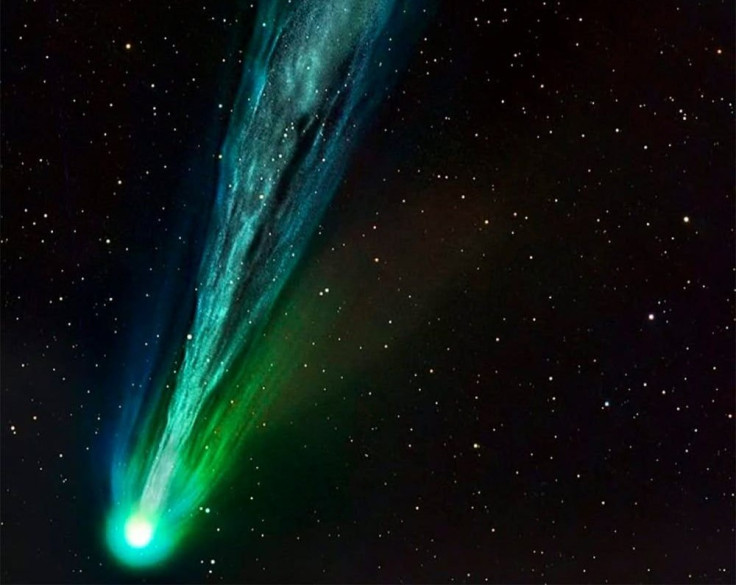
In the vast, icy darkness of interstellar space, a pristine time capsule has been sailing for potentially billions of years, untouched by the stellar nurseries of our Solar System. Astronomers, already stunned by the speed and unique origin of the comet 3I/ATLAS, now face a genuinely mind-bending theory: this interstellar visitor may be erupting with active, icy cryovolcanoes.
If confirmed, the evidence detailed in a new pre-print study doesn't just add a colourful footnote to the comet's story; it forces a profound reconsideration of how comets—not only those from distant star systems but those in our own cosmic backyard—are formed.
The celestial object, which is only the second interstellar comet ever tracked, is challenging decades of astrophysical assumptions, turning what was thought to be a simple, uniform ball of ice into a complex, metal-laced geological phenomenon.
An Untouched Cosmic Artefact: The Mysteries of 3I/ATLAS
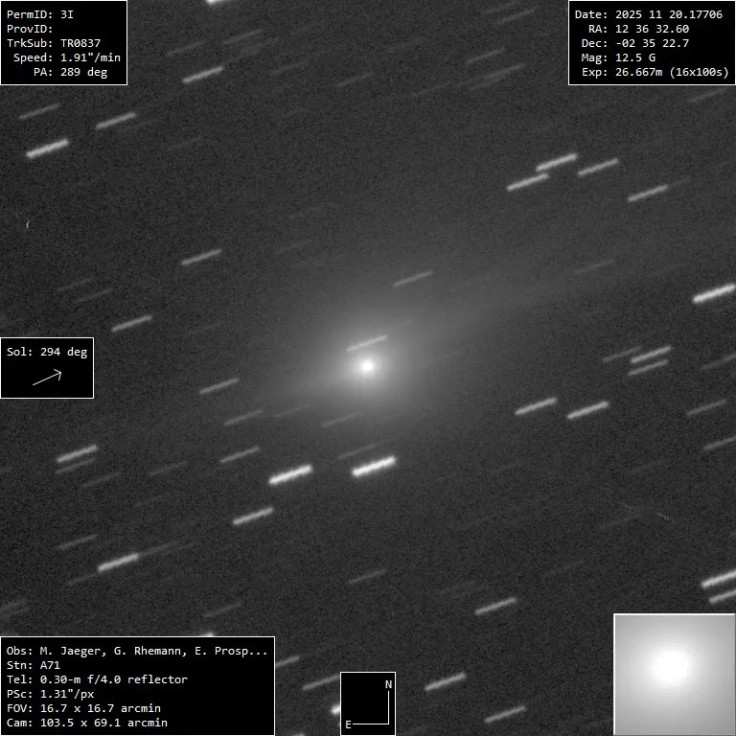
3I/ATLAS first gripped global attention when astronomers detected it in July 2025. It earned its designation, 3I, for being the third Interstellar object found, and its discovery by the ATLAS (Asteroid Terrestrial-impact Last Alert System) telescope network. Since then, researchers around the world have aimed their most sensitive equipment at it as the comet continues its journey, travelling at a breathtaking speed, peaking around 153,000 miles per hour (246,000 km/h) at its closest point to the Sun.
This immense speed is a key part of its mystery; its highly hyperbolic orbit, with an eccentricity estimated to be around 6.1, confirms that it is travelling too fast to be gravitationally bound to our Sun. It is crucial to note that the first interstellar object discovered was the famously odd, cigar-shaped asteroid 'Oumuamua in 2017. The second was Comet 2I/Borisov in 2019.
What makes 3I/ATLAS invaluable is its pristine nature. Unlike comets from the Oort Cloud, this icy rock has spent millions of years drifting in the cold interstellar medium, meaning it has never passed close enough to a star to be altered by its heat and radiation. This essentially makes it an untouched cosmic artefact dating back billions of years, providing us with a never-before-seen glimpse at the materials from which other star systems are built.
The Eruption Across the Surface of 3I/ATLAS
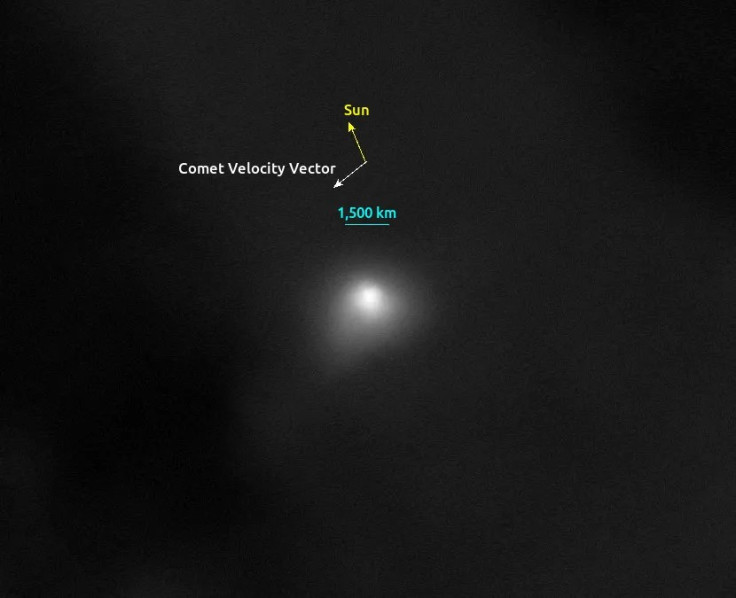
Apart from being the fastest comet ever observed (and assuredly 'not an alien spacecraft'), 3I/ATLAS appears to display some truly unexpected surface activity. After monitoring the visitor for months, astronomers recorded a 'sharp and lasting surge' in brightness as it reached approximately 2.5 astronomical units from the Sun (roughly 185.9 million miles).
The dramatic, sustained level of brightness captured by their analysis indicates that 3I/ATLAS didn't withstand a sudden explosion, but what appears to be an eruption across the comet's entire water-ice surface layer. The study's authors argue the most likely explanation for this prolonged, widespread brightening is cryovolcanism.
While volcanism on Earth is traditionally associated with scorching lava, cryovolcanism operates similarly, but with opposite materials. In this process, liquid and vapourous water, alongside other volatile materials like carbon dioxide and carbon monoxide, are ejected from inside a cosmic body.
Astronomers have seen this type of behaviour on moons like Jupiter's Europa and Saturn's Enceladus, but if confirmed, it represents a rarely seen and surprisingly vigorous event on a comet. The pre-print paper detailing this finding was led by astronomers at the California Institute of Technology (Caltech) and the University of Maryland.
A Metalliferous Heart: The Role of Carbonaceous Chondrite
The cryovolcanism on 3I/ATLAS is unique due to the object's origins and apparent lack of a protective, dusty mantle. This lack of a shield is thought to be why its entire surface erupted in such a noticeable way when warmed by the Sun.
Further examination of light reflected from the comet surface revealed that 3I/ATLAS likely resembles a rare, ancient type of meteorite called a carbonaceous chondrite. This class of meteorite is known for being extremely rich in volatile organic compounds and hydrated minerals, with a composition that is often considered the most primitive in the Solar System. The type observed is thought to be heavy in metals such as nickel and iron, a composition which could directly explain the comet's cryovolcanism.
The study, which is still awaiting peer review, theorises a precise chemical mechanism: as 3I/ATLAS warmed and its subsurface ice began to melt, the resulting liquid corroded microscopic metal grains inside the rock. This aqueous alteration would subsequently release more energy and gases, particularly carbon dioxide, which is highly enriched in the comet's coma. This gas pressure is what ultimately drives the frigid eruption, allowing jets of material to escape through the porous ice crust.
The ultimate significance of 3I/ATLAS lies in its potential to contradict the standard model of comet formation. Instead of a more uniform amalgamation of rock, ice, and low amounts of metal, this interstellar visitor suggests that comets may begin their lives under a much more diverse, metal-rich set of circumstances.
'Interstellar visitors like 3I/ATLAS continue to challenge and refine our understanding of planetary-system formation and the chemical evolution of small bodies', the study's authors wrote, adding that, 'each newly discovered object reveals unexpected properties that test and expand current models'.
The identification of cryovolcanism and a primitive, metal-rich composition on 3I/ATLAS is pushing the boundaries of cometary science. This interstellar visitor is more than just a passing curiosity; it's a geological rebel that demands we rewrite the rules of planetary-system formation across the galaxy. As this pristine, billion-year-old 'cosmic artefact' streaks toward the edge of our Solar System, the debate among astrophysicists will only intensify pending the full peer review.
© Copyright IBTimes 2026. All rights reserved.
- MOST POPULAR IN Trending