

'ChatGPT Told Him Who to Hire and Fire': Shared Accounts Exposed Boss' AI Chats, Employees Stunned
AI's growing workplace influence is blurring the line between support tool and decision-maker
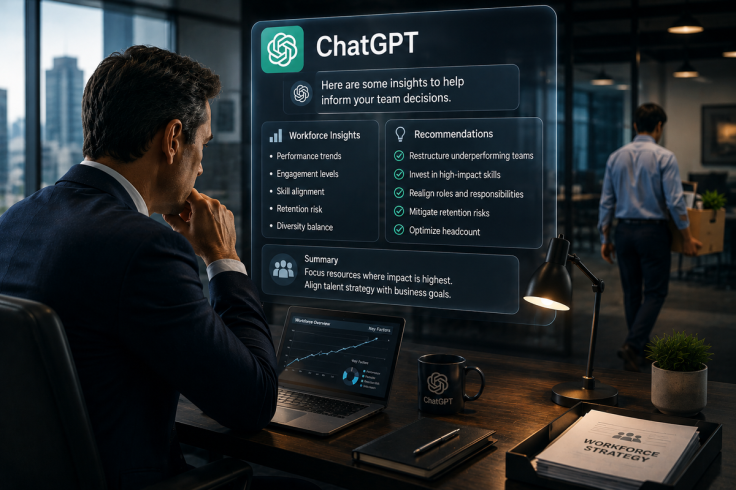
Artificial intelligence (AI) is transforming offices around the world, introduced as a tool to save time and maximise productivity. However, some employees say its function extends far beyond productivity and that it's becoming the voice behind their boss' key decisions.
There have been growing doubts among employees that some managers are going even further, utilising AI-generated input to help them with high-stakes workplace decisions like who gets hired, promoted or worse, fired.
AI-First Workplace Culture
One lawyer working in a legal tech start-up said that her manager became increasingly fixated on ChatGPT, making it a required step in communicating in the workplace. 'He called a company-wide meeting to announce that from then on, we had to discuss with the AI before all meetings or before communicating with him,' she recalled, saying that if they didn't run their ideas with the AI first, 'It was a sign that we didn't care about our jobs.'
She also added that her manager's reliance on AI reached the point where he was 'making structural company decisions based solely on his conversations with ChatGPT,' including hiring and firing decisions. Employees later discovered that they could monitor their boss' AI activity via shared accounts.
A Workplace in Constant Flux
This former employee also claimed that the company's direction changed dramatically every week, depending on ChatGPT's suggestions and how their manager interpreted them.
'He would call meetings to tell us that ChatGPT had told him that the leading cause of death in the world was medical malpractice, so that's what we were going to offer people now,' she recalls, 'Then, after other (AI) conversations, we were better off focusing on bankruptcy.'
She also added that roles at the company would be in constant flux. During her time working there, she had three different roles and titles. Based on the conversations her boss had with AI week after week, her job responsibilities also kept changing.
She eventually had enough and left after employees told her to rely on the AI-generated handbook known internally as 'The Bible'. She said the goal of the AI 'Bible' was to have employees rely on human guidance as little as possible and eventually quit because of the company's heavy reliance on AI.
Productivity Promise or Productivity Problem?
AI was meant to streamline work processes, but some employees claim that it instead led to confusion and delays, with most decision-making increasingly controlled by unrealistic chatbot outputs.
One non-social worker and an employee of a non-profit that helps deliver food and nutrition counselling said that her boss repeatedly insisted on implementing AI suggestions without considering whether they were feasible.
She added that this constant reliance on AI stalled decision-making altogether: 'It has led to a decrease in productivity... because they weren't suggested by AI. Nothing is decided upon.'
Human Decision Still Seen as Vital
Despite their concerns, many of the interviewees said they're not against AI but against how it's used in decision-making. They argue that workplace issues often arise because leaders treat these chatbots as the ultimate decision-makers rather than as tools for support.
As AI is adopted more widely in workspaces, it raises a broader question: where does automation end and human decision-making take over?
© Copyright IBTimes 2026. All rights reserved.