Fired for Criticizing Charlie Kirk a Year Ago and Still Jobless: The Revenge Purge That Never Ended
Workers caught in the backlash say lost careers, threats, and lengthy job searches have outlasted the controversy
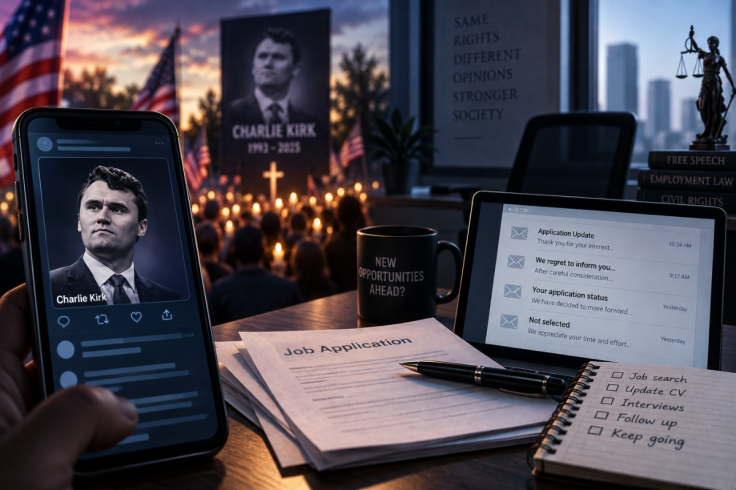
One year after Charlie Kirk's death, the professional fallout is still being measured in court cases, settlement payments, and careers that have yet to recover.
More than 600 people faced professional consequences, including firing, suspension, or investigation, after social media posts about Kirk's death, according to a Reuters investigation. The Intercept separately spoke with five people affected by the firings and four attorneys representing seven others, finding that several remain out of work or unable to return to their previous careers.
The cases reveal a longer-lasting consequence of the backlash: political disputes that began online have moved into workplaces, universities, and courtrooms, leaving some people fighting to recover jobs, income, and professional standing.
The Career Cost Outlasted the Backlash
Emily Taylor, a former tenured English professor at Presbyterian College in South Carolina, resigned in December 2025 after state lawmakers threatened to withdraw funding from the college over an essay she wrote about Kirk's rhetoric. Taylor said she spent much of the following year searching for work and believes returning to a tenure-track position may no longer be realistic.
In March 2026, she sued four South Carolina lawmakers with the ACLU of South Carolina, seeking compensation for lost wages and benefits and other damages. The lawmakers denied affecting her employment and said she chose to resign.
Her case illustrates how the consequences of political speech can extend beyond losing a single job, particularly for workers whose careers depend on specialised positions and professional networks.
Online Criticism Became an Employment Fight
Kimberly Hunt, an HR professional from Scottsdale, Arizona, posted a video criticising Kirk after his death. She said online users identified her employer despite her not listing her workplace on social media.
According to Hunt, complaints were then made to the company. She said her boss told her the volume of calls was disrupting the business before she was dismissed. Hunt also said she was warned by local law enforcement that she was reportedly on a 'hit list' and that officers monitored her home for two weeks.
A year later, she said she still had not found full-time work. Dave Handler, a former teacher at Minnesota Connections Academy, was also dismissed after posting that he would not mourn Kirk and sharing an article about controversial statements Kirk had made.
'I post basically 10 words and an article, and I lost my career,' Handler told The Intercept. The cases demonstrate how quickly political commentary can become an employment dispute once posts are identified, circulated, and brought to an employer's attention.
Legal Battles Have Produced Mixed Results
Some workers have successfully challenged disciplinary decisions, while others remain in legal disputes. Joshua Bregy, an assistant professor at Clemson University, was fired after sharing a Facebook post critical of Kirk.
Under a mediated settlement, Clemson rescinded his termination, continued his pay and benefits through the original employment term, and agreed to provide positive recommendations. Bregy later agreed to resign effective 15 May 2026.
Phillip Michael Hook, a tenured University of South Dakota art professor, was temporarily reinstated by a federal judge after the university moved to fire him over a Facebook post about Kirk. Karen Leader, a tenured art history professor at Florida Atlantic University, was also placed on leave after criticising Kirk and later reinstated. Reuters reported that she continued to face harassment and threats.
The financial consequences have also mounted. At least $2 million in settlements had been agreed by May 2026 involving employees and other critics who faced professional penalties over posts about Kirk, according to Axios.
The Free-Speech Dispute Has Become an Economic One
The First Amendment generally restricts government censorship rather than giving private-sector employees an unlimited right to make political statements without workplace consequences. But cases involving public universities, government officials, or alleged pressure on institutions can raise separate constitutional questions.
That distinction is central to the continuing backlash. Reuters found that the post-Kirk campaign had open backing from Trump administration allies, while some people were also targeted by online activists and private individuals.
For workers such as Taylor, Hunt, and Handler, the original posts lasted minutes. The consequences have lasted a year. With lawsuits, settlements, and unresolved employment disputes still continuing, the controversy surrounding the Charlie Kirk firings has outlasted the initial wave of online outrage.
© Copyright IBTimes 2026. All rights reserved.
- Recommended For You