China's Floating Rocket Launchpad Sends Nine Satellites Soaring 800KM Into Space in Historic First
The OrienSpace rocket carried eight Qianfan broadband satellites and a technology test satellite to an orbit about 800 kilometres above Earth
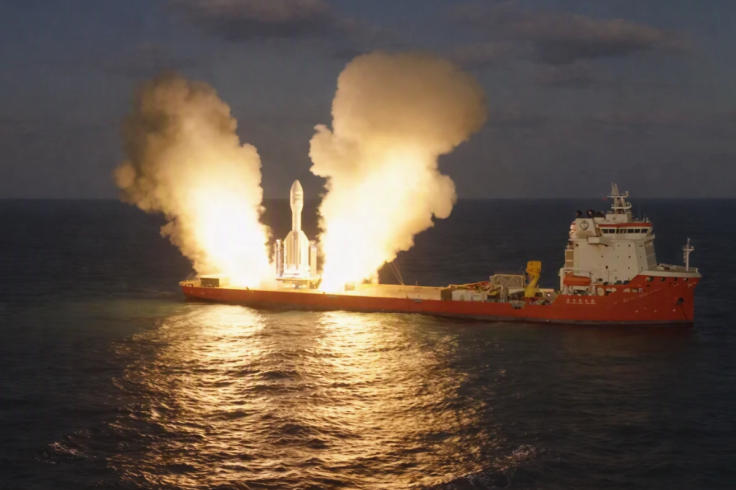
A rocket fired from a floating platform in the East China Sea has sent nine satellites into their preset orbits, in a mission China describes as the world's first sea-based mobile launch dedicated to networking a low Earth orbit broadband internet constellation.
The launch also set new Chinese records for the heaviest payload and highest orbital altitude achieved in a single sea-based launch.
The Gravity-1 Y3 rocket, built by Chinese commercial space firm OrienSpace, lifted off from waters off the coast of Shanghai on 16 September. It carried eight satellites for China's Qianfan broadband internet constellation and one EUHT technology test satellite, with the launch taking place at 6 a.m. Beijing time.
A Record-Breaking Launch From the Sea
The mission's net payload exceeded three tonnes, while the satellites were inserted into orbit at an altitude of 800 kilometres. Both figures represent new Chinese records for a single sea-based rocket launch, demonstrating the sea-launch mode's ability to handle medium- and large-sized satellite payloads.
The mission also highlighted the growing role of sea-based launches in supporting China's large-scale satellite constellation plans.
By combining a payload of more than three tonnes with an orbital insertion altitude of 800 kilometres, the Gravity-1 Y3 demonstrated its ability to deliver a substantial satellite payload to an 800-kilometre orbit from a maritime launch platform.
A new milestone in China’s commercial space sector. On Sept. 16, China successfully launched nine satellites into their preset orbits from waters off Shanghai using the Gravity-1 Y3 carrier rocket.
— Ambassador Kong Xianhua (@China_Amb_Mdv) September 17, 2026
The mission deployed eight Qianfan Constellation satellites and one EUHT… pic.twitter.com/iE54nGUFn9
What Made This Mission a World First
The launch was described as the world's first sea-based mobile launch for networking satellites for a low Earth orbit broadband internet constellation. That distinction relates specifically to this type of mission, rather than sea-based satellite launches generally.
This was also OrienSpace's first launch dedicated to a large low Earth orbit satellite internet constellation. The payload combined a stacked-satellite assembly with flat-panel satellites, a configuration that placed higher demands on the rocket's multiple-separation control technology.
Why Sea Launches Matter to China's Space Race
Wang Ya'nan, editor-in-chief of Beijing-based Aerospace Knowledge magazine, said that the mission represents a step forward for China's commercial space sector across solid-fuel rockets, sea-based launches and large-scale satellite constellation services.
He said the achievement strengthens China's position in the global commercial space race.
Wang added that the launch platform's mobility is its central advantage, since it can sail to locations suited to a satellite's target orbit. He also noted that firing rockets out towards open water can reduce risks to coastal towns and residents.
The September mission was Gravity-1's second far-sea launch, following its 22 July mission, which was the rocket's first far-sea launch. The latest launch came just 56 days later and further demonstrated the adaptability of the launch system to sea conditions.
What This Means Going Forward
The eight satellites delivered on Wednesday add to China's Qianfan constellation, a low orbit broadband network being developed to compete in the satellite internet market with systems such as SpaceX's Starlink. Qianfan is targeting more than 15,000 satellites by 2030.
OrienSpace is also accelerating development of its reusable liquid-propellant rocket, Gravity-2, which is designed to carry up to 21.5 tonnes into low Earth orbit.
The rocket remains under development, with its planned maiden flight expected in the fourth quarter of 2026.
Sea launches let rockets reach a wider range of orbital paths without being tied to a fixed inland launch site, while potentially reducing risks to people living near traditional spaceports.
As China expands the Qianfan constellation and competes with Starlink in satellite internet, the latest mission demonstrates that sea-based platforms can support heavier payloads and higher-altitude deployments, giving China's commercial space sector another option for future constellation launches.
© Copyright IBTimes 2026. All rights reserved.
- Recommended For You